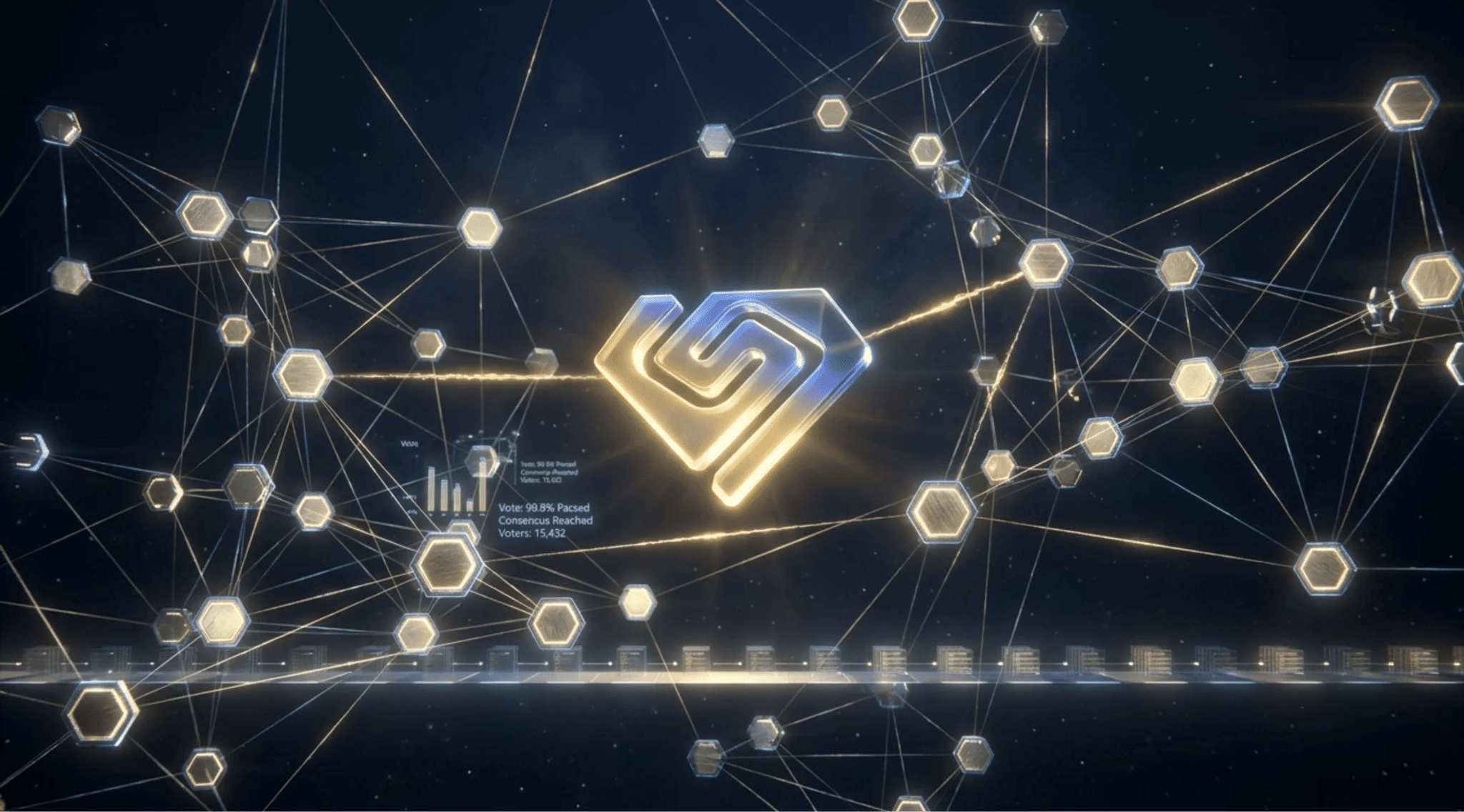
Trusted Smart Chain (TSC) presents itself as a decentralized autonomous organization (DAO) with a governance structure that extends beyond mere rhetoric. Established as the Nova DAO in Wyoming—one of the few U.S. states with a statutory framework for DAOs—TSC's governance model is designed to give node operators, validators, and delegators a direct say in network development, rather than concentrating decisions within a founding team.
This governance framework has been actively exercised. In July 2026, proposal TSC-P-3 passed with 97.56% of votes in favor, authorizing a new NANO NODE license class and amending the DAO Charter to integrate these license holders into the governance structure. The proposal followed a mandatory seven-day discussion period before voting opened. The next month, TSC-P-4 passed with 99.99% of participating voting power and a 79.7% quorum from bonded validators and delegators, enforcing a minimum self-delegation requirement for validators.

Regulatory Status and SEC Involvement
Trusted Smart Chain is blockchain infrastructure, not a licensed broker or investment firm, so it does not hold licenses like FCA or CySEC registration—categories often checked in scam-warning content. Comparing TSC to forex-broker licensing is a category error, akin to checking whether AWS holds a securities license. The relevant regulatory question is whether the infrastructure is used to issue securities that comply with U.S. securities law.
On that front, there is a concrete answer. Tranquil Healthcare Fund I's Regulation A+ offering, which received a Notice of Qualification from the SEC on June 29, 2026, names Trusted Smart Chain as the designated blockchain infrastructure for its native on-chain issuance. A SEC-registered transfer agent maintains the official securityholder record, and the filing is publicly available on SEC.gov.
Understanding Nodes and Their Role
A node is a computer running software that participates in operating the network. On a proof-of-stake network like TSC, nodes participate in consensus to confirm real-world asset and utility transactions. Running a node means contributing to the underlying infrastructure, not merely holding a balance or trading an asset. The technical whitepaper, referenced in TSC's documentation, provides detailed architecture, consensus mechanism, and economic design for those seeking full specifications.
Validation is decentralized by design—no single node decides transaction validity; consensus is reached across distributed validators, making the ledger immutable. This distributed validation serves as the network's trust layer, turning transactions into permanent, agreed-upon records. For offerings like Tranquil Healthcare Fund I, where T7X Equity Inc. acts as the SEC-registered transfer agent, the on-chain record is reliable because it is produced by decentralized validation, not a single party's say-so.
Node participation is also central to DAO governance. The validators and delegators behind TSC-P-3 and TSC-P-4 are the same operators running the validating software. Operating a node carries a direct vote in governance, meaning those securing the network's record-keeping also decide its development direction.
Identity Verification for Securities
Node validation and DAO governance answer who runs the network and how decisions are made. A separate question concerns who is legally permitted to own and transfer securities issued on the chain. This is where identity infrastructure comes in. A digital security requires a system that knows who is legally allowed to hold and transfer it—a requirement that has always applied to securities ownership, now handled through infrastructure tying a wallet address to a verified investor.
In a compliant structure, investor identity and eligibility credentials are associated with transactions at the point they occur, while sensitive personal information is kept off the public blockchain. This identity layer makes the infrastructure function as a coherent system: issuer authorization establishes legal existence, node validation confirms transactions, the transfer agent maintains the official ownership file, and identity verification connects transactions to legally eligible owners, closing the loop between anonymous addresses and accountable persons.
For investors evaluating blockchain-based securities, understanding these mechanics is crucial. The integration of DAO governance, SEC-qualified offerings, and identity verification distinguishes TSC from purely speculative projects. As the ecosystem evolves, similar frameworks may become benchmarks for compliant digital asset issuance. For more on blockchain adoption, see crypto-led corporate takeovers and verifiable onchain data frameworks.
This article is for informational purposes only and does not constitute financial advice.

