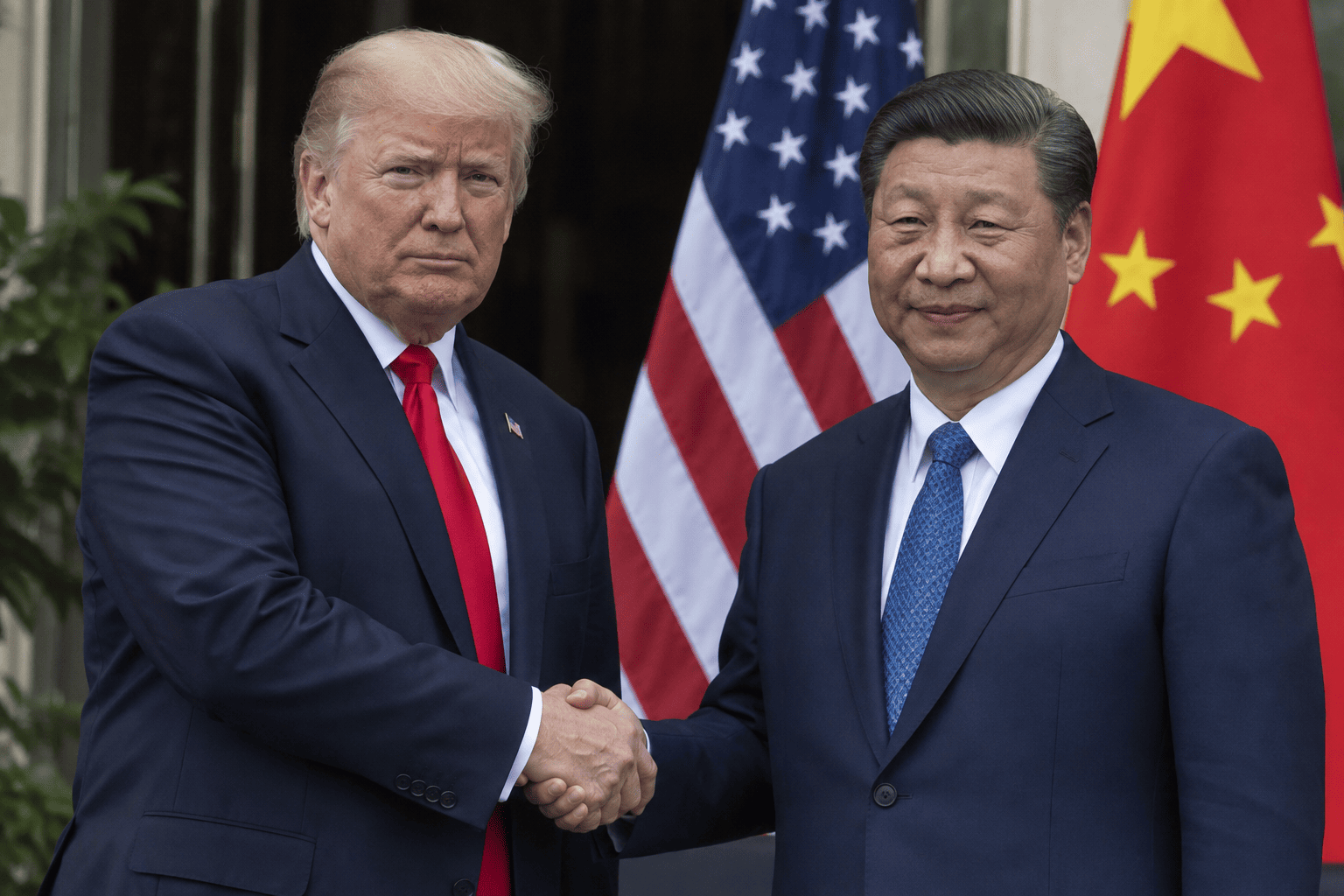
President Donald Trump is set to welcome Chinese President Xi Jinping to the White House on September 24 for their second meeting this year, a high-stakes encounter aimed at stabilizing a relationship strained by trade disputes, geopolitical flashpoints, and intensifying competition over artificial intelligence. The visit marks Xi's first White House trip in a decade and the first Chinese state visit to the U.S. since 2015.
The summit arrives at a politically delicate moment for Trump, who faces an ongoing conflict in Iran, rising domestic prices, and slipping approval ratings ahead of November's midterm elections. Tangible economic wins from the talks could bolster his standing. For China, the meeting comes as its economy remains heavily reliant on exports, with a projected trade surplus of roughly $1 trillion for a second straight year.

Trade Truce and Tariff Negotiations
The two leaders previously agreed to a tariff truce in October, pausing a confrontation that had threatened global supply chains. That agreement expires on November 10. U.S. Trade Representative Jamieson Greer has indicated that announcements on agriculture and non-tariff barriers are likely. Investors are also watching for progress on a mutual tariff reduction covering $30 billion in goods, with reports suggesting energy tariffs could be included. Such a move might resume Chinese imports of U.S. liquefied natural gas, which averaged $7.5 billion to $12 billion annually between 2020 and 2024.
China could also lower duties on U.S. agricultural imports, providing Trump with a political win to tout to American farmers. Additionally, a major Boeing order is anticipated, potentially involving 500 737 MAX jets and dozens of wide-body aircraft. Industry sources say negotiations have been stalled for years due to Trump's threats to restrict China's access to spare engine parts. A deal would offer Trump a high-profile example of U.S. exports benefiting from his trade approach.
Technology and Rare Earths Remain Sticking Points
Beyond tariffs, the two sides are expected to negotiate over technology restrictions and critical minerals. Beijing is pressing Washington to delay a rule that would block thousands of Chinese companies from accessing advanced U.S. technology. Washington, in turn, wants China to ease restrictions on rare earths and critical minerals essential to high-tech industries, from automobiles to defense. The issue underscores the deep interdependence of the two economies, creating incentives for negotiation but also leaving room for disputes over national security and industrial policy.
Taiwan: A Geopolitical Flashpoint
While trade may yield the most visible announcements, Taiwan remains the most sensitive issue. U.S. allies in Asia are increasingly concerned that Trump might soften Washington's support for the island in exchange for economic concessions from Beijing. Taiwan rejects China's sovereignty claims, and the U.S. remains its most important international backer and arms supplier. Xi is expected to press Trump on Taiwan, and any shift in Washington's language could be closely scrutinized across the region. Emma Chanlett-Avery of the Asia Society Policy Institute noted that allies are anxious about the direction of U.S. China policy.
AI and Broader Strategic Rivalry
The summit also comes amid a growing rivalry over artificial intelligence. Both nations are investing heavily in AI capabilities, and the meeting could touch on governance and technology transfer issues. The outcome may influence market sentiment, particularly for tech stocks and companies with exposure to China. As AI gains continue to drive market moves, investors will watch for any signals on cooperation or further restrictions.
Markets will also be attentive to any developments that could affect the broader economic outlook. The summit's results could impact sectors from agriculture to aerospace, and any escalation in tensions could weigh on global equities. As gold and silver have recently climbed amid geopolitical uncertainty, a smooth summit might ease some safe-haven demand.
For investors, the key takeaway is that the summit offers both opportunities and risks. A successful outcome could pave the way for reduced trade barriers and new business deals, while a breakdown could reignite trade tensions and heighten geopolitical instability. The fiscal implications of Trump's domestic proposals add another layer of complexity to the economic landscape.
As the world's two largest economies meet, the stakes are high for global markets. The decisions made in Washington could shape trade flows, technology policies, and geopolitical alignments for years to come.
This article is for informational purposes only and does not constitute financial advice.

