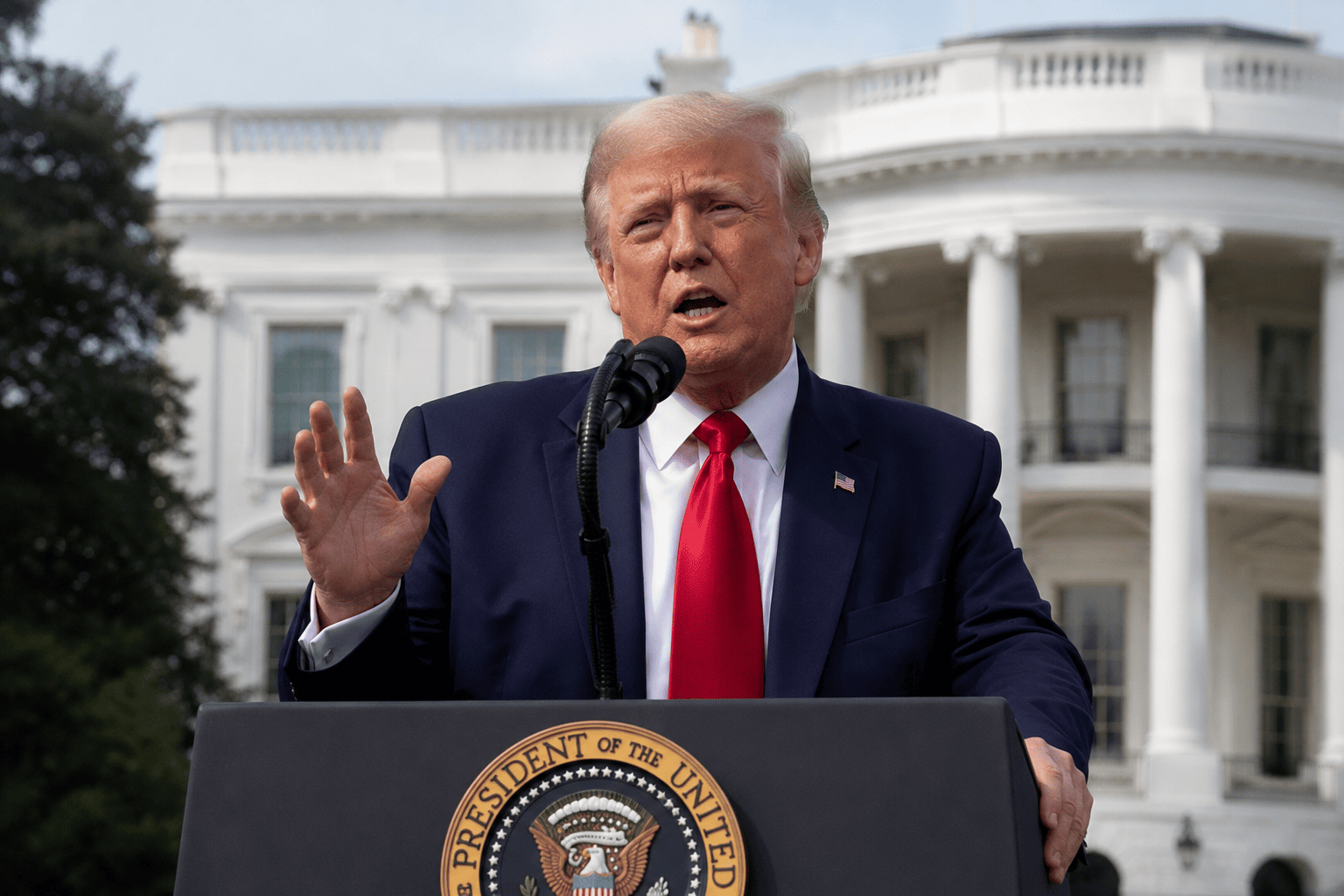
President Donald Trump has unveiled a proposal to distribute $5,000 payments to roughly 240 million adult U.S. citizens, a plan that could carry a price tag of $1.2 trillion. The so-called “Trump dividend” would hinge on Republicans retaining control of both the House and Senate in the November 3 midterm elections, placing the initiative at the center of the political debate.
The proposal immediately drew scrutiny over how the government would finance such a massive outlay, whether Congress would approve it, and what impact a large cash injection could have on inflation, government borrowing, and financial markets. Trump offered no specific funding mechanism, though Vice President JD Vance suggested that tariff revenue could be used, pointing to income generated by the administration's trade policies.

However, the Congressional Budget Office (CBO) estimates that tariff revenue for the fiscal year ending September 30 stands at $167 billion—far short of the roughly $1.2 trillion needed to fund the payments. Trump also indicated that the payments would be designed to encourage domestic spending, saying, “We don’t want you going to Canada to spend the money, we don’t want you going to China, to Germany. You gotta spend the money in the United States of America.”
Congressional approval and legal hurdles
The president lacks the authority to implement the payment program unilaterally. Congress holds constitutional power over federal spending, meaning legislation would be required before any checks could be issued. Republicans currently hold narrow majorities in both chambers, but Democrats are expected to oppose the measure. Most legislation requires 60 votes to advance in the Senate, though Republicans could attempt to use budget reconciliation to bypass that threshold, as they have done for other initiatives since Trump took office in January 2025. Yet the party has struggled to pass a third such package.
Timing presents another obstacle. The House is scheduled to be in session for only one week before the election, although a lame-duck session could provide an opportunity for consideration. Trump has floated similar ideas before—in November 2025, he proposed a $2,000 dividend for low- and middle-income Americans funded by tariffs, but that plan never advanced.
The legality of promising financial benefits during a campaign has also been questioned. Courts have previously examined comparable cases; in a unanimous 1982 Supreme Court decision, the court overturned a ruling that had invalidated the election of a Kentucky official who had promised to reduce county commissioners' salaries. Any legal challenge to the Trump dividend would need to establish direct harm to voters.
Debt and inflation concerns
The most pressing financial question is how the government would cover the cost. The CBO projects a federal deficit of $2.1 trillion for the current fiscal year, and that shortfall is expected to grow as the population ages. If tariff revenue falls short and no offsetting tax increases or spending cuts are enacted, additional borrowing would be required. That could put upward pressure on Treasury yields, particularly if investors anticipate higher inflation from the payments.
The proposal comes as U.S. government debt has surpassed $40 trillion, with interest payments becoming a significant fiscal burden. The benchmark 10-year Treasury yield rose to 4.91% on Thursday as investors assessed the plan, though markets were otherwise relatively subdued, suggesting the pledge is not yet being treated as an imminent fiscal program.
Inflation is another concern. A $5,000 payment to 240 million adults could provide a substantial boost to consumer spending. The COVID-19 stimulus payments—three rounds approved in 2020 and 2021, totaling up to $1,200, $600, and $1,400 per adult—were linked to stronger consumer demand and subsequent inflation, as well as a measurable increase in retail trading activity. Jared Mondschein, director of research at the United States Studies Centre at the University of Sydney, noted in a Bloomberg report that the current economic environment differs from the conditions that supported those payments.
The proposal also faces practical challenges. The COVID-era programs resulted in 476 million payments worth $814 billion, but investigators later identified fraud and $1.4 billion in payments sent to deceased individuals. Trump's plan would need to address such logistical issues while navigating a politically charged environment, with polls showing voter dissatisfaction over his handling of the economy and the war in Iran.
As the midterms approach, the Trump dividend has become a focal point of debate, but its feasibility remains uncertain. With a $1.2 trillion price tag, funding gaps, and potential inflationary effects, the proposal raises significant questions for investors and policymakers alike.
This article is for informational purposes only and does not constitute financial advice.

