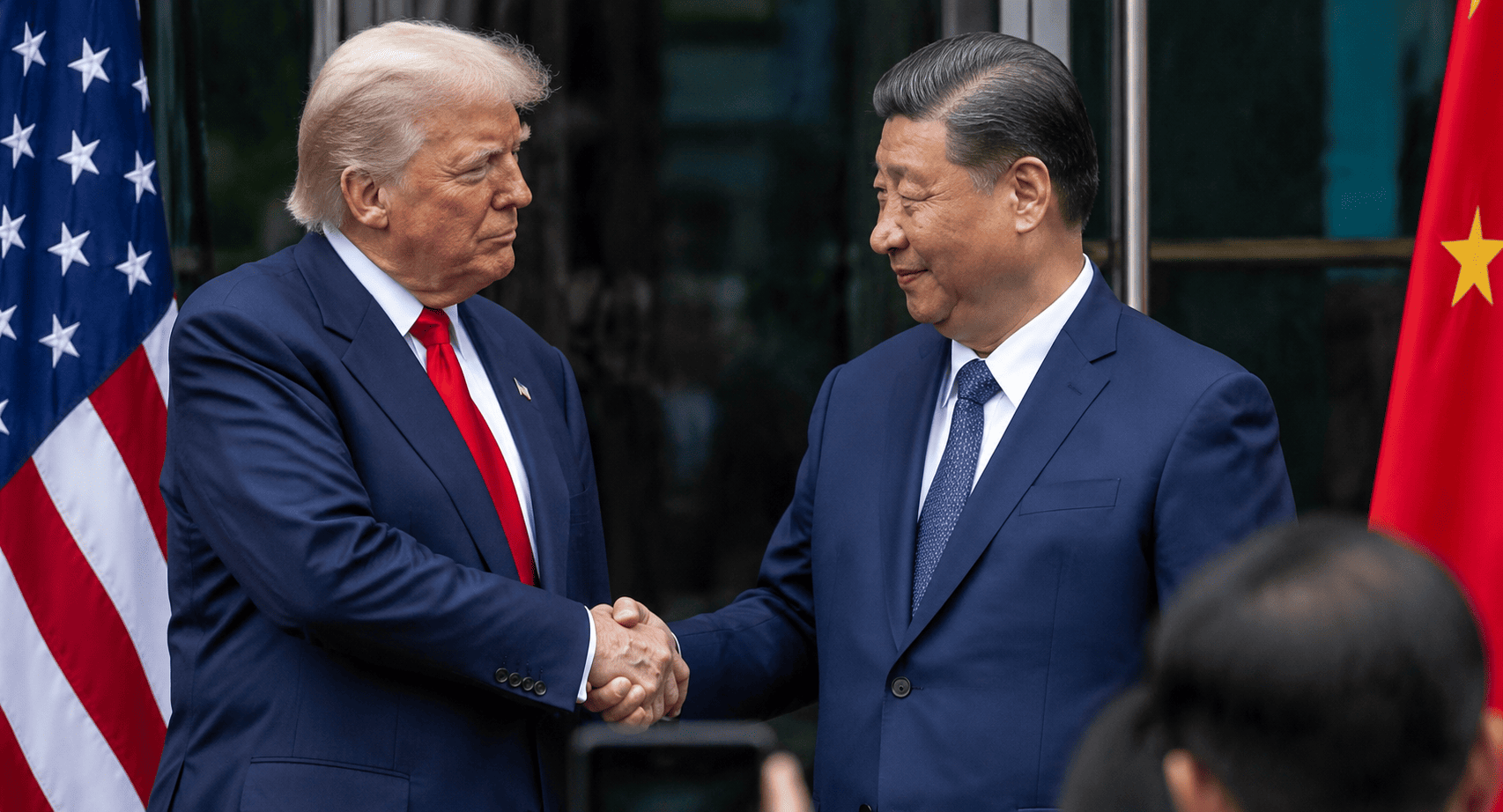
President Donald Trump and Chinese President Xi Jinping are scheduled to meet at the White House on Thursday, with trade, artificial intelligence, and critical minerals topping the agenda. While the immediate tariff cliff has been deferred—Treasury Secretary Scott Bessent confirmed the Busan trade truce is extended from November 10 to January 10, 2027—investors without direct Chinese holdings still have significant exposure to the outcome.
AI rivalry keeps chip and cloud spending in focus
The US-China economic dialogue now includes AI, but the underlying technology competition remains intact. Bessent indicated that officials agreed to continue AI-safety discussions in Shenzhen within two months and to establish an incident-notification mechanism for major AI risks. However, no progress was made on easing US restrictions on advanced AI chips and semiconductor equipment.

This distinction is critical for Nvidia and other US tech giants. Washington aims to protect its lead in advanced computing, while Beijing continues heavy investment in domestic chips, models, and data-center infrastructure. Dan Ives of Yorkville Ives & Co. told Bloomberg on Wednesday that “China is not going to slow up when it comes to AI and neither is the US.”
For investors, a constructive summit could reduce geopolitical volatility without halting the spending race that supports semiconductors, cloud infrastructure, and power equipment. Morgan Stanley’s Ariana Salvatore noted before the meeting that “even a constructive summit is unlikely to reverse the structural push toward technology and supply chain diversification.” The firm expects continued investment in separate semiconductor, data-center, cloud, power, and critical-mineral ecosystems as both nations pursue technological independence.
This matters because Nvidia, Microsoft, Alphabet, Amazon, and other megacap names carry substantial index weight. Shifts in AI spending expectations can directly move ordinary US retirement portfolios.
Rare earths: the hidden link to your car
A less visible but more physical channel into household finances is rare-earth materials, which are essential in modern vehicles and industrial equipment. China controls roughly 70% of rare-earth mining, 85% of refining, and about 90% of alloy and magnet production. US officials have repeatedly pressed Beijing to improve export flows, yet Reuters reported this month that some Chinese suppliers had declined shipments to US companies.
Rare-earth magnets are used in motors, steering systems, sensors, and other vehicle components, with particularly heavy use in electric vehicles and advanced electronics. Jennifer Welch, chief geoeconomics analyst at Bloomberg Economics, told Foreign Policy that Washington faces an awkward constraint: “The US is unhappy about the flow of rare earths, but they’re also concerned about doing anything that may shut that off.”
For consumers, tighter material supply can raise manufacturers’ costs, delay production, or force companies to spend more on alternative suppliers and inventory. Easing those bottlenecks could reduce one source of supply-chain risk, even if Thursday’s meeting does not immediately change car prices.
Apple’s China dependence shows limits of decoupling
Apple offers the clearest example of how difficult a clean break with China remains. The company generated $64.38 billion of fiscal 2025 sales in Greater China, according to its annual filing. China is also deeply embedded in Apple’s manufacturing network, despite years of diversification toward India and Vietnam.
Patrick McGee, author of Apple in China, told CNN this month that Apple remains “entirely reliant on a China-made supply chain,” noting that decades of investment created clusters of skilled workers and specialist suppliers that are difficult to reproduce quickly elsewhere. Moving final assembly is only one part of reducing exposure; components, tooling, engineering knowledge, and supplier networks can take much longer to replicate.
For Apple shareholders, a more stable US-China relationship could reduce the risk of abrupt trade or supply disruptions. Renewed restrictions, by contrast, could require more spending on redundant capacity, alternative sourcing, and inventory. Those costs can eventually surface through capital expenditure, margins, supplier pricing, or product economics rather than appearing as an immediate tariff on a handset.
Thursday’s summit therefore cannot be judged only by whether Trump and Xi announce another deal. The tariff truce is already extended. The harder issues are structural.
This article is for informational purposes only and does not constitute financial advice.

