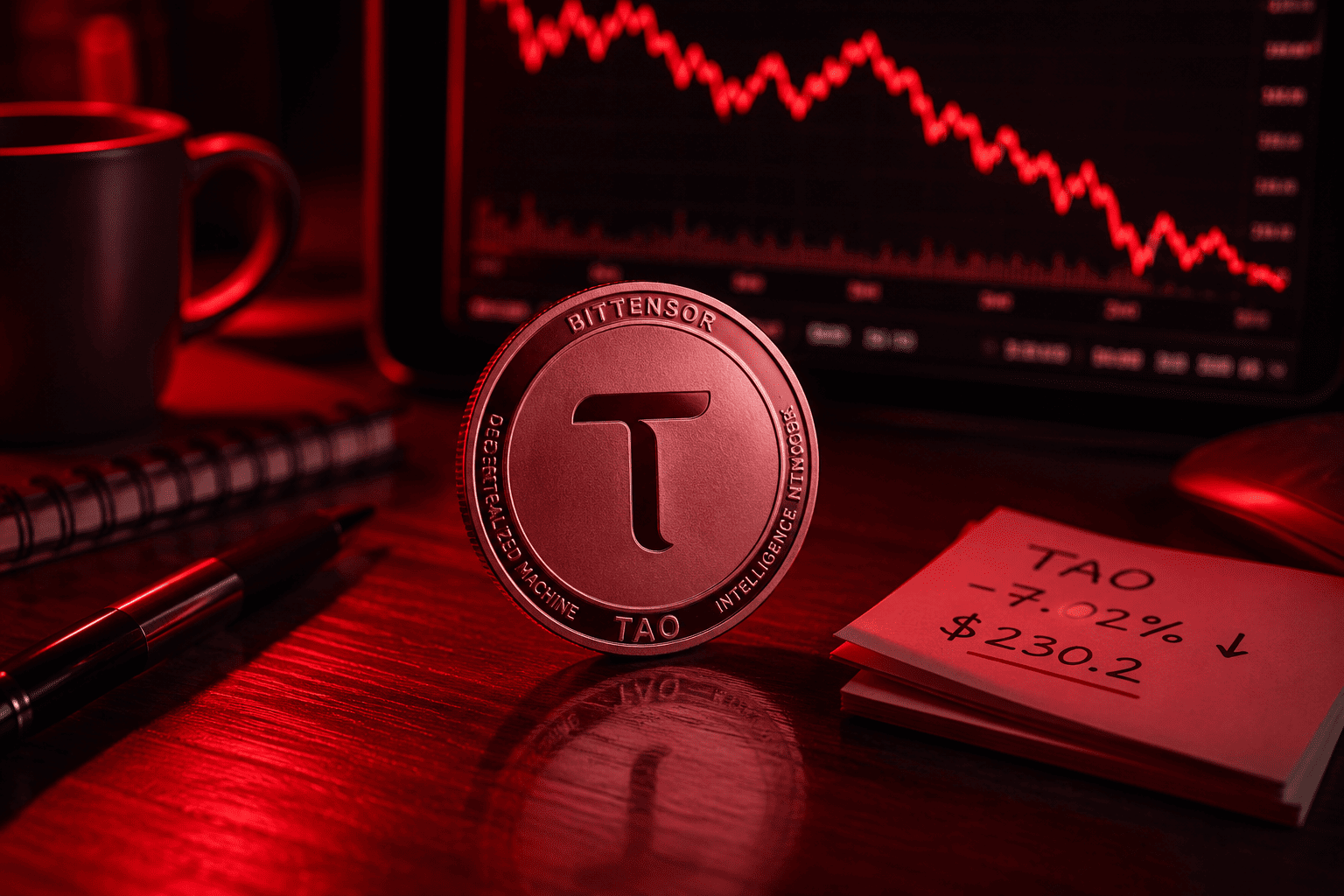
Bittensor's TAO token declined nearly 7% from its recent 24-hour high as market participants reacted to growing criticism of the proposed Root Reborn governance upgrade. The token traded near $230 after touching a low of $226.66, reflecting persistent selling pressure driven by concerns over validator power and capital allocation changes.
Root Reborn Proposal Under Fire
The Root Reborn upgrade was initially designed to address the continuous block-by-block selling of subnet tokens, a mechanism widely viewed as economically inefficient. However, the proposal has instead ignited a debate over the role of validators within the ecosystem. According to Yuma, a validator group, the upgrade introduces governance, liquidity, and regulatory risks that may outweigh its intended tokenomics benefits.

At the heart of the dispute is a new weight-setting mechanism that would allow leading validators to influence how capital flows into subnets. Yuma argued that this could fundamentally alter validators' roles, turning them from neutral network participants into active capital allocators. The group warned that concentrating influence among a small number of major operators could incentivize collusion, preferential treatment, and frontrunning.
Such a shift might lead subnet teams to prioritize securing validator support over developing competitive artificial intelligence products, according to the critique. This uncertainty has prompted investors to reassess whether fixing one economic issue could create new structural weaknesses elsewhere in the network.
Staking and Redemption Concerns
Additional concerns stem from the proposal's staking and redemption design. Yuma noted that rewards would become tied to baskets of subnet tokens that could be difficult to liquidate during periods of market stress. A sudden wave of unstaking could force large amounts of subnet tokens onto the market as users redeem rewards for TAO, potentially leading to substantial losses for later participants while early redeemers secure better execution prices.
The validator group also highlighted a 'triple slippage' problem embedded within the emission process, warning that staking returns could deteriorate over time. Regulatory implications add another layer of uncertainty, as directing capital allocations may expose validators to scrutiny typically associated with investment management activities. Such a change could complicate participation for infrastructure providers, exchanges, custodians, and other institutional operators.
TAO Price Analysis
Price action has mirrored the growing unease surrounding the proposal. Over the past 24 hours, TAO fell from approximately $243.34 to a low near $226.66 before recovering slightly toward the $230 area. The decline unfolded through a series of lower highs and lower lows, suggesting persistent selling pressure rather than a single liquidation event.
On the daily chart, TAO remains below all major exponential moving averages, with the 20-day EMA near $239.9 and the 50-day, 100-day, and 200-day EMAs around $250.2, $255.3, and $266.2, respectively. Trading beneath each of those levels leaves the long-term trend tilted to the downside. Momentum indicators also remain cautious, with the daily Relative Strength Index falling to roughly 45, below the neutral 50 level, indicating that buyers have yet to regain control.
On the 4-hour chart, TAO recently failed to hold above a cluster of moving averages between $243 and $246 before retreating toward $230. Price is now trading beneath the 20, 50, 100, and 200-period EMAs on that timeframe. Capital flows have weakened as well, with the Chaikin Money Flow indicator dropping to around -0.23, pointing to continued outflows and stronger selling activity than buying interest.
As of publication, the charts suggest TAO remains vulnerable to further downside if the current support zone around $226 to $230 fails to hold. Any meaningful recovery would first require buyers to reclaim resistance levels near $240, followed by the $245 to $250 region where multiple moving averages currently converge. For broader context on AI-related market movements, see our coverage of AI-Driven Power Demand Fuels Nuclear Stocks and SpaceX Stock Dips 3% as Post-IPO Rally Fades on AI Spending Concerns.
This article is for informational purposes only and does not constitute financial advice.