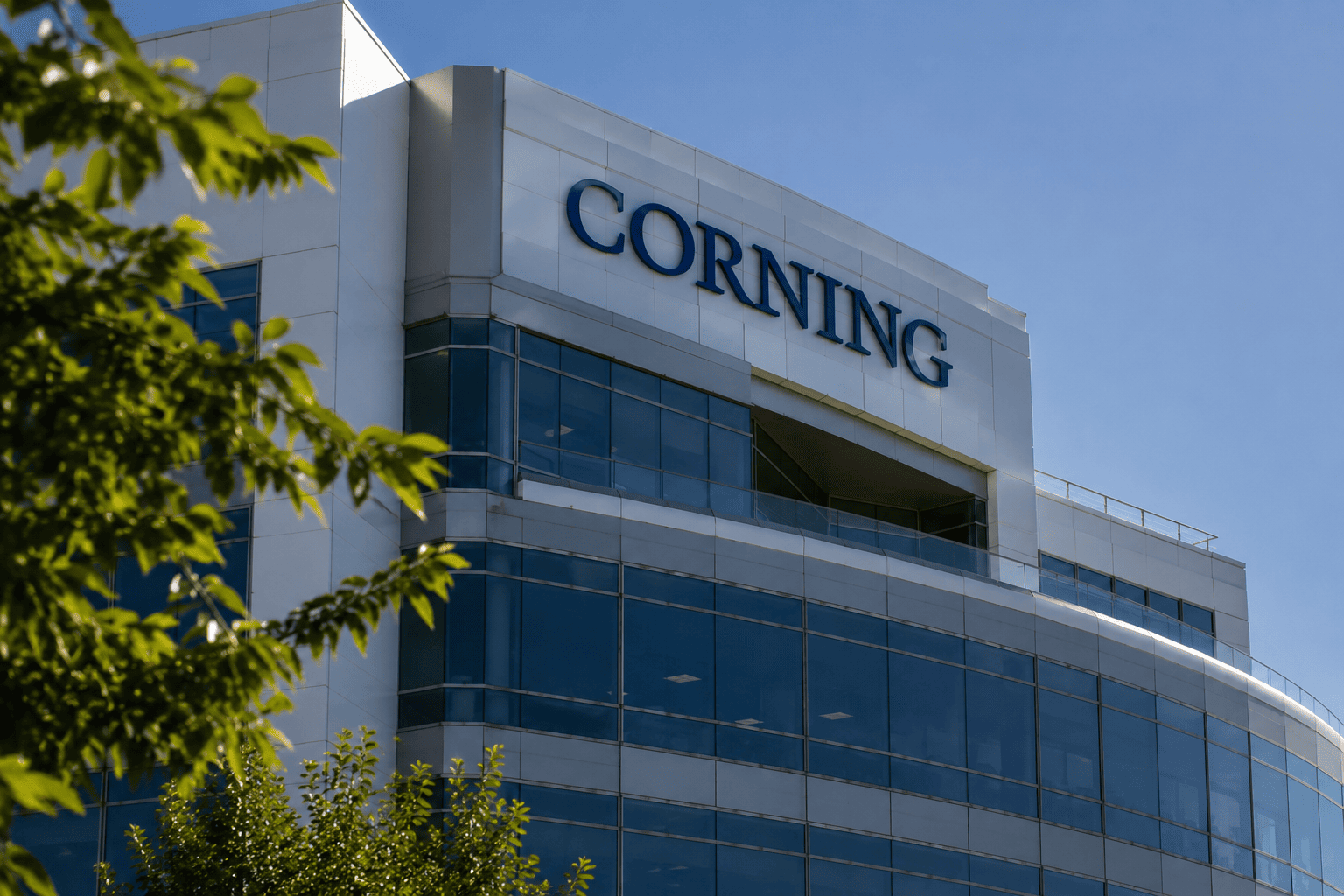
Corning Inc. (GLW) shares climbed 5.6% to $146.12 on Monday, extending Friday's 2.2% gain, after Truist Securities upgraded the optical networking and specialty glass maker to Buy from Hold. The analyst argued that the stock's brutal July selloff—its worst monthly performance in 24 years—has created a more attractive entry point for investors.
The upgrade comes after Corning's shares tumbled nearly 46% in July, making it one of the worst performers in the S&P 500 during the month. The decline followed the company's third-quarter guidance that largely met Wall Street expectations but failed to exceed the elevated forecasts that had been priced in. Despite the correction, the stock remains up 61% year-to-date and has gained 130% over the past 12 months.

Truist sees improved risk-reward
Truist analyst Matthew Niknam raised his rating to Buy while trimming his price target to $175 from $205. The new target still implies roughly 27% upside from Friday's close. In a client note, Niknam said the pullback has improved the stock's risk-reward profile, noting, "Simply put, we have waited for a more reasonable entry point to get more constructive, and we now have one post a ~45% pullback in July."
The upgrade is supported by continued customer spending in Corning's optical segment, expectations for accelerating revenue growth over the coming years, improving operating margins, and a projected 30% compound annual earnings growth rate through 2029. Truist also highlighted strong demand across artificial intelligence, data center infrastructure, and fiber-to-the-home deployments, as well as the recently introduced Photonics MAP as a long-term growth catalyst.
Corning currently trades at 32 times Truist's 2027 earnings estimates and 24 times its 2028 estimates, reflecting the market's high expectations for the company's AI-driven growth.
AI sentiment remains a key risk
Corning has become a major beneficiary of the AI infrastructure investment theme, with its Optical segment accounting for roughly 45% of company sales. However, Truist cautioned that investor sentiment around AI spending remains a significant risk. "Fears around durability of the 'AI trade' and sustainability of elevated hyperscaler capex could weigh on sentiment, given the Optical segment (~45% of sales) is driving the lion's share of GLW's forward growth," Niknam wrote.
The July selloff reflected those concerns, as investors worried that AI-related valuations had become stretched. The company's guidance, while in line with expectations, did not provide the upside that the market had hoped for.
Other analysts remain cautious but constructive
UBS also maintained a positive stance, reiterating its Buy rating while lowering its price target to $196 from $228. Analyst Joshua Spector said the recent selloff appeared overdone, with only modest revisions to earnings estimates reflecting a more conservative outlook for fiber capacity expansion and the timing of the photonics business.
Morgan Stanley, however, kept an Equal Weight rating and cut its price target to $165 from $180. The firm noted that Corning's second-quarter results largely met expectations but that sold-out conditions limit additional upside. Analysts also pointed out that much of Corning's business operates under long-term contracts, leaving limited room for further pricing gains or earnings-per-share expansion.
For the third quarter, Corning expects adjusted earnings between $0.85 and $0.89 per share on revenue of $4.9 billion to $5.0 billion. Wall Street is looking for earnings of $0.87 per share on revenue of approximately $4.99 billion. The company reported second-quarter earnings of $0.78 per share on revenue of $4.74 billion, beating analysts' estimates.
Investors have also been watching other AI-related plays, such as Bloom Energy's recent surge on AI data center demand, and Amazon's AWS growth which has raised cash-flow concerns. The broader AI trade remains volatile, and Corning's fortunes are closely tied to the sustainability of hyperscaler capital expenditures.
This article is for informational purposes only and does not constitute financial advice.