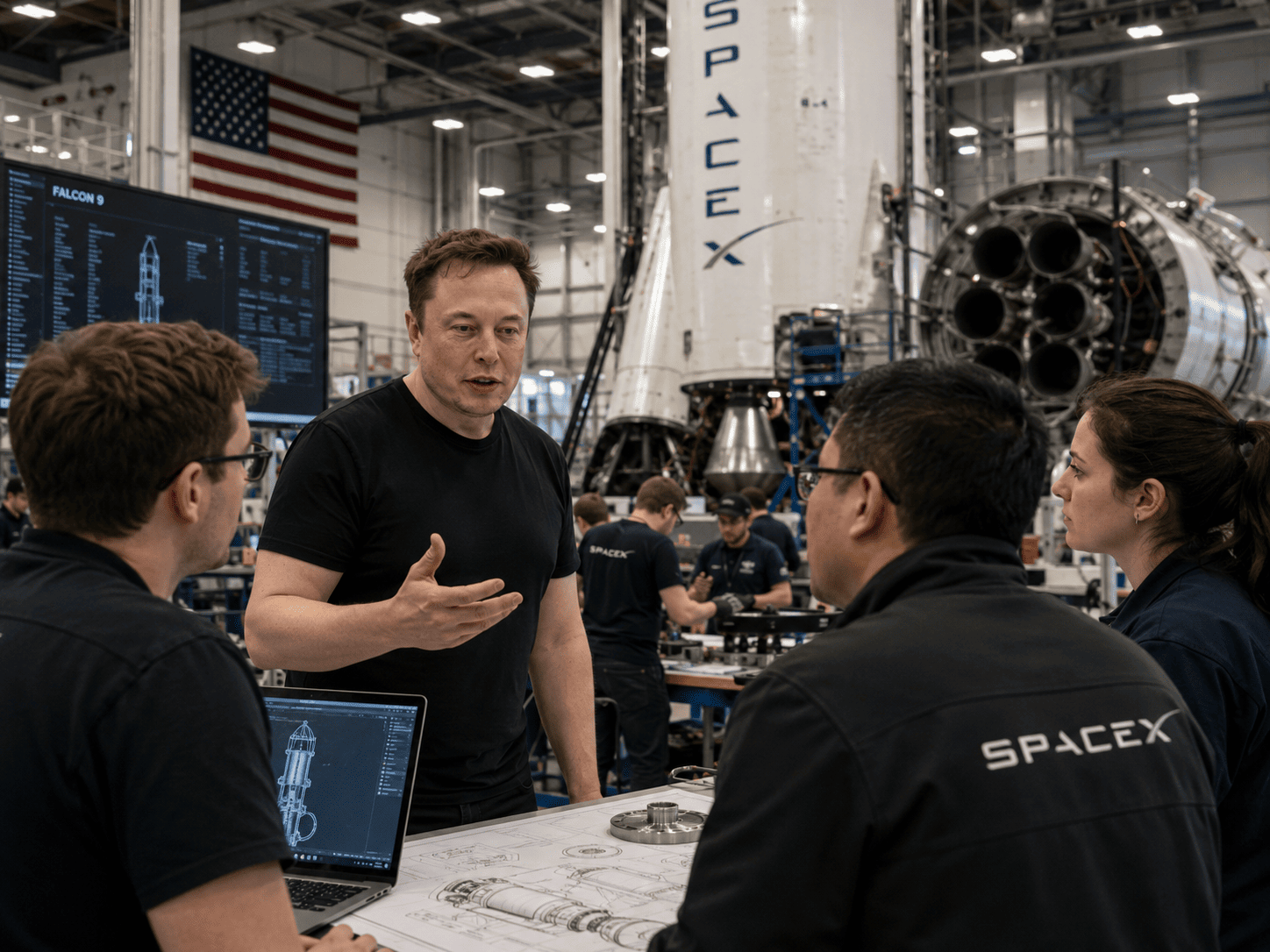
SpaceX shares (SPCX) advanced approximately 4% on Monday, buoyed by Morgan Stanley's reaffirmation of its overweight rating on the rocket and satellite company. The brokerage highlighted the stock as an unusually cost-effective avenue for investors seeking exposure to the expanding space and artificial intelligence (AI) sectors.
Morgan Stanley maintained its $300 price target, implying an 88.7% upside from Friday's closing price. This rally also propelled Elon Musk back to the pinnacle of global wealth, with Forbes estimating his net worth at $1 trillion on Monday, a $30.6 billion increase from Friday, driven by gains in both SpaceX and Tesla shares.

Morgan Stanley's Valuation Perspective
Analyst Adam Jonas noted that while SpaceX appears expensive under conventional valuation metrics, it looks more attractive when adjusted for expected growth. The company trades at roughly 30 times estimated 2028 EV/EBIT, compared with about 16 times for other mega-cap AI enablers. However, its EV/EBIT-to-growth ratio stands at 0.3 times, approximately 40% below the peer median, according to Morgan Stanley.
Jonas argued that the current valuation only partially reflects SpaceX's broader business potential. At Friday's closing price of $159, the market assigns about $127 per share to Starlink and the rocket-launch business, leaving roughly $32 per share for its AI operations. The brokerage's $300 price target values external launch operations at $8 per share, Starlink connectivity at $118, consumer AI tools such as Grok at $8, and enterprise AI services at $165.
Jonas wrote that SpaceX is one of the cheaper ways to gain exposure to the growth potential of the space and intelligence economy when its valuation is adjusted for growth. He also indicated that the risks of upside surprises outweigh those on the downside at current levels.
Starship Flight 15 as a Key Catalyst
Morgan Stanley identified SpaceX's upcoming Starship Flight 15 as a major potential catalyst. The launch is expected in late October or early November and could include an attempt to catch the spacecraft's upper section in mid-air. A successful ship catch would represent further progress toward a reusable rocket system, potentially reducing launch costs and accelerating infrastructure deployment.
Jonas described a successful ship catch as potentially the biggest positive catalyst for SpaceX since its initial public offering. Other catalysts identified include additional AI compute contracts, new Grok releases, and further progress on Starship reusability. SpaceX's third-quarter earnings later this month could also provide early indications of adoption and monetization of its AI services, including Cursor and Grok Bot, which were acquired and launched during the quarter.
Musk's Return to Trillionaire Status
The gains in SpaceX and Tesla shares helped Musk's estimated wealth return to the $1 trillion mark. Forbes ranked Musk as the richest person in the world, with Amazon founder Jeff Bezos in second place at an estimated $371.5 billion. Musk had previously crossed the trillion-dollar threshold in June after SpaceX began trading on the Nasdaq but subsequently fell below it after declines in both companies' shares.
Musk's net worth had been approaching the milestone in recent days as both companies' shares advanced. Tesla's third-quarter deliveries exceeded analyst expectations last week, while SpaceX shares also gained following the company's recent Starship launch into orbit.
Risks and Considerations
Despite the recent gains, Morgan Stanley highlighted several risks to its SpaceX outlook, including slower-than-expected AI growth, higher infrastructure costs, and potential dilution. The brokerage also noted that institutional ownership of SpaceX remains relatively low among its clients, partly due to the complexity of the company's interconnected businesses across space, connectivity, and AI.
This article is for informational purposes only and does not constitute financial advice.

