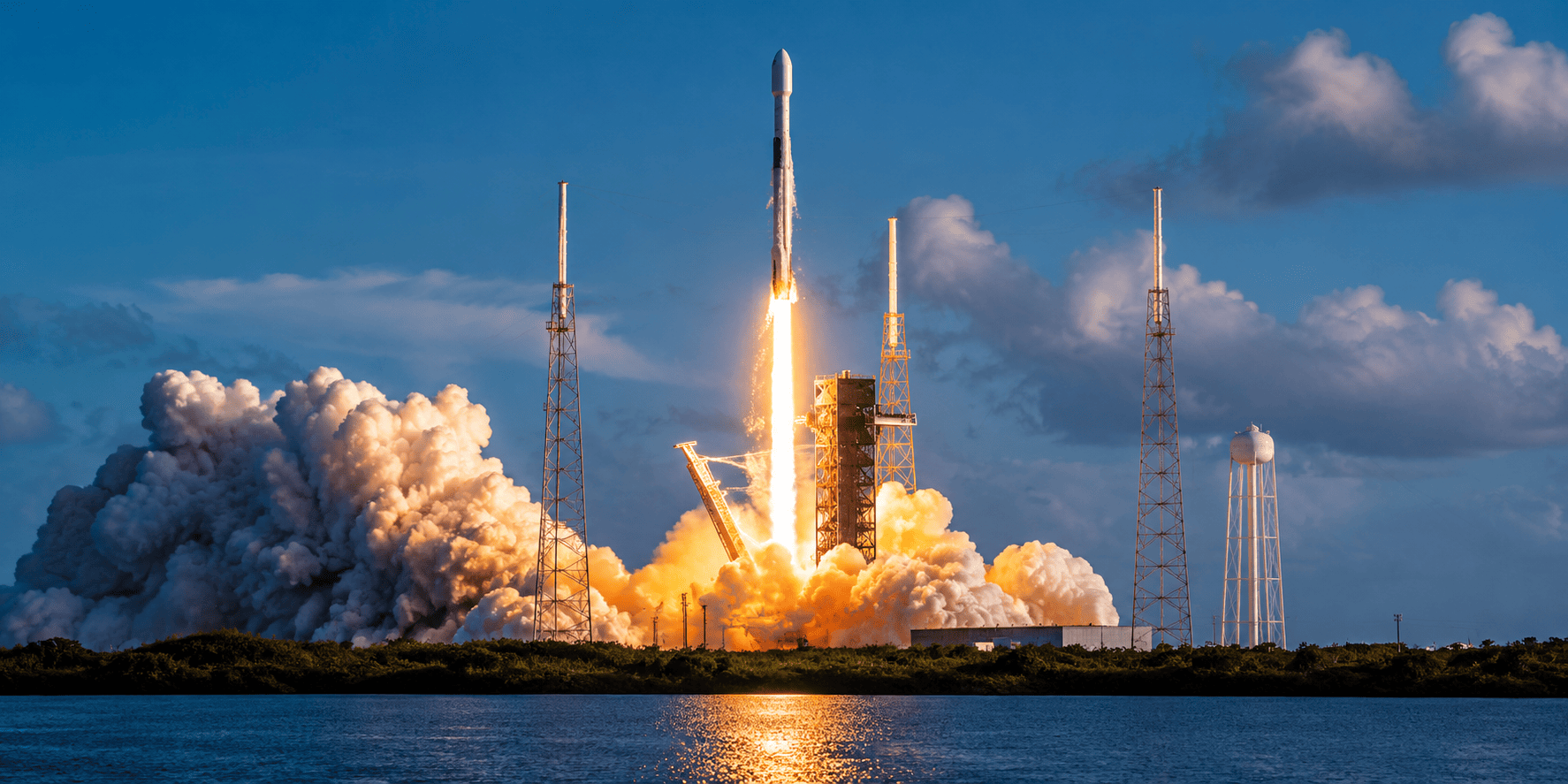
SpaceX (SPCX) began trading on the Nasdaq today at $150 per share, marking an 11% premium above its IPO price and valuing the company at nearly $2 trillion. The landmark listing, however, has sent shockwaves through the broader space sector, with key peers opening deep in the red.
Rocket Lab (RKLB), Virgin Galactic (SPCE), Intuitive Machines (LUNR), and EchoStar (SATS) all experienced sharp declines at the open, shedding a significant portion of their recent gains. The rotation trade—where investors sell proxy stocks to buy the real asset—is playing out in real time.

Why Space Proxies Are Under Pressure
For months, investors seeking exposure to the commercial space economy had limited options: RKLB as a 'mini-SpaceX,' SATS as a direct ownership play, and SPCE as a pure-play space tourism bet. That dynamic evaporated the moment SPCX stock appeared on trading terminals. Fund managers and retail traders alike moved to sell these proxies to free up capital for the massive offering.
SpaceX sold over 555 million shares in a deal that raised $75 billion—comfortably the largest IPO in history, surpassing Saudi Aramco's 2019 record. With such a large capital call hitting the market, portfolio rebalancing was inevitable. As one analyst noted, 'Why hold a proxy when you can own the original?' The anticipation had lifted the entire sector; now, execution is draining it.
Virgin Galactic Hit Hardest
Virgin Galactic stock suffered the steepest decline as investors focused on its fundamentals. The company generated just $227,000 in total revenue last quarter while posting a net loss of $64.7 million. It guided Q2 free cash flow to negative $87 million, with gradual improvement expected through 2026. Management has reaffirmed Delta-class test flights in Q3 2026 and a first commercial spaceflight in Q4 2026, but these remain promises—not revenue.
In contrast, SpaceX boasts roughly 10 million Starlink paid subscriptions, while Virgin Galactic holds only hundreds of unfilled $450,000 ticket reservations. The scale disparity is stark.
What Happens Next: The Post-IPO Hangover
The selloff in space proxies today is likely the first chapter of a longer recalibration, not a one-day event. SpaceX's valuation has raised concerns among some investors, and market jitters surrounding the IPO were already weighing on peers ahead of today's debut. Now that SPCX stock is live, speculative premiums baked into names like Rocket Lab and EchoStar must compete directly against the real thing—and SpaceX's pitch is formidable.
Its IPO filing claims a total addressable market of $28.5 trillion, with a significant portion tied to AI enterprise applications via its Starlink connectivity infrastructure. Meanwhile, at a $2 trillion valuation, SpaceX trades at a price-to-sales ratio of about 104x—steep, but still below Rocket Lab's 123x and AST SpaceMobile's 409x. This raises a key question for investors: if SpaceX is a better business at a lower multiple, what exactly are you paying for in the proxies?
In short, the sector will need fresh operational catalysts—such as Rocket Lab's Neutron launch and Virgin Galactic's first commercial flight—to rebuild its identity outside the SpaceX shadow. For now, the rotation trade is in full effect.
For more on the broader market impact, see Dow Adds 353 Points on SpaceX Debut, Iran Deal Optimism and SpaceX Stock Opens at $150; Wolfe Research Sees 17% Upside to $175 Target.
This article is for informational purposes only and does not constitute financial advice.