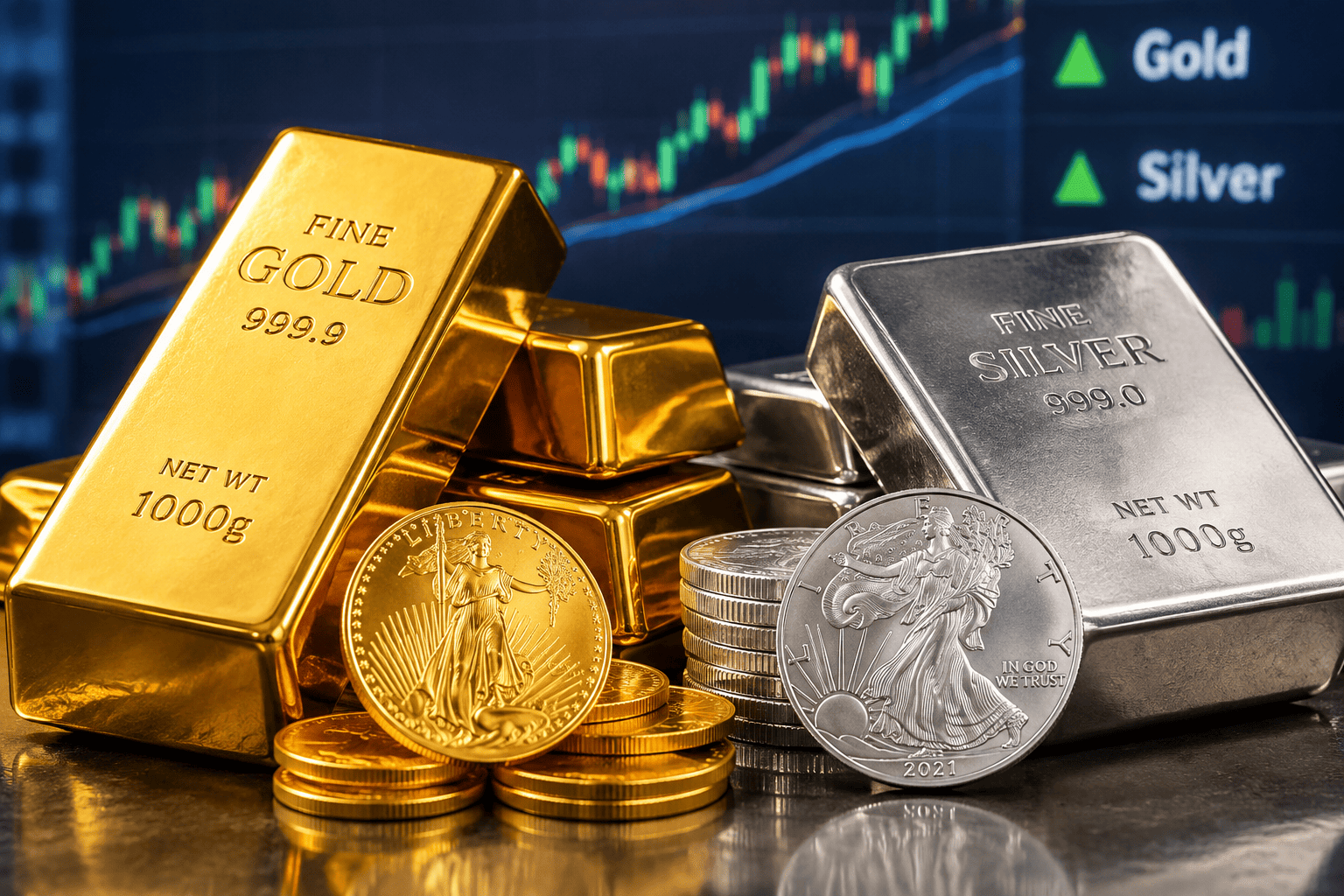
Silver retreated toward $58.50 an ounce on Friday, erasing part of a two-day advance as the US dollar staged a modest recovery, prompting traders to trim long positions. The metal traded down roughly 0.8% at $58.52 in early action, a pullback that underscores how quickly silver can reverse course when currency dynamics shift.
The decline follows a brief rally sparked by the Federal Reserve's decision to hold interest rates steady. However, the dollar's rebound, after a sharp drop on Thursday, has renewed pressure on the precious metal. Investors had unwound bets on an imminent rate hike, but uncertainty over Chair Kevin Warsh's inflation stance has left markets cautious.

Dollar strength and Fed policy weigh
Strategists at Brown Brothers Harriman attributed the earlier dollar weakness to the removal of July tightening expectations and a lack of clear policy guidance. They noted that the currency could remain vulnerable if long-term yields continue to climb while the Fed stays on hold. A weaker dollar typically supports silver by making it cheaper for overseas buyers, while reduced rate expectations lower the opportunity cost of holding non-yielding assets.
Yet the policy backdrop is not unequivocally bullish. The Fed's decision to keep its target range at 3.5% to 3.75% was not unanimous, with three officials—Beth Hammack, Neel Kashkari, and Lorie Logan—preferring a quarter-point increase. Policymakers also flagged elevated inflation, partly due to energy supply shocks, leaving the door open for further tightening.
Industrial demand complicates outlook
Silver's dual role as both a monetary asset and an industrial input makes it more sensitive to economic conditions than gold. Oil prices, while easing on Friday with Brent near $88 a barrel, are still heading for a monthly gain of about 20%, which could reinforce inflation expectations and weigh on global growth. Higher energy costs can also dampen industrial activity, a key driver for silver used in electronics, solar panels, data centers, and vehicles.
The Silver Institute projects industrial fabrication will decline 2% in 2026 to about 650 million ounces. Although solar installations continue to expand, manufacturers are reducing silver usage per panel and substituting cheaper materials. Demand from AI infrastructure, data centers, and the automotive sector is expected to offset some of that decline.
Technical levels and market positioning
From a technical perspective, silver is trading below its 20-day exponential moving average near $58.91, leaving rallies vulnerable until a decisive close above that level. A breakout could bring the July 22 peak of $60.94 back into focus. On the downside, traders are monitoring the July 28 low around $56.64, followed by the July 17 trough near $54.77. Momentum appears subdued rather than deeply oversold, suggesting room for movement in either direction.
Physical fundamentals provide some support. The Silver Institute expects a sixth consecutive annual deficit in 2026, with demand exceeding supply by about 67 million ounces. Physical investment is forecast to rise 20% to 227 million ounces, while the market continues to rely on above-ground inventories. That deficit may limit deeper losses, but it does not guarantee an immediate rebound.
Silver must first overcome the stronger dollar, uncertain industrial demand, and resistance near $59 before the $60 level becomes a credible target again. Recent price action has been choppy, with the metal holding near $57.90 amid hawkish Fed dissents, and gains capped by rate hike bets. The rebound has stalled at $57.50 as geopolitical risks and oil surges complicate the outlook.
This article is for informational purposes only and does not constitute financial advice.