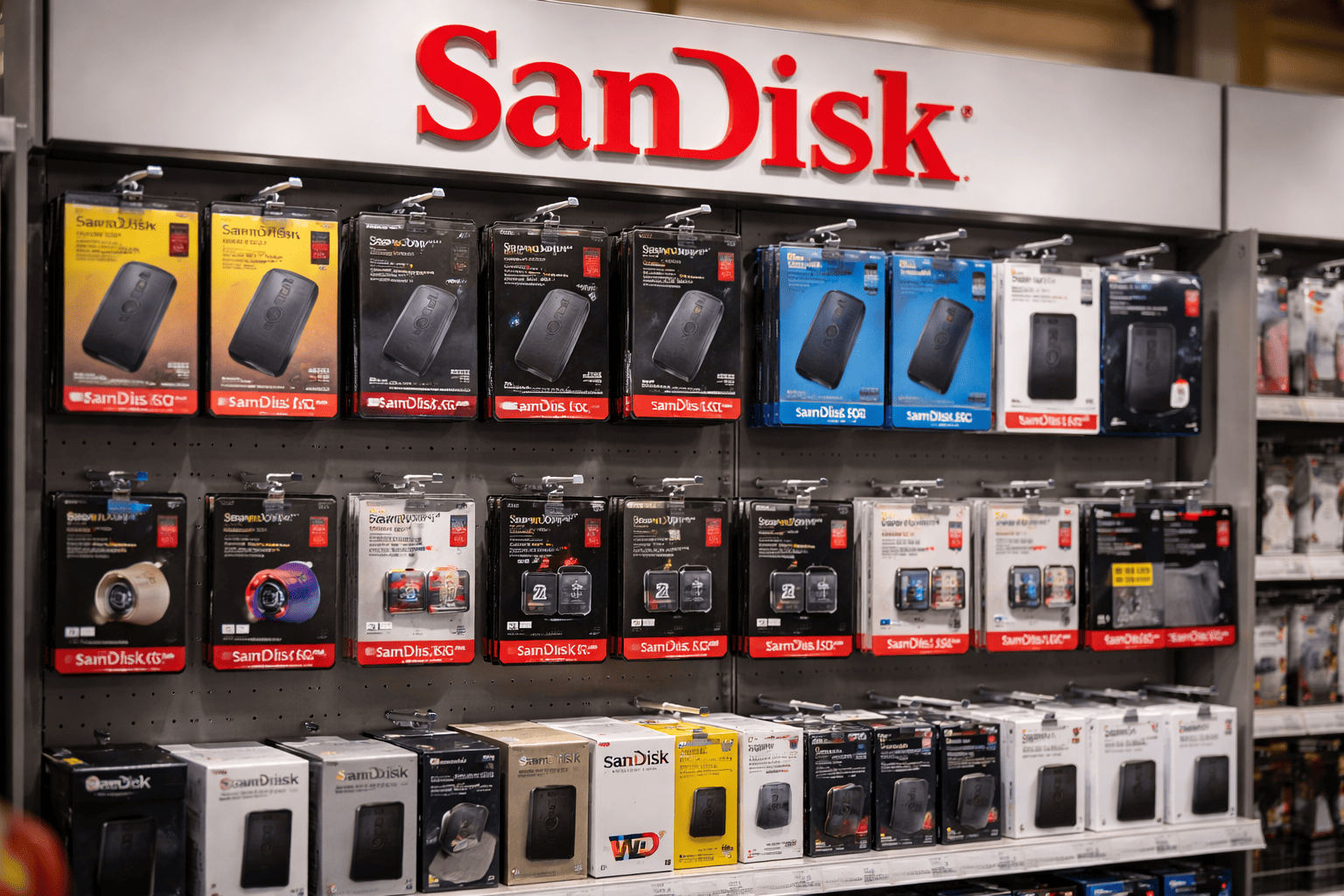
SanDisk (NASDAQ:SNDK) shares slid more than 5% in extended trading on Wednesday, adding to a 5.4% decline during the regular session, despite the flash-memory maker posting quarterly results that would typically spark a rally. The company reported adjusted earnings of $39.25 per share, surpassing the $34.96 consensus, while revenue of $8.97 billion beat the $8.48 billion estimate. The culprit was the outlook: SanDisk guided September-quarter revenue to $10.3 billion–$10.8 billion, with the midpoint slightly below analyst expectations.
High bar set for the stock
SanDisk's fourth-quarter revenue surged 51% sequentially and 372% year-over-year. Adjusted earnings rose 68% from the prior quarter, and gross margin expanded to 84.6% from 78.4%. These figures underscore the strength of the current NAND upcycle. Data center revenue climbed 103% sequentially to $2.98 billion, more than offsetting a 32% decline in consumer sales to $556 million.

However, management's first-quarter revenue midpoint of $10.55 billion fell short of the roughly $10.8 billion analysts had modeled. Adjusted earnings guidance of $44–$46 per share was broadly in line with consensus rather than a clear beat. After a strong run in the stock, investors had priced in near-perfect execution and repeated upward revisions. The guidance challenged that narrative, but it did not signal any weakening in AI-related storage demand.
AI storage engine remains intact
SanDisk's business is increasingly tied to enterprise and hyperscale customers rather than traditional consumer devices. AI training, inference, and software agents require fast storage, while limited new NAND capacity has preserved pricing power for suppliers. Wedbush analyst Matt Bryson expects earnings momentum to continue through fiscal 2027 and 2028, citing constrained manufacturing additions and multiyear customer agreements that should support pricing and profitability even as quarterly growth moderates.
Goldman Sachs analyst James Schneider had raised his price target to $2,200 before the results, citing persistent NAND tightness and an improving mix of enterprise solid-state drives. The quarter reinforced that view: data center sales more than doubled sequentially, and two-thirds of SanDisk's revenue growth came from higher pricing. The sell-off, therefore, reflects concerns about valuation rather than a deterioration in demand fundamentals.
Long-term contracts could change the cycle
The case for a rebound rests on SanDisk's efforts to reduce NAND volatility. The company said it signed five new customer agreements, following five announced in April. CEO David Goeckeler told Reuters that eight agreements with six customers represent $93.9 billion in contracted value, with an average duration of about four years. By fiscal 2027, roughly half of SanDisk's output is expected to be sold under these arrangements, rising to about two-thirds in fiscal 2028.
Bank of America analyst Wamsi Mohan expects favorable NAND pricing to persist into mid-2027, although sequential price increases may slow. Bernstein has maintained an Outperform rating and a $3,000 price target, arguing that long-term agreements offer more meaningful downside protection than previous cycle structures. For investors, the key question is whether the market's immediate disappointment will give way to recognition of the company's improved earnings durability. As seen with Kioxia's recent slide, strong earnings alone may not prevent volatility, but SanDisk's contract backlog could provide a cushion. The stock's 45% drop from its June peak, despite a Q2 beat and a $15.5 billion buyback, suggests that sentiment has already turned cautious, as noted in our earlier analysis. With AI-driven demand still accelerating and supply constraints likely to persist, the current pullback may offer a more attractive entry point for long-term investors, though near-term volatility remains a risk.
This article is for informational purposes only and does not constitute financial advice.