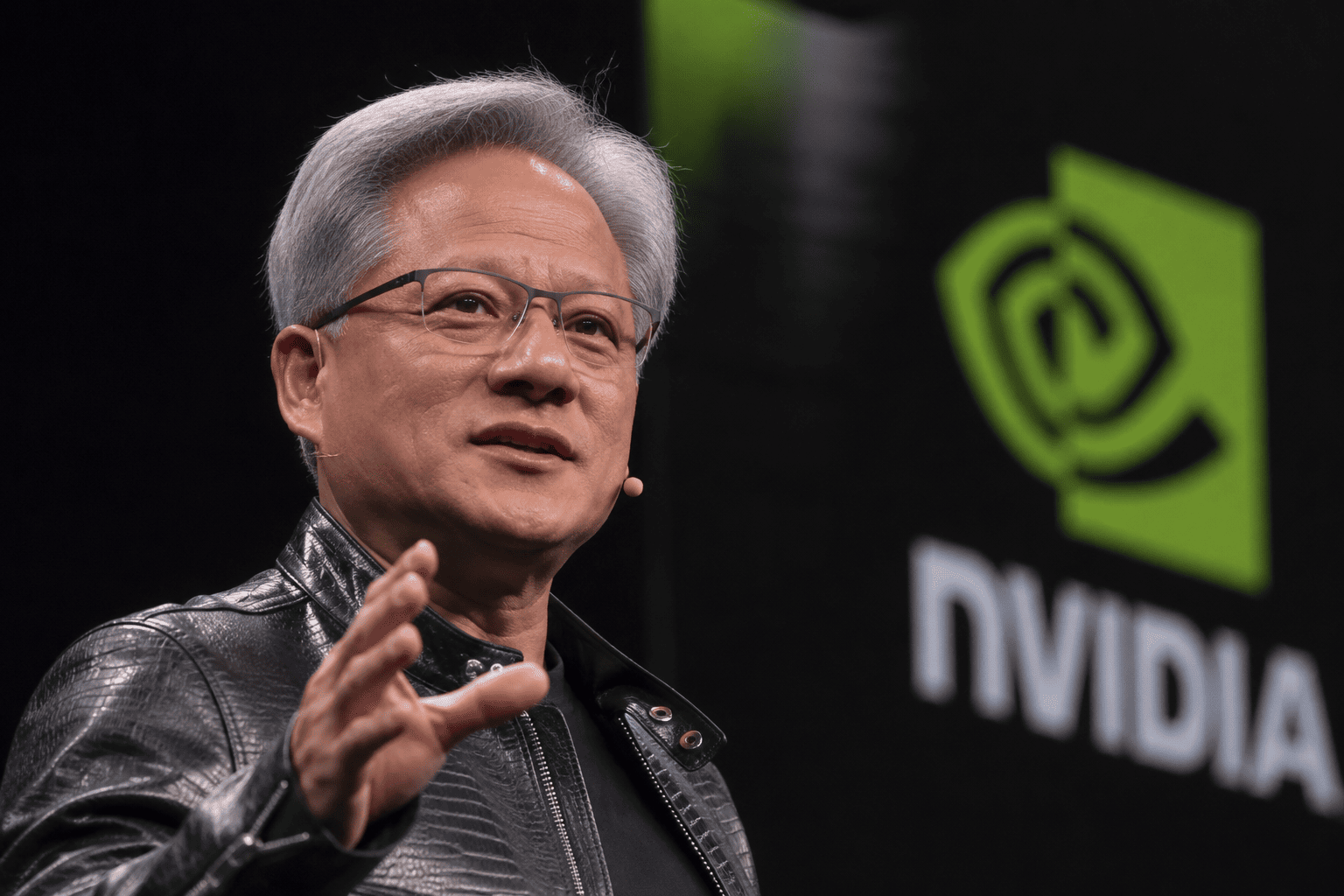
Nvidia shares are encountering firm resistance just beneath their record peak, with the stock changing hands around $229 on Tuesday, a modest retreat from its year-to-date high of $236. The pause comes even as several supportive forces remain in place, leaving investors to weigh a compelling fundamental backdrop against a growing list of concerns.
AI Spending Provides a Powerful Tailwind
The broader artificial intelligence infrastructure buildout continues to underpin demand for Nvidia's data center products. Bain projects that AI-related spending could reach $6 trillion within a few years, while a PwC study estimates the figure could climb to $32 trillion by 2032. Nvidia's dominant position in accelerated computing, with its Blackwell chips widely deployed by hyperscalers such as Microsoft and Amazon, positions it to capture a substantial share of that outlay.

Analyst consensus points to annual revenue growth of roughly 90% this year, reaching $411 billion. Management has guided for a further 70% increase next year, though the company has historically issued conservative forecasts. Notably, its outlook excluded China, a market that could reopen if Beijing permits leading firms like ByteDance and Alibaba to purchase advanced Nvidia chips.
Valuation and Buyback Support the Bull Case
From a valuation standpoint, Nvidia trades at a forward price-to-earnings ratio of 24, well below its five-year average of 42. Its forward PEG ratio of 0.47 compares favorably with the sector median of 1.25. Those metrics help explain the company's decision to authorize a $150 billion share repurchase program this week, bringing total planned buybacks to more than $235 billion. Repurchases reduce the share count, lifting earnings per share and effectively increasing the portion of profits attributable to each remaining share.
Headwinds Keep a Lid on the Stock
Despite these positives, the shares have struggled to break out. Fears of an AI bubble have weighed on sentiment, and several of Nvidia's largest customers are developing their own silicon. OpenAI has introduced its Jalapeno chip, Google's TPU continues to gain traction, and in-house processors from Amazon and Microsoft are advancing. Those efforts could pressure Nvidia's demand and margins over time.
Another area of scrutiny is circular investment. Nvidia has channeled capital into customers that then use those funds to buy its chips, and it recently arranged financing from major U.S. institutions including Goldman Sachs and Brookfield. While such arrangements can reinforce the ecosystem, they also raise questions about the sustainability of demand.
Technical Picture Sends Conflicting Signals
On the daily chart, Nvidia completed a double-bottom formation at $190 with a neckline at $213, a pattern that typically precedes further gains. The stock remains above its 50-day and 100-day exponential moving averages, a bullish configuration. However, a diamond reversal pattern has also taken shape, which often signals a bearish turn, and the shares have run into heavy resistance near their all-time high.
The next move could be decisive. A rebound above $236 would confirm a bullish breakout and open the door to $250 and beyond. Conversely, a decline below the $213 support level would invalidate the constructive setup.
This article is for informational purposes only and does not constitute financial advice.

