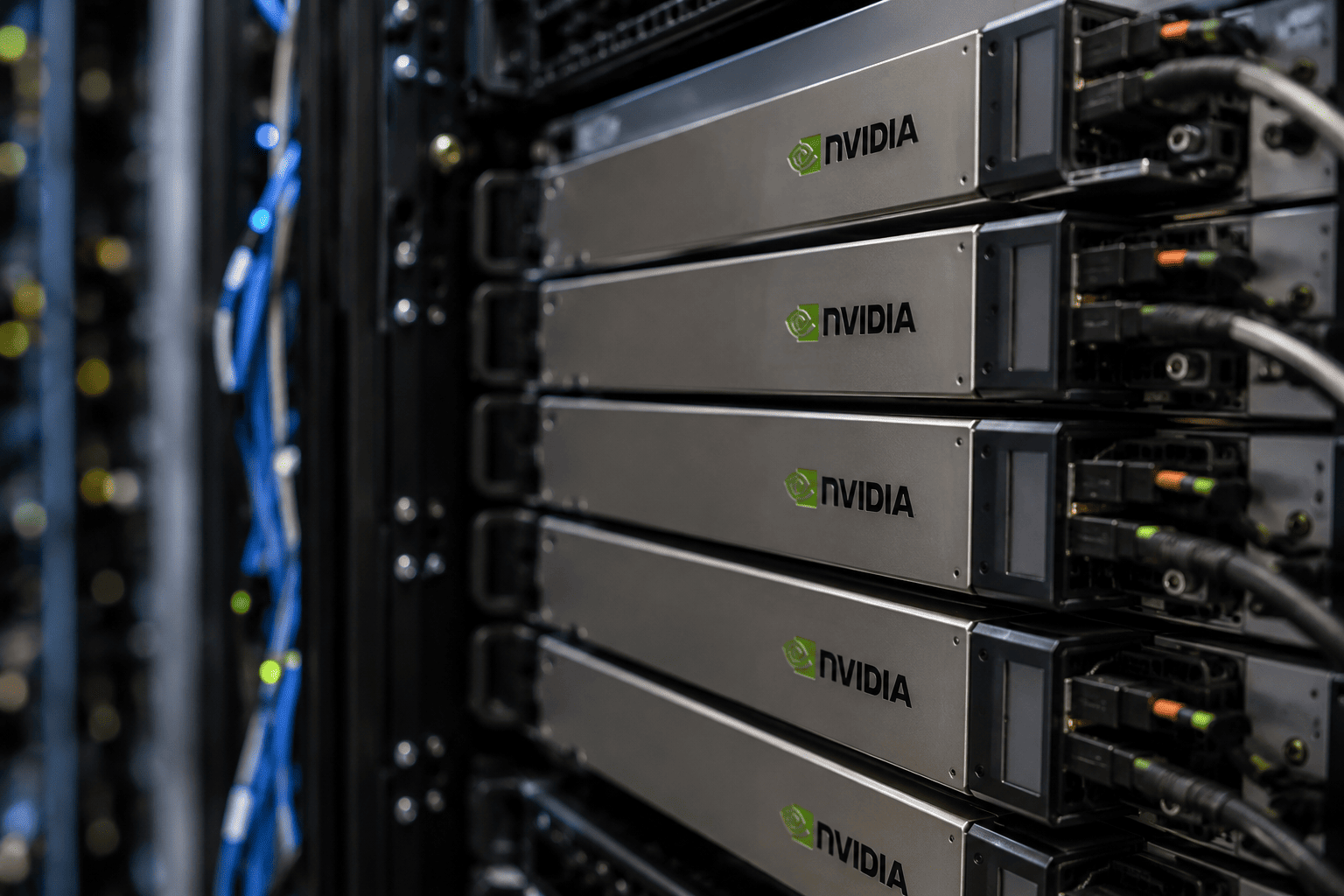
Nvidia's expanded partnership with SK Hynix has given investors a fresh catalyst to watch, even though the market has yet to react strongly. NVDA closed Friday at $206.84, down 0.92%, before details of the SK Group initiative were fully absorbed. The agreement addresses a critical supply constraint that could determine how many AI factories Nvidia can build and ship.
Memory bottleneck in focus
Nvidia already dominates AI accelerators, but its processors cannot be delivered as complete systems without enough high-bandwidth memory (HBM). By securing and jointly developing HBM with SK Hynix, Nvidia is tackling a component that is becoming one of the tightest constraints in the AI supply chain. Morgan Stanley analyst Joseph Moore described the market as unlike a conventional semiconductor cycle, arguing that memory was becoming "increasingly THE bottleneck" for AI and agentic-computing systems. Moore identified Nvidia and Broadcom as among the strongest-value computing names, supporting the investment case behind the SK Hynix agreement: if Nvidia secures more advanced memory while demand remains above supply, it could ship more complete systems and reduce a major execution risk.
The deal does not eliminate shortages immediately. HBM capacity remains limited, qualification requirements are demanding, and Nvidia, hyperscalers, and rival accelerator developers are competing for the same advanced supply. The partnership is designed to align memory technology with Nvidia's computing platforms, but near-term constraints persist.
Vera Rubin gains a customer
The partnership also links Nvidia to a potentially important customer. SK Telecom plans to develop an AI factory of up to 2 gigawatts using Nvidia's DSX architecture and Vera Rubin accelerated-computing systems powered by SK Hynix HBM4. The first facility is planned to begin operating in 2027. That creates a strategic loop: SK Hynix supplies and co-develops the memory, Nvidia provides the computing systems, networking, software, and data-center architecture, and SK Telecom becomes an infrastructure customer serving South Korea and the wider Asia-Pacific region.
The deployment could become a valuable reference site for Vera Rubin as Nvidia faces competition from hyperscalers' custom processors and specialist AI-chip companies. It also reinforces Nvidia's shift from selling individual GPUs toward supplying complete AI factories. However, the companies signed letters of intent for a program described as exceeding $500 billion. They did not disclose Nvidia's expected revenue, system volumes, memory prices, or binding purchase commitments.
Execution remains the key risk
Execution remains the central risk. KeyBanc analyst John Vinh said the Vera Rubin ramp appeared slightly delayed because of thermal-lid issues and SK Hynix's HBM4 qualification. He nevertheless viewed the financial risk as manageable because additional Blackwell shipments could offset slower Rubin deliveries. Vinh retained an Outperform rating and raised his Nvidia price target to $330 from $310. His view captures the stock's tension: the partnership addresses the correct bottleneck, but Nvidia must still qualify HBM4, solve system-level challenges, and scale Rubin on schedule.
Investors must also see continued capital spending from Microsoft, Amazon, Alphabet, and Meta. Barron's recently argued that renewed Big Tech spending commitments were needed to drive sustained gains above $200. The broader context includes recent volatility in Nvidia-backed neocloud stocks, which have tumbled on rising costs and competition fears, and a rotation toward memory stocks after Alphabet's massive capex boost. Meanwhile, SK Hynix ADR cap limits arbitrage, with US shares trading at a 33% premium, adding another layer of complexity for investors tracking the memory supply chain.
The partnership with SK Hynix is a strategic move to secure a critical component, but the stock's next leg higher likely depends on execution of the Vera Rubin ramp and sustained hyperscaler spending. For now, the deal provides a catalyst, but the market is waiting for tangible results.
This article is for informational purposes only and does not constitute financial advice.