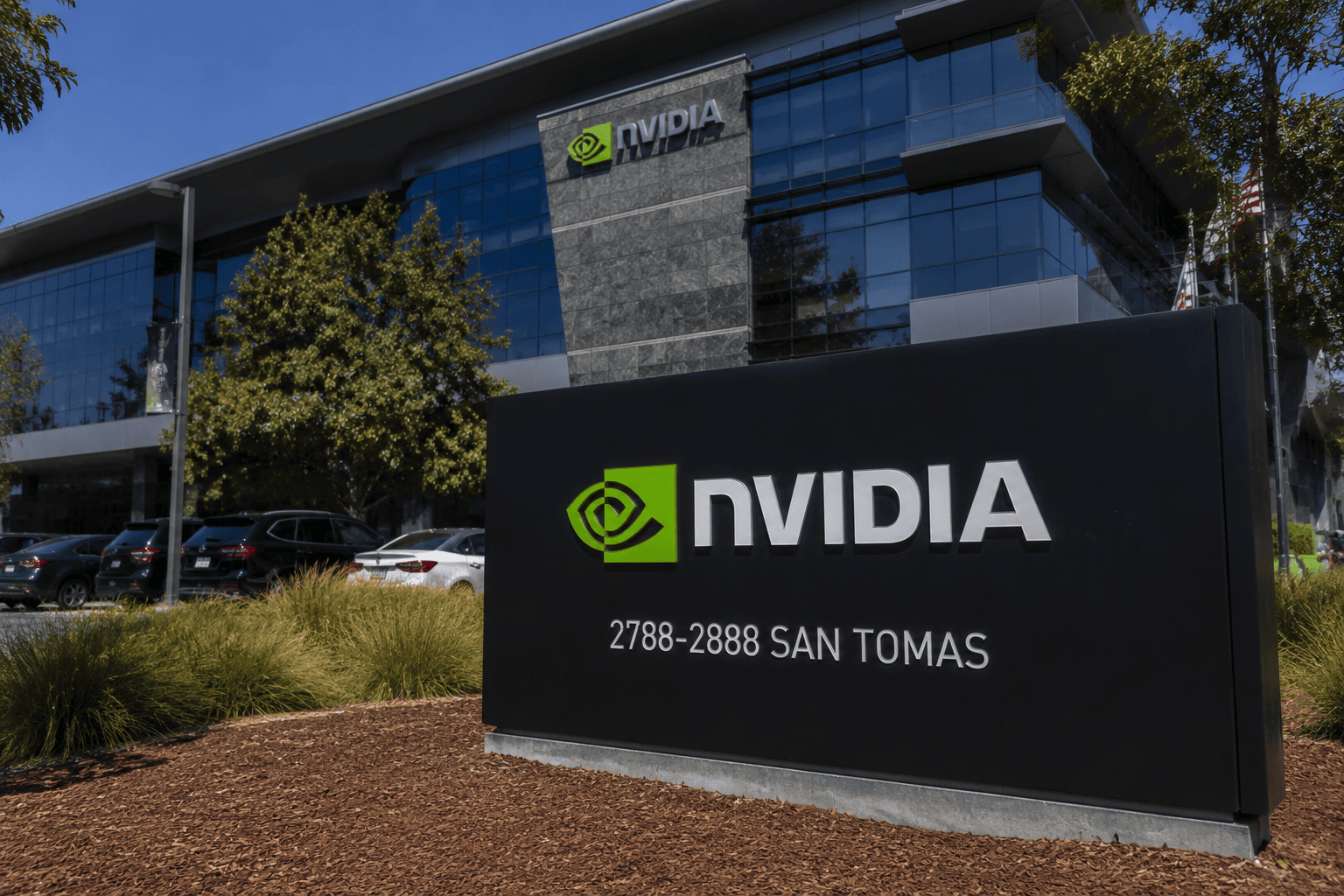
Nvidia (NASDAQ:NVDA) closed Friday at $200.75, up 2.9%, as robust cloud results from Microsoft and Amazon reignited confidence in AI infrastructure spending. Yet a quieter part of the chipmaker's strategy is emerging beyond the data centers that dominate Wall Street's focus.
Nvidia has joined CuspAI's new AI Materials Foundry, a global initiative that combines generative AI, accelerated simulations, scientific data, and laboratory testing to discover new materials for semiconductors, energy, and advanced manufacturing. The foundry launched alongside a $450 million Series B round that valued Cambridge-based CuspAI at $2.6 billion. More than 45 founding partners include Nvidia, Meta, Samsung Electronics, Applied Materials, Hyundai Motor Group, Tokyo Electron, and Lam Research.

The goal is to compress a materials-development process that traditionally takes years. CuspAI's approach spans generating candidate materials, simulating their properties, planning synthesis, validating results in labs, and preparing successful compounds for production. Nvidia's role is strategically important because these simulations demand substantial computing power. Its ALCHEMI platform provides GPU-accelerated microservices and software tools for chemistry and materials research. Nvidia claims its batched geometry-relaxation technology can speed up certain material-stability simulations by up to 100 times.
For investors, the immediate impact is not that CuspAI will suddenly become a major customer—no revenue or purchase commitments have been announced. The opportunity lies in materials discovery becoming another specialized workload tied to Nvidia processors, CUDA-X software, and cloud infrastructure. This fits the broader thesis that each new workload added to Nvidia's ecosystem strengthens its competitive moat.
Wall Street's bullish case for Nvidia still rests on its established strengths. Bank of America analyst Vivek Arya said investors were overlooking an "enhanced" buying opportunity, arguing that concerns about rising memory costs and competition from custom chips underestimate Nvidia's pricing power, scale, and supply-chain commitments. KeyBanc's John Vinh raised his price target to $330 from $310, maintaining an Outperform rating, citing the barriers created by Nvidia's hardware and CUDA software ecosystem. Bernstein's Stacy Rasgon also kept a Buy rating and $315 target despite concerns about Nvidia's increasingly interconnected AI deals.
The materials catalyst, however, faces a lengthy reality check. AI-generated materials must still survive physical testing, regulatory reviews, and mass-production requirements. Moving from a promising simulation to a commercially viable semiconductor material could take years, and many candidates will fail. There's also a broader risk: scientific computing will matter less to Nvidia's shares if spending by its largest customers slows. Jim Paulsen warned that flat or declining US core capital spending could force a "major readjustment" among investors committed to the AI-spending story, as reported by Business Insider.
Microsoft and Amazon offered a more encouraging signal, as their latest cloud growth showed that heavy AI investment is producing revenue, supporting continued infrastructure demand. This aligns with recent market moves, such as Nvidia's climb on Amazon's AI spending boost and the Dow's gains on cloud strength. Meanwhile, memory makers like Samsung and SK Hynix have seen volatility, as noted in their recent slide, highlighting the sector's sensitivity to AI demand signals.
In the near term, Nvidia's stock will likely continue to be driven by AI infrastructure spending trends. The materials foundry is a long-term optionality play, one that could eventually expand Nvidia's addressable market into scientific computing. For now, it remains a promising but distant catalyst.
This article is for informational purposes only and does not constitute financial advice.