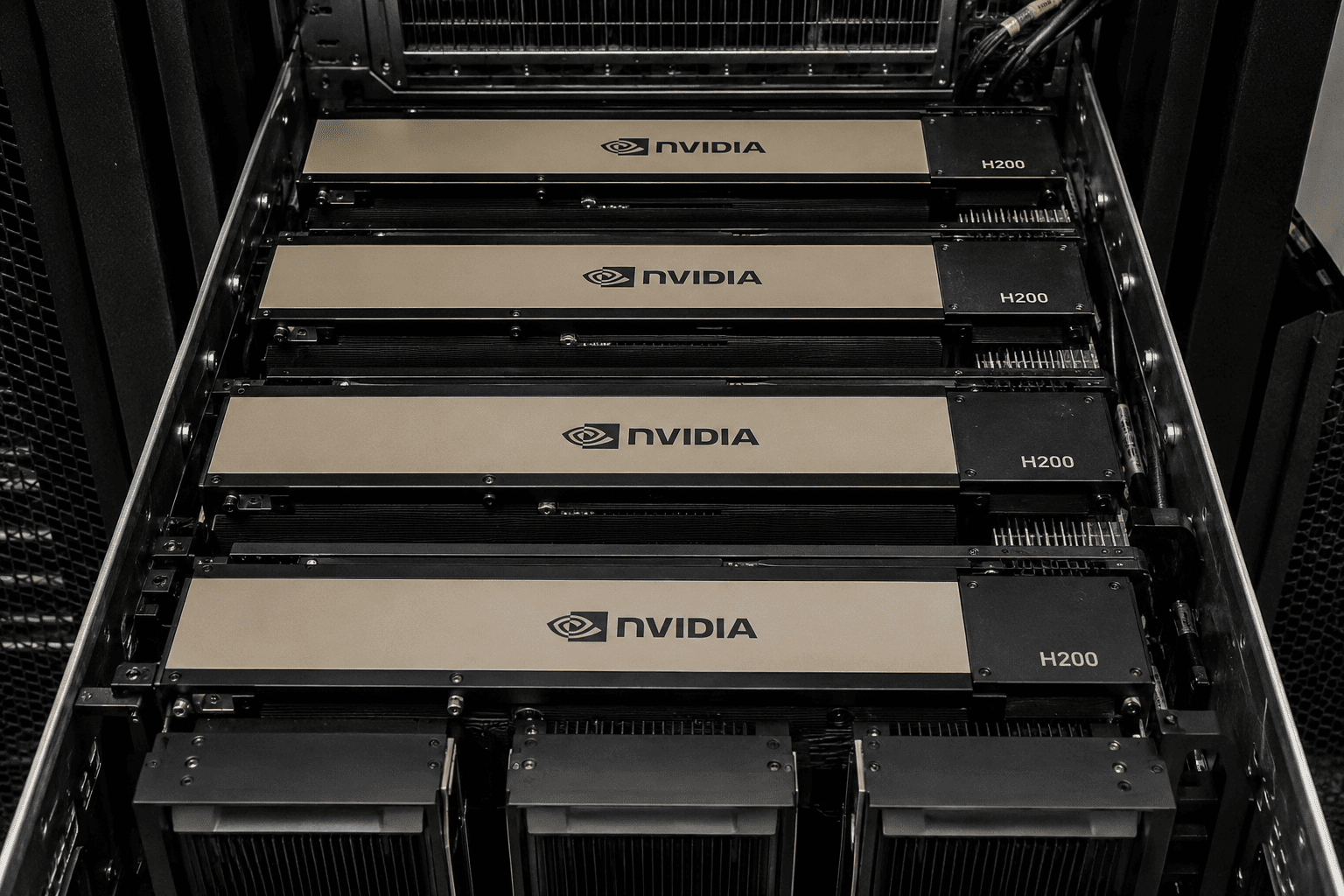
Nvidia (NASDAQ: NVDA) shares have been under pressure, heading into Wednesday's fiscal second-quarter 2027 earnings report with a potential seventh consecutive losing session. The stock slipped about 2.5% on Monday, putting it on track for its longest losing streak since September 2022, according to Dow Jones Market Data. Despite the recent slide, Nvidia is still up roughly 12% year-to-date, a modest gain compared with the 59% advance in the PHLX Semiconductor Index over the same period.
Cantor Fitzgerald analyst CJ Muse believes this disconnect presents an opportunity. In a Monday note to clients, Muse wrote that it is "time to close your eyes" and "bet big" on Nvidia's stock, arguing that once momentum returns, the shares could move "very, very fast." He set a price target of $350, implying about 67% upside from current levels.

Earnings estimates make valuation look cheaper
Muse's bullish case is partly based on Nvidia's earnings growth potential. He points to consensus estimates of $17 per share for calendar 2027 and $25 for calendar 2028. Based on those projections, Nvidia trades at roughly 14 times the 2027 estimate and 10 times the 2028 figure, which he argues makes the stock look inexpensive relative to its growth trajectory. He also notes that investors are currently "underweight" Nvidia, meaning the stock is less represented in portfolios than its market position would suggest.
Financing strategy as a competitive moat
The analyst's argument goes beyond simple GPU sales. Nvidia has increasingly used what Muse describes as "financial engineering," including equity stakes in AI companies like OpenAI and Anthropic, as well as revenue-sharing arrangements with neocloud providers such as CoreWeave and Nebius. While this strategy has drawn criticism, Muse sees it as a critical competitive advantage.
"This strategy is becoming increasingly critical and one that we believe will shine as we move further through today's robust AI infrastructure buildout," he wrote. By helping finance AI infrastructure, providing computing capacity, and participating financially in the companies building that infrastructure, Nvidia can create deeper relationships that are harder for competitors to disrupt. Muse argues that these moves, including plans to help raise as much as $500 billion for AI infrastructure, effectively turn Nvidia's GPUs "into a financeable, increasingly fungible asset class." That could make it more difficult for customers to switch to competing chips.
Five potential catalysts
Cantor Fitzgerald identified five catalysts that could change market perception of Nvidia. First, greater clarity around data-center revenue for 2027, as other companies have provided specific infrastructure spending targets while Nvidia has not. Second, additional information from Anthropic ahead of its expected fourth-quarter 2026 IPO, which could ease investor concerns about its recent annual recurring revenue. Third, more visibility into hyperscaler capital expenditure plans for 2027 and 2028. Fourth, sustained growth among neocloud providers, particularly if Nvidia continues using financing and revenue-sharing arrangements to support data-center expansion. Finally, the potential for GPUs to become standardized as a new asset class through financing agreements, broadening Nvidia's role beyond traditional semiconductor sales.
Custom chips remain a risk, but moat is widening
The biggest challenge to Nvidia's dominance comes from its largest customers, which are developing custom AI accelerators to reduce dependence on Nvidia. Muse believes the neocloud strategy offers some protection, as revenue-sharing agreements with neocloud companies could prove "much more resilient" because Nvidia is helping enable data-center deployments beyond the largest hyperscalers. The company is also expanding its customer base among enterprises and sovereign AI programs while moving toward selling complete AI systems that include racks, networking, and other components. That broader strategy could make Nvidia less vulnerable to losing a particular chip program.
Wall Street remains bullish ahead of results
Other analysts are also maintaining positive views. Rosenblatt Securities has a Buy rating and expects Nvidia's revenue and earnings to exceed consensus. Benchmark has reiterated its Buy rating with a $335 price target, expecting revenue of about $92 billion and earnings per share of $2.10. The earnings report will be an important test of whether Nvidia's fundamental growth can overcome concerns about valuation, custom-chip competition, and the sustainability of AI infrastructure spending. For Muse, the bigger opportunity lies in recognizing that Nvidia's competitive advantage may no longer be limited to its semiconductor technology.
As investors await the earnings release, the broader market is also watching. Recent chip stock slides and AI spending concerns have weighed on sentiment, but Muse's analysis suggests that Nvidia's financing strategy could be a key differentiator. The company's ability to embed itself in the AI ecosystem beyond chip sales may ultimately support its long-term growth.
This article is for informational purposes only and does not constitute financial advice.