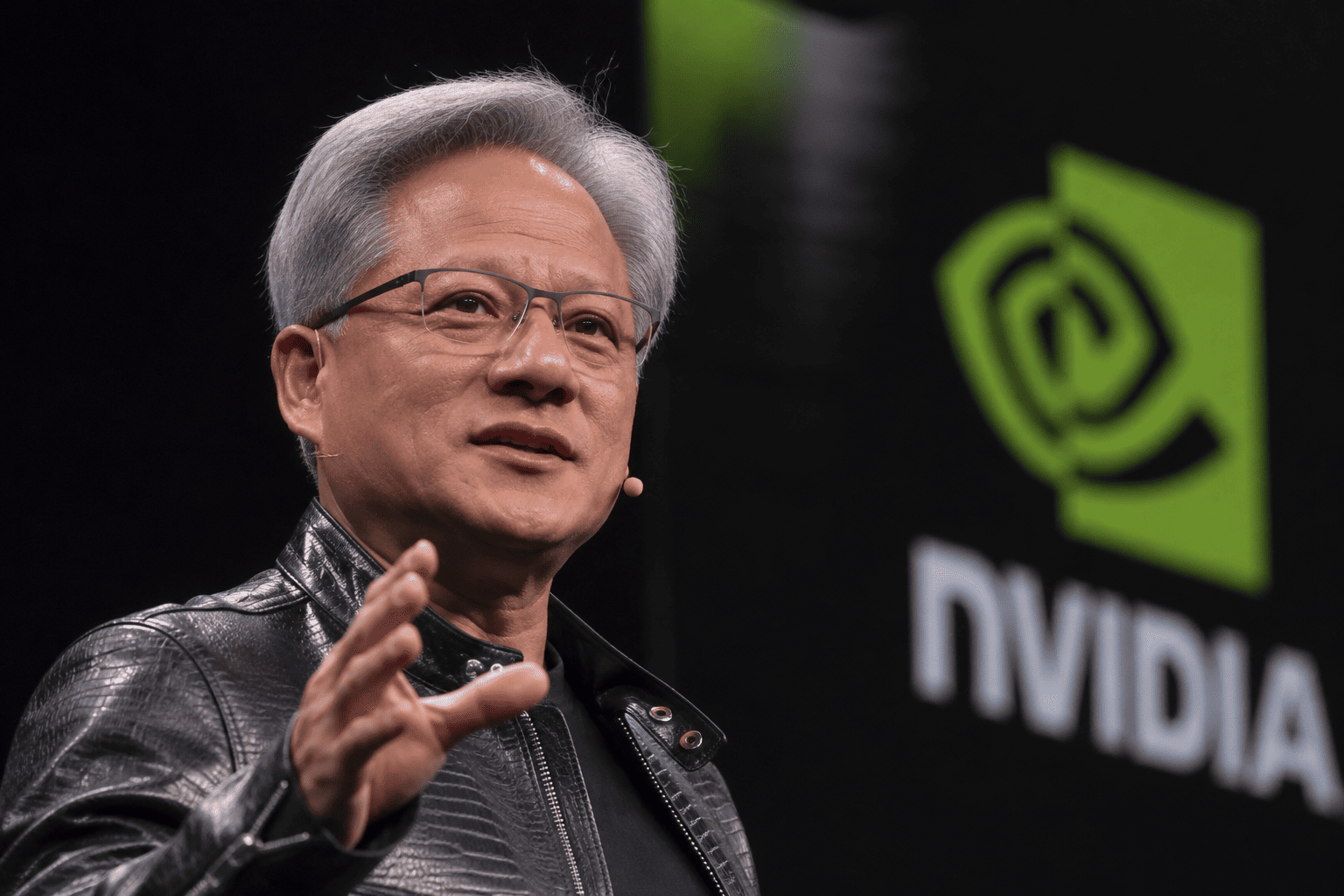
Nvidia's chief executive, Jensen Huang, sought to reassure investors at Goldman Sachs' Communacopia + Technology Conference, arguing that the company's investments in the AI ecosystem yield outsized returns. "I put in one, and a hundred comes back," he said, dismissing concerns that Nvidia is effectively financing its own customers. Despite this bullish rhetoric, Nvidia's stock (NASDAQ:NVDA) fell 2.37% to $218.36, marking a third consecutive decline.
Market context and broader sell-off
The drop was not isolated to Nvidia. The Nasdaq composite slipped 0.65% as Treasury yields approached 5% and oil prices surged, creating headwinds for growth stocks. This broader market pressure suggests the decline was not solely a reaction to Huang's comments, but rather a combination of macroeconomic factors and lingering investor skepticism.

Nvidia's expanding role in AI infrastructure
Huang rejected the notion that Nvidia's investments constitute circular financing. "It's not circular because we put a little bit of money in, and a lot of money comes back," he explained. The company has invested approximately $50 billion in AI labs and has provided guarantees up to $105 billion linked to OpenAI's Ohio data-center project, where Nvidia is the exclusive chip supplier. Additionally, a financing platform aims to mobilize roughly $500 billion in third-party capital.
David Wagner of Aptus Capital Advisors expressed confidence in the strategy, noting that major institutions like BlackRock, Blackstone, Apollo, and Goldman Sachs are supplying much of the capital. "Not worried about it at all," he told The Washington Post. Nvidia's approach effectively accelerates the infrastructure buildout that drives demand for its GPUs.
The independence question
Supplier financing is a well-established practice in industries like aerospace and telecoms, but Nvidia's scale and interconnectedness set it apart. The company can invest in an AI firm, support financing for its data center, supply the chips, and benefit as that customer expands. This creates a powerful flywheel, but also intertwines capital flows and demand in ways that could amplify risks.
Gary Tan of Allspring Global Investments highlighted this dynamic: "Capital is increasingly being used to fund future AI customers and infrastructure deployments." If AI spending slows, highly leveraged cloud operators may struggle to service debt, potentially leading to a cascade of reduced orders and financial strain.
Demand signals and double ordering
Nvidia's outlook remains robust, with revenue expected to grow about 70% in the next fiscal year. Goldman Sachs reiterated a Buy rating with a $300 price target, citing strong AI demand and supply dynamics. However, supply shortages can distort ordering behavior. Investor Dan Niles warned that large customers may request far more chips than they need, anticipating partial fulfillment. "They all double order," he said, complicating how investors interpret demand signals.
While Niles remains bullish on Nvidia, the potential for over-ordering adds a layer of uncertainty. As the AI buildout continues, investors will need to distinguish between genuine demand and speculative ordering.
For more on Nvidia's recent market moves, see Nvidia's slide amid oil surge and DOJ probe. Also, explore Nvidia and Palantir's sovereign AI initiative and Nvidia's potential next move ahead of Sept 10 event.
This article is for informational purposes only and does not constitute financial advice.

