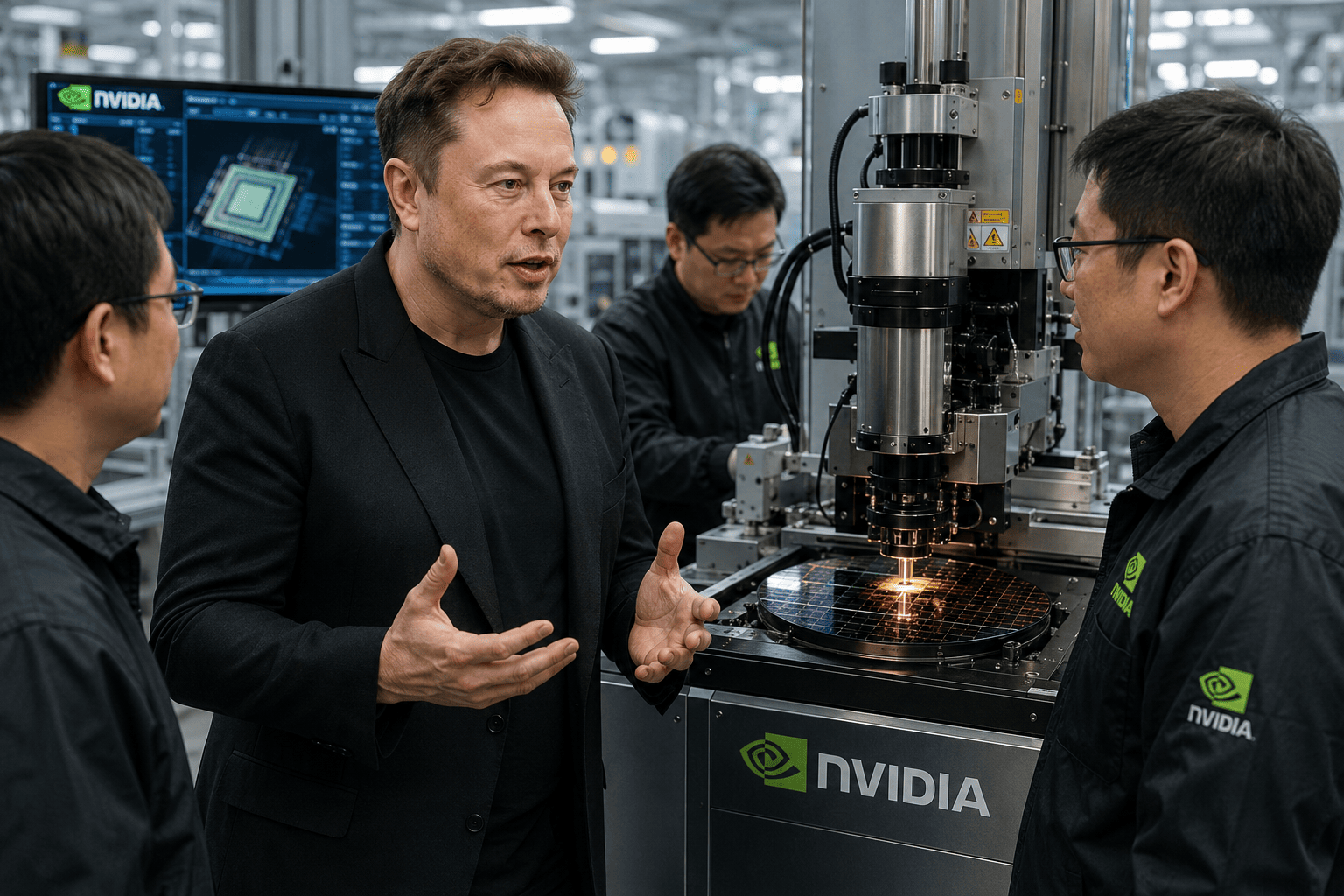
Nvidia (NVDA) shares advanced in premarket trading Wednesday after Elon Musk said during SpaceX's earnings call that the company would build its future artificial intelligence infrastructure exclusively with Nvidia. The stock gained roughly 2% ahead of the opening bell, even as several semiconductor peers traded lower.
Intel fell about 2%, while Broadcom and Marvell Technology slipped between 0.5% and over 1%, respectively. The comments also intensified selling pressure on Advanced Micro Devices (AMD), whose shares dropped approximately 9% in premarket trading despite reporting quarterly revenue and profit that exceeded Wall Street expectations.

Musk backs Nvidia for future AI buildout
During the call, Musk made clear that SpaceX had chosen Nvidia as its exclusive AI infrastructure partner going forward. "Going forward, we've decided to build exclusively on Nvidia, because we think the Vera Rubin architecture is the best architecture. We think it's the best AI computer, and we greatly value our close cooperation and partnership on many levels with Nvidia. We're exclusive to Nvidia," Musk said.
He added that SpaceX's computing deployment would continue expanding rapidly, quantifying its increasing demand for Nvidia. "Our efficiency of compute deployment, I think, is also the highest. We expect to end this year with over two gigawatts of compute. Probably our cumulative compute online by the end of next year will be several times higher. It may, let's say, be closer to 10 gigawatts of compute than five gigawatts of compute, as a way to think about it."
Later in the call, Musk indicated that Nvidia would remain a key supplier for the company's future expansion. "Our understanding with NVIDIA is that we will receive a very significant percentage of their GPUs next year." The remarks reinforced Nvidia's position at the center of the AI infrastructure boom, with demand for its latest-generation AI systems continuing to outstrip supply.
Cramer says Musk's statement overshadowed AMD's stellar earnings
Musk's endorsement comes at a crucial time for AMD. In May, Musk had said he expected Tesla and xAI to continue buying chips from semiconductor giants Nvidia and AMD, and possibly others. xAI is a part of SpaceX. Further, AMD had only recently highlighted that eight of the world's top 10 AI companies were running workloads on its Instinct GPU platform, including OpenAI, Cohere, and SpaceXAI, which operates within SpaceX.
Market commentators were quick to draw conclusions, calling it a veritable loss of business for AMD. "Musk going all in Nvidia... 'We think it's the best AI computer and we greatly value our close cooperation and partnership on many levels with Nvidia. So we're exclusive to Nvidia...' why the stock ran after the bell," CNBC host Jim Cramer wrote on X. He later added: "If Elon hadn't gone all in Nvidia with what could be the biggest set of orders in the history of Nvidia then AMD's stock would have been up last night. The loss of that business overshadowed ANOTHER MONSTER quarter from Lisa Su."
Endorsement for Nvidia, but AMD still grows rapidly
While the endorsement is a huge boost for Nvidia, it does not discount AMD's rapid rise as a challenger to the AI giant. AMD has steadily expanded its AI business over the past year in an effort to challenge Nvidia's grip on the data-center GPU market. Lisa Su said data-center sales are expected to more than double in 2027 and forecast revenue growth above the more than 35% target and annual earnings above its $20-per-share goal set at its 2025 analyst day.
The forecast suggests AMD's investments to challenge Nvidia's dominance in AI chips are beginning to bear fruit, with sales of its data-center processors accelerating in the second quarter. AMD's quarterly data-center revenue more than doubled to $6.72 billion, beating expectations of $6.48 billion. It grew 16.3% sequentially from $5.78 billion in the first quarter. Last month, the company introduced Helios, its first rack-scale AI system, positioning it as a direct competitor to Nvidia's Grace Blackwell and upcoming Vera Rubin platforms. Microsoft was among the customers announced for the system.
According to the Futurum Group, Nvidia controls more than 95% of the data-center GPU market, while AMD's share stands at roughly 4.5%. Still, some analysts believe AMD has a lot of room to grow. "I think there's a serious case in which AMD does great and can get to 20% and 25%. And by the way, this is hundreds of billions of dollars of revenue," Daniel Newman, analyst and CEO of the Futurum Group, said last month.
AMD has also secured several major AI-related agreements this year. In July, it agreed to supply Anthropic with tens of billions of dollars worth of AI servers powered by up to two gigawatts of MI450 chips beginning in early 2027, while also committing up to $5 billion to invest in the AI startup, subject to deployment milestones. The company also recently secured up to 2.5 gigawatts of data-center capacity through a deal with Core Scientific, underscoring its ambition to become a larger player in the rapidly expanding AI infrastructure market.
For more on SpaceX's financials, see SpaceX's first earnings reveal Starlink's hidden orbital cost burden. Also, check Nvidia's recent AI optimism and valuation and SpaceX's post-IPO stock drop.
This article is for informational purposes only and does not constitute financial advice.

