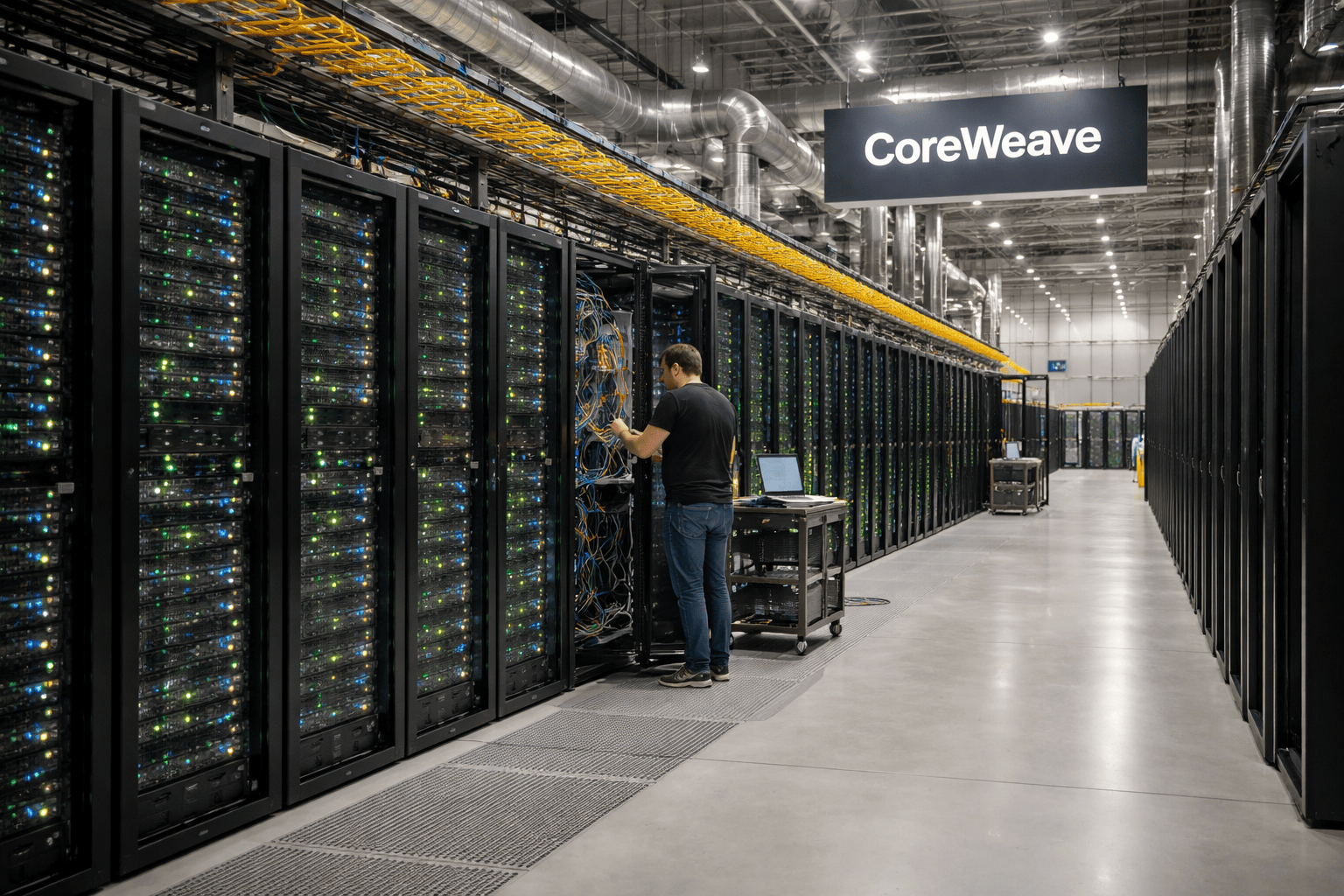
Shares of leading neocloud providers have tumbled sharply from their record highs, even as their top-line growth remains robust. CoreWeave, the sector's pioneer, has fallen to around $87 from its all-time high of $186, cutting its market capitalization from over $88 billion to roughly $49 billion. Nebius has retreated to $224 from a year-to-date peak of $300, while IREN, a Bitcoin miner pivoting to AI data centers, has dropped to $43 from $77. All three companies have received significant investments from Nvidia.
Demand remains strong
The latest earnings reports show these firms are experiencing exceptional demand for their GPU infrastructure. CoreWeave's revenue backlog has surged past $104 billion, driven by partnerships with Microsoft, Anthropic, OpenAI, and Jane Street. The company's revenue jumped 112% to $2.6 billion, with adjusted EBITDA reaching $1.5 billion. Analysts project annual revenue of $12.9 billion this year and $26.4 billion next year.

Nebius also posted impressive growth, with quarterly revenue rising over 400%, fueled by large contracts from Microsoft and Meta Platforms. Analysts expect Nebius to generate $3.34 billion in revenue this year and $12 billion next year. IREN is projected to bring in $2.8 billion this year and $7.2 billion next year.
Growth comes at a steep cost
The primary drag on these stocks is the escalating cost of expansion. The AI boom has driven up prices for GPUs, memory, servers, and optical systems, forcing companies to spend far more than initially planned. CoreWeave, for example, now expects capital expenditures between $35 billion and $39 billion this year, up from its earlier guidance of $30 billion to $35 billion.
To fund these outlays, neocloud firms are turning to both debt and equity markets. Nebius raised over $2 billion through a share sale in the second quarter and still has roughly 12 million shares available to sell. CoreWeave has accumulated more than $27 billion in debt over the past few months. Nebius, spun off from Russian search giant Yandex, has maintained a more conservative balance sheet.
Short interest and competitive pressures
These financial strains have attracted substantial short interest. Nebius has a short interest of 23%, while CoreWeave and IREN stand at 12.8% and 24%, respectively, indicating that many investors expect further downside.
Competition is also intensifying. SpaceX recently secured a large order worth $1.1 billion per month starting in December, and both Meta Platforms and Microsoft are beginning to lease out their excess computing capacity. Additionally, concerns about a potential AI bubble persist, with some industry leaders calling for a slowdown in the development of advanced AI models. These factors have contributed to the recent weakness in neocloud shares, as seen in the broader pressure on AI stocks.
Long-term outlook
Despite the near-term headwinds, these companies could emerge as significant free cash flow generators once their heavy capital investment phase winds down. The current spending spree is laying the groundwork for future profitability, but investors will need to weather the volatility in the meantime. The recent GPU shortage has boosted pricing, yet capex fears continue to weigh on sentiment.
As the market digests these dynamics, the neocloud sector remains a high-risk, high-reward play. The AI safety debate and calls for slower model development could further impact demand expectations. For now, the stocks are likely to remain under pressure until capital spending peaks and profitability becomes more tangible.
This article is for informational purposes only and does not constitute financial advice.

