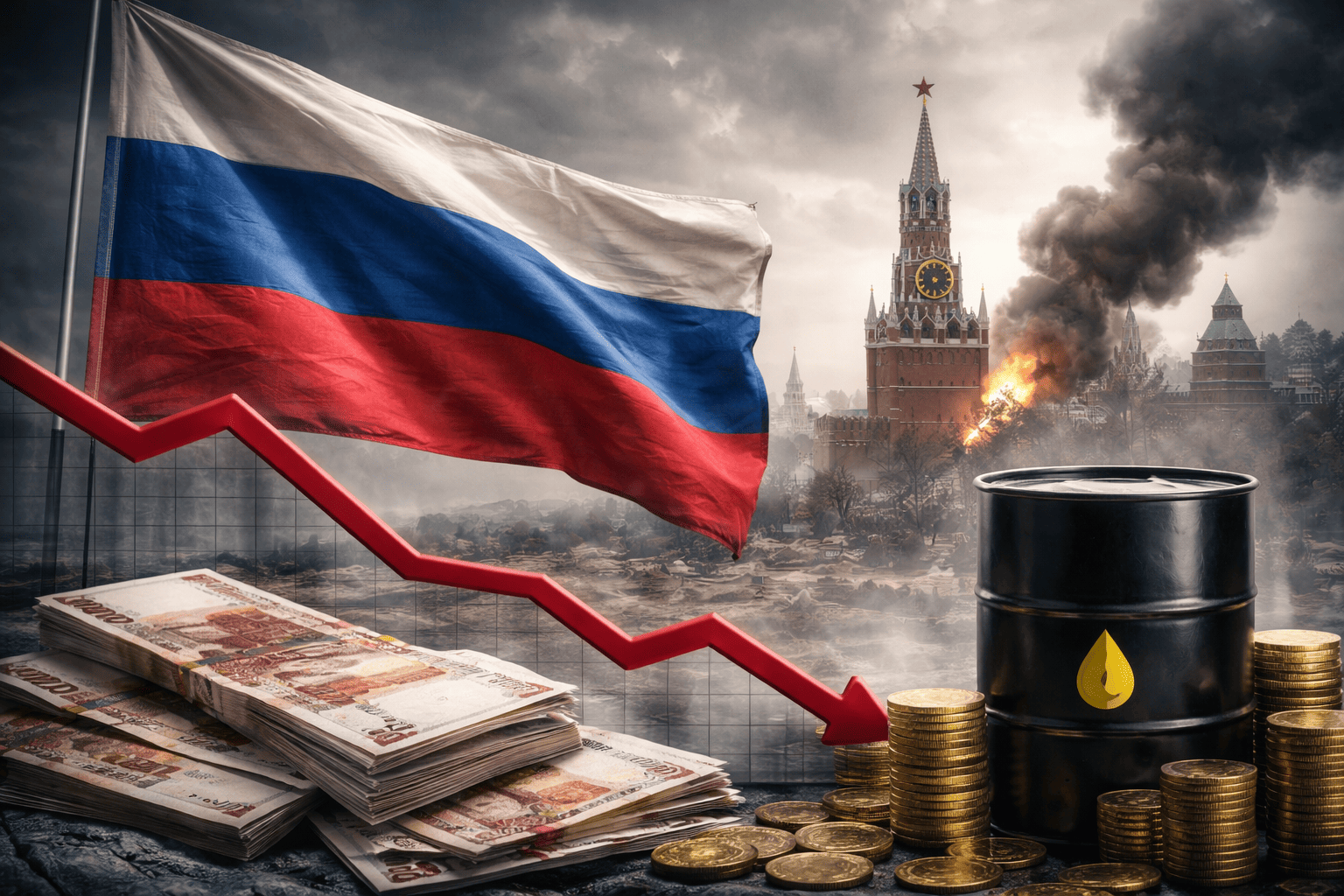
The MOEX Index has fallen more than 10% from its year-to-date peak, while the Russian ruble has weakened to its lowest level since April, as mounting economic strains from the ongoing conflict with Ukraine weigh on investor sentiment. The USD/RUB pair surged to 78.6860, a level not seen in months, as capital outflows accelerated.
Ukraine's Intensified Campaign Hits Russian Assets
Investors are increasingly shunning Russian equities and currency as Ukraine escalates its military operations. President Volodymyr Zelensky recently announced a 40-day campaign of sustained strikes against key Russian infrastructure, aiming to pressure Moscow into negotiations. Crimea has declared a state of emergency, and several major Russian cities are experiencing severe energy shortages. Ukrainian forces have also targeted critical oil refineries, disrupting domestic fuel production and export capacity.
In response, Russia has imposed a ban on diesel exports to ensure local supply, and President Putin has formed a task force to manage energy distribution. However, the risk of further attacks on western Russian ports remains high, threatening additional disruptions to trade flows.
Budget Deficit Doubles as Oil Revenues Slide
The fiscal picture has deteriorated sharply. Russia's budget deficit reached over 6 trillion rubles ($81.4 billion) in the first five months of the year—double the shortfall recorded in the same period last year. The shortfall is exacerbated by falling crude oil prices; Urals crude has dropped to around $57 per barrel, underperforming global benchmarks Brent and WTI. Since energy companies dominate the MOEX Index, the decline in oil revenues directly pressures both the stock market and government finances.
For context on broader market trends, see our analysis on Retail Investors Shift from Broad Index Bets to Selective Trades Amid Market Rotation.
Central Bank Cuts Rates Amid Economic Contraction
The Bank of Russia has adopted a relatively accommodative stance, cutting its key interest rate by 25 basis points to 14.25%—a smaller reduction than the 50 basis points many analysts had anticipated. The central bank aims to stimulate an economy that contracted by 0.2% in the first quarter of this year. However, the modest rate cut reflects the delicate balance between supporting growth and containing inflation risks from a weakening ruble.
Technical Outlook: MOEX Index and USD/RUB
The MOEX Index has broken below its 50-day and 100-day exponential moving averages, and the MACD indicator has crossed below the zero line, signaling bearish momentum. The path of least resistance appears lower, with a potential decline toward the 150 level if selling pressure persists.
Meanwhile, the USD/RUB pair has rallied above the 74.60 resistance level—the neckline of a double-bottom pattern—and is now trading above both the 50-day and 100-day moving averages. A continued advance could target the 85 area, especially if the US dollar remains strong. For related currency moves, see USD/ZAR Falling Wedge Signals Potential Rand Pullback Amid Oil Price Surge.
Investors should also monitor broader emerging market dynamics, as discussed in Hang Seng Index Drops 10% in H1 as Nikkei, Kospi Surge on AI Demand.
This article is for informational purposes only and does not constitute financial advice.