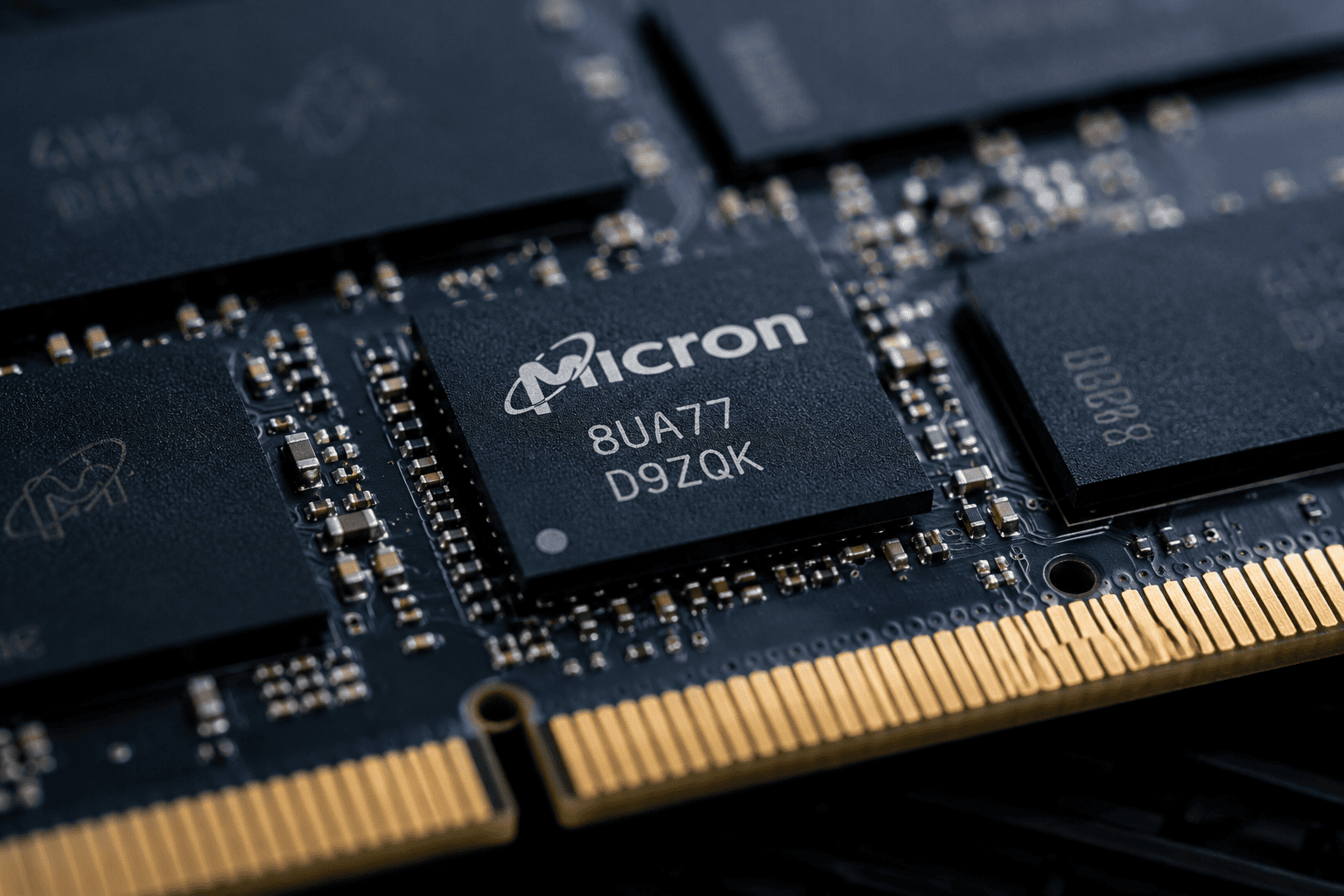
Micron Technology (MU) has experienced one of its most turbulent periods in recent memory, leaving investors to question whether the AI-driven memory boom can sustain the chipmaker's record earnings. Although the stock has rebounded 12% over the past five sessions, it remains roughly 30% below its all-time high of $1,255 reached on June 25 following the company's fiscal third-quarter earnings report.
Shares closed Friday at $877.57 after suffering a 29% decline in July, marking their worst monthly performance since June 2015. The steep retreat has reignited debate over whether Micron's correction presents an attractive buying opportunity or reflects mounting concerns that the AI memory supercycle is beginning to lose momentum.

Investors question how long the memory boom can last
Micron's recent selloff has not been driven by deteriorating business fundamentals. The company continues to benefit from unprecedented demand for high-bandwidth memory (HBM) chips used in artificial intelligence servers, while earnings remain near record levels. Instead, investors have become increasingly concerned about how long current industry conditions can persist.
Following months of rapid gains, Micron's valuation had begun pricing in several years of elevated memory prices, expanding profit margins, and sustained AI spending. Those expectations have come under pressure as concerns grow over rising industry capital expenditure, additional manufacturing capacity, and intensifying competition from Chinese memory producers. The broader AI trade also experienced heightened volatility throughout July as investors reassessed whether hyperscale cloud companies could continue spending aggressively on AI infrastructure.
James Foord sees limited downside after the correction
Despite the sharp decline, some investors argue that the market has become overly pessimistic. James Foord, investment manager at Five Arrows and one of TipRanks' top-ranked stock experts, believes Micron now offers an attractive risk-reward profile. According to TipRanks, Foord believes "the stock is now too cheap to ignore," citing the company's improving balance sheet and robust cash generation.
A key pillar of his investment case is Micron's growing ability to return cash to shareholders. Management has indicated that it intends to accelerate capital returns, while Foord estimates the company could theoretically repurchase between 8% and 19% of its outstanding shares over the next two years. While acknowledging that such projections remain speculative because significant buybacks would likely affect the share price itself, Foord argues that the company's financial strength gives it considerable flexibility.
"Micron has so much to give back to investors that it makes the stock really attractive," he said. Perhaps more importantly, Foord argues that investors do not need today's extraordinary memory conditions to persist indefinitely for the investment thesis to remain compelling. Under what he describes as a conservative scenario, which assumes meaningful margin compression and no recovery in Micron's valuation multiple, the company could still retire more than 8% of its shares while trading at roughly 14.5 times projected fiscal 2028 earnings. That would leave Micron trading below its historical valuation despite assuming substantially weaker profitability than current levels.
"The current price is pretty much pricing in the worst-case scenario," Foord said. Although he acknowledges that expanding industry capacity, increased Chinese competition, and weaker memory pricing could pressure profitability over time, he believes much of that downside is already reflected in today's valuation. "The stock really can't go much lower at this point," he argued, adding that stronger-than-expected memory conditions could produce considerably better returns. Foord ultimately concludes that investors can "buy Micron now with little downside risk."
Citi trims target but remains bullish
Wall Street has also become more cautious on the pace of future memory pricing while maintaining a constructive long-term view. Citi on Friday lowered its price target on Micron shares to $1,150 from $1,400 while reiterating its Buy rating, citing mixed earnings from memory peers SanDisk and Western Digital and expectations for moderating DRAM and NAND pricing next year. "We trim MU TP to $1,150 from $1,400 based on 8x P/E vs prior 10x times revised C27 EPS to reflect lower market multiples on mixed memory peer results," the analyst wrote.
The revision followed meetings with supply-chain participants and industry experts during the Future of Memory and Storage conference. While Citi continues to expect both DRAM and NAND prices to rise, it believes the pace of gains will gradually slow. "We see both DRAM and NAND prices decelerating Q/Q in the next four quarters with prices peaking in Q2 of next year," the analyst said. Because memory stocks tend to trade on expectations for future pricing rather than current profitability, investors remain highly sensitive to any signs that pricing momentum could weaken.
KeyBanc event may provide stock catalyst as analysts remain bullish
Despite July's sharp correction, analyst sentiment toward Micron remains overwhelmingly positive. According to Wall Street consensus estimates, 29 of 30 analysts covering the company currently recommend buying the stock, with only one maintaining a Hold rating. That gives Micron a Strong Buy consensus, while the average price target stands at $1,560.74, implying roughly 78% upside from Friday's closing price.
Near-term catalysts could also influence investor sentiment. Micron management is scheduled to present at the KeyBanc Capital Markets Technology Leadership Forum, which could provide clarity on the company's outlook. As the AI memory trade continues to evolve, investors are closely watching for any signals that could either validate or challenge the current bullish consensus. For more context on the broader AI memory landscape, see SpaceX's AI spending spree and recent price target cuts.
This article is for informational purposes only and does not constitute financial advice.