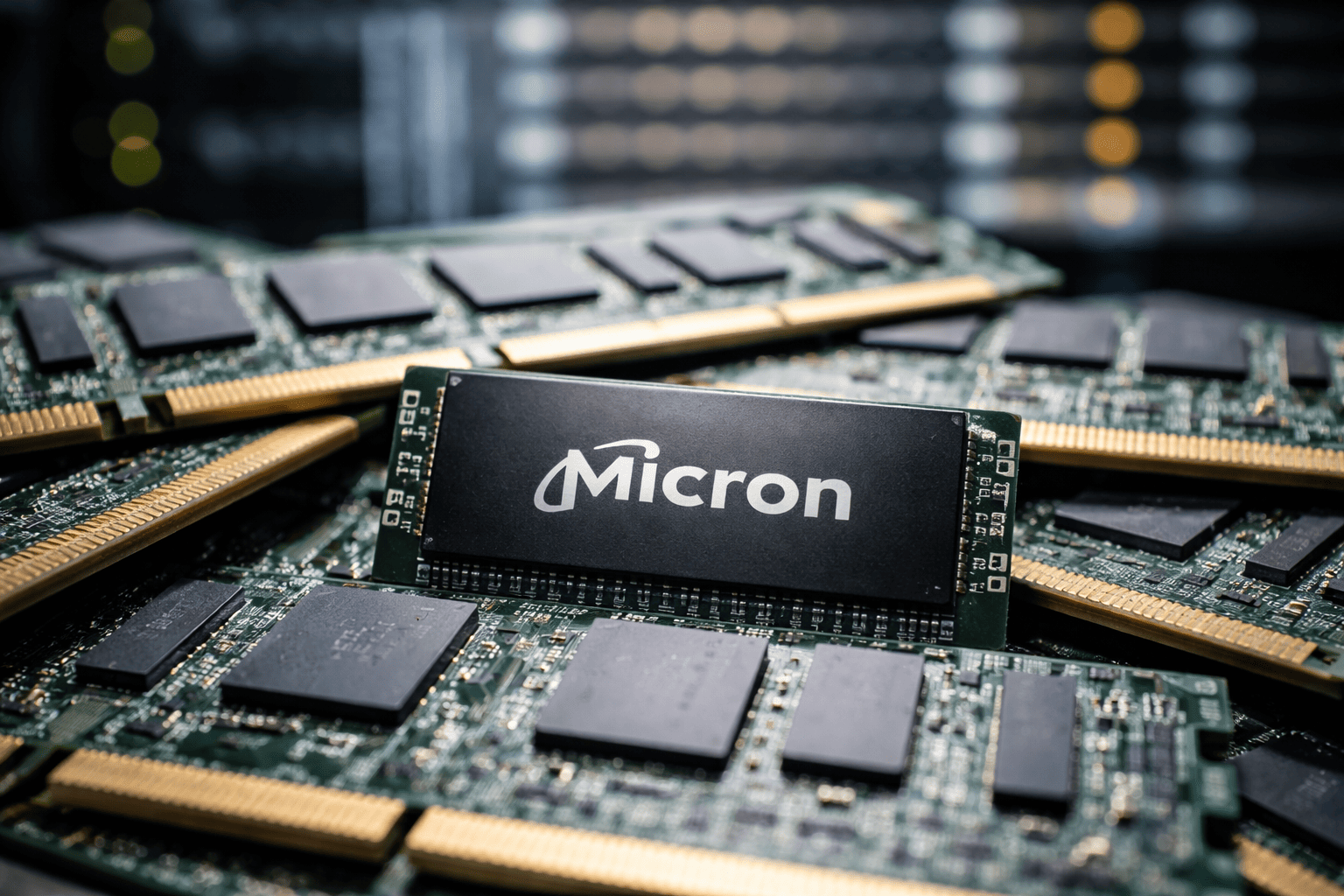
Micron Technology (MU) shares climbed 3.3% on Thursday, buoyed by two major catalysts from the latest earnings reports of Alphabet and Tesla. The gains helped reverse a recent slump, with the stock having fallen nearly 9% over the past month. SK Hynix's American Depositary Receipts surged 6.2% in sympathy.
Alphabet's Capex Boost Reassures Investors
Alphabet, Google's parent company, raised its 2026 capital expenditure guidance to a range of $195 billion to $205 billion, up from the prior $180 billion to $190 billion. The revised outlook exceeded analysts' consensus estimate of approximately $188 billion, according to Visible Alpha. CFO Anat Ashkenazi cited an acceleration in capacity delivery to meet growing demand, noting that the company remains in a supply-constrained environment with strong demand from both external cloud customers and internal business units.
The increased spending plan alleviated concerns that AI infrastructure investment might slow after months of heavy outlays by big tech firms. For memory chip makers like Micron and SK Hynix, this signals sustained demand for high-bandwidth memory (HBM) and other advanced chips critical for AI workloads. The broader market also reacted positively, with the Kospi surging 3% as Asian chip stocks rallied on the news.
Tesla's Public Acknowledgment Highlights Micron's Role
During Tesla's second-quarter earnings call, CEO Elon Musk publicly thanked Micron for providing memory allocation, adding that memory pricing has become “pretty insane” due to surging demand. He also acknowledged TSMC and Samsung for their support. The comments underscored the growing importance of advanced memory in AI systems, which require large amounts of high-speed memory to train and deploy sophisticated models.
Musk discussed Tesla's plans to build a Terafab, a semiconductor development facility that would integrate logic, memory, lithography, packaging, and testing to accelerate custom AI chip production for projects like Optimus. This highlights that access to memory is now a critical bottleneck in AI hardware development.
Despite the positive mention, Tesla stock fell 13% on Thursday after adjusted earnings missed expectations. For a deeper look at Tesla's earnings and AI spending impact, see Tesla Stock Drops 4% as Q2 Earnings Reveal AI Spending Squeeze on Margins.
Memory Demand Remains Central to AI Expansion
The twin developments from Alphabet and Tesla reinforce the thesis that memory chip demand will remain robust as AI infrastructure investments continue across the technology industry. Alphabet's capex increase directly supports data center expansion, which drives demand for DRAM and NAND flash. Meanwhile, Tesla's acknowledgment highlights that even automotive and robotics AI applications require dedicated memory allocation.
Investors should note that while Micron and SK Hynix are direct beneficiaries, the memory sector has seen significant volatility. The recent DRAM ETF inflows surged as the sector rebounded, but concentration risks remain. Alphabet's own stock slid despite the capex news, as investors weighed negative free cash flow implications—detailed in Alphabet Stock Slides as $205B Capex Plan and Negative FCF Overshadow Cloud Surge.
For investors, the key takeaway is that AI-driven demand for memory appears durable, supported by concrete spending commitments from major tech players. However, market reactions can be mixed, as seen with Tesla's earnings miss and Alphabet's stock decline, underscoring the need to monitor broader earnings trends.
This article is for informational purposes only and does not constitute financial advice.