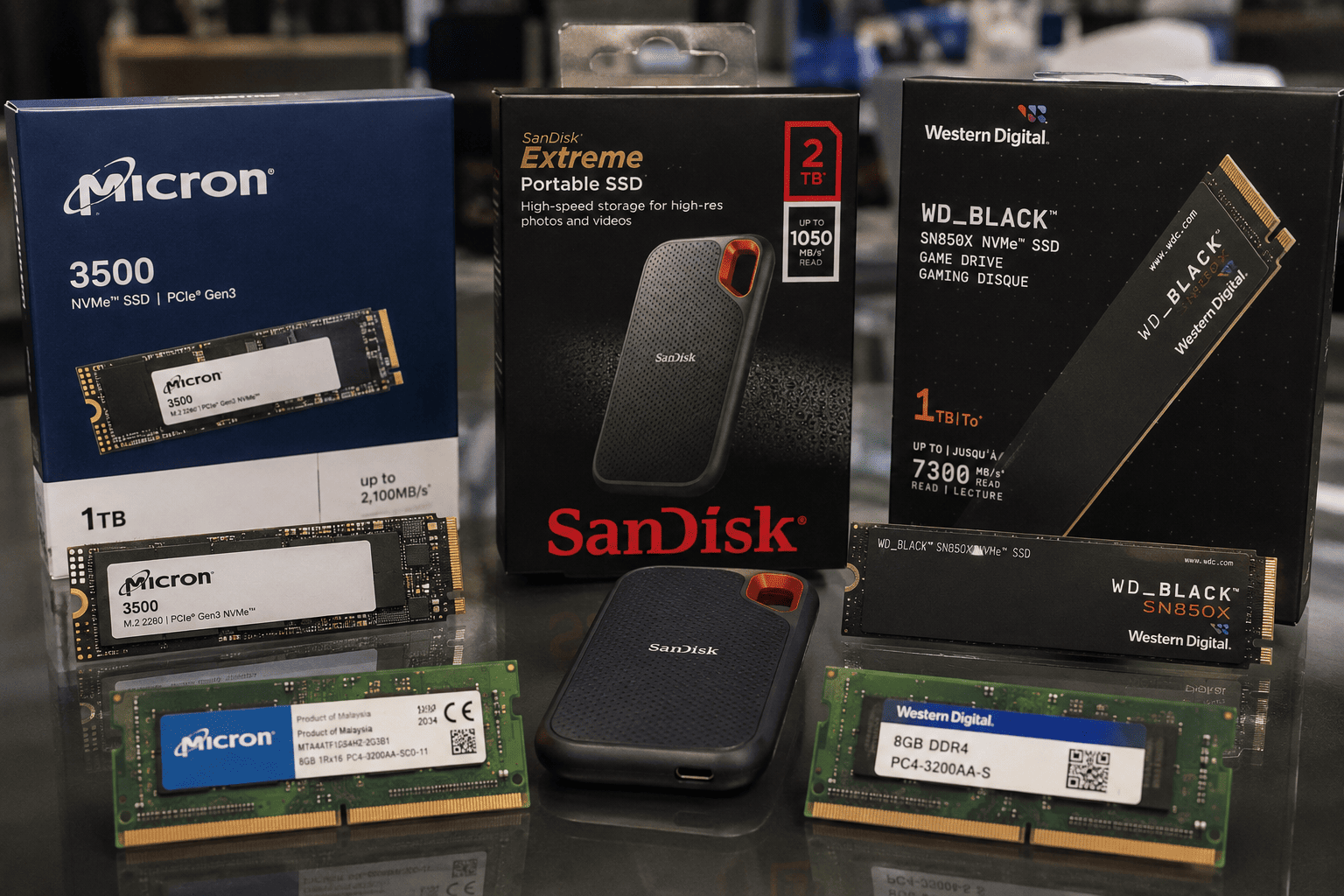
Memory stocks traded lower on Thursday even as Nvidia's blockbuster earnings reinforced the strength of artificial intelligence demand. Micron Technology (MU) slipped 2%, SanDisk (SNDK) lost 1.7%, and Western Digital (WDC) dropped 2.7%, as investors focused on company-specific challenges rather than the broader AI tailwind.
Nvidia reported fiscal second-quarter revenue of $96.22 billion, up 106% year over year, with data-center revenue reaching $89 billion. The company guided current-quarter revenue to $108 billion, plus or minus 2%, signaling sustained demand for AI infrastructure. That outlook initially lifted tech stocks, but memory names failed to hold gains.

Micron's HBM ramp faces scrutiny
Micron's connection to Nvidia is direct: high-bandwidth memory (HBM) is essential for AI accelerators. Micron began volume shipments of its 36-gigabyte HBM4 in the first quarter for Nvidia's Vera Rubin platform. The chip delivers over 2.8 terabytes per second of bandwidth and is more than 20% more power-efficient than its predecessor, HBM3E.
Micron's own financials show robust growth. Fiscal third-quarter revenue jumped to $41.46 billion from $23.86 billion in the prior quarter. Operating cash flow more than doubled sequentially to $25.39 billion, and adjusted free cash flow reached $18.3 billion. Despite these numbers, the stock fell, suggesting investors are questioning whether Micron can convert Nvidia's demand into proportional HBM shipments, pricing power, and margin expansion.
Scaling HBM output to match Vera Rubin's production ramp is a key test. At the same time, Micron must manage conventional memory capacity to avoid a supply glut. Analysts remain largely bullish: BMO initiated coverage with a $1,300 price target on August 20, while Mizuho trimmed its target to $1,300 from $1,375 on August 25. The average target among 47 analysts surveyed by S&P Global is $1,515, with 43 rating the stock Buy or Strong Buy.
SanDisk and Kioxia's $31B Japan investment
SanDisk faced additional pressure after announcing a massive capital expenditure plan. Kioxia and SanDisk said they will invest more than $31 billion in Japan through 2032, subject to government support. The funds will expand infrastructure at Kioxia's Yokkaichi and Kitakami plants and support related technology development.
The companies said the investment is aimed at supporting multi-year flash memory supply growth and meeting demand for NAND flash. Over the past 25 years, the joint venture has invested more than $50 billion in Japan. In January, the partners extended their collaboration at the Yokkaichi Plant through December 2034.
Western Digital also declined, falling 3.6% to $452. Summit Insights downgraded the stock to Hold from Buy, adding to the negative sentiment. The pullback came after an initial rally in memory and storage names following Nvidia's forecast.
Investors are now weighing the long-term supply picture. Nvidia's warning about a memory crunch through 2028 has boosted some names, but the scale of new investment and potential oversupply remain concerns. For a broader view, see Samsung and SK Hynix's surge and SanDisk's premarket reaction.
The divergence between Nvidia's strength and memory stocks' weakness highlights the market's focus on execution and supply-demand balance. While AI demand is robust, memory makers must navigate capacity expansion, pricing dynamics, and potential oversupply risks.
This article is for informational purposes only and does not constitute financial advice.