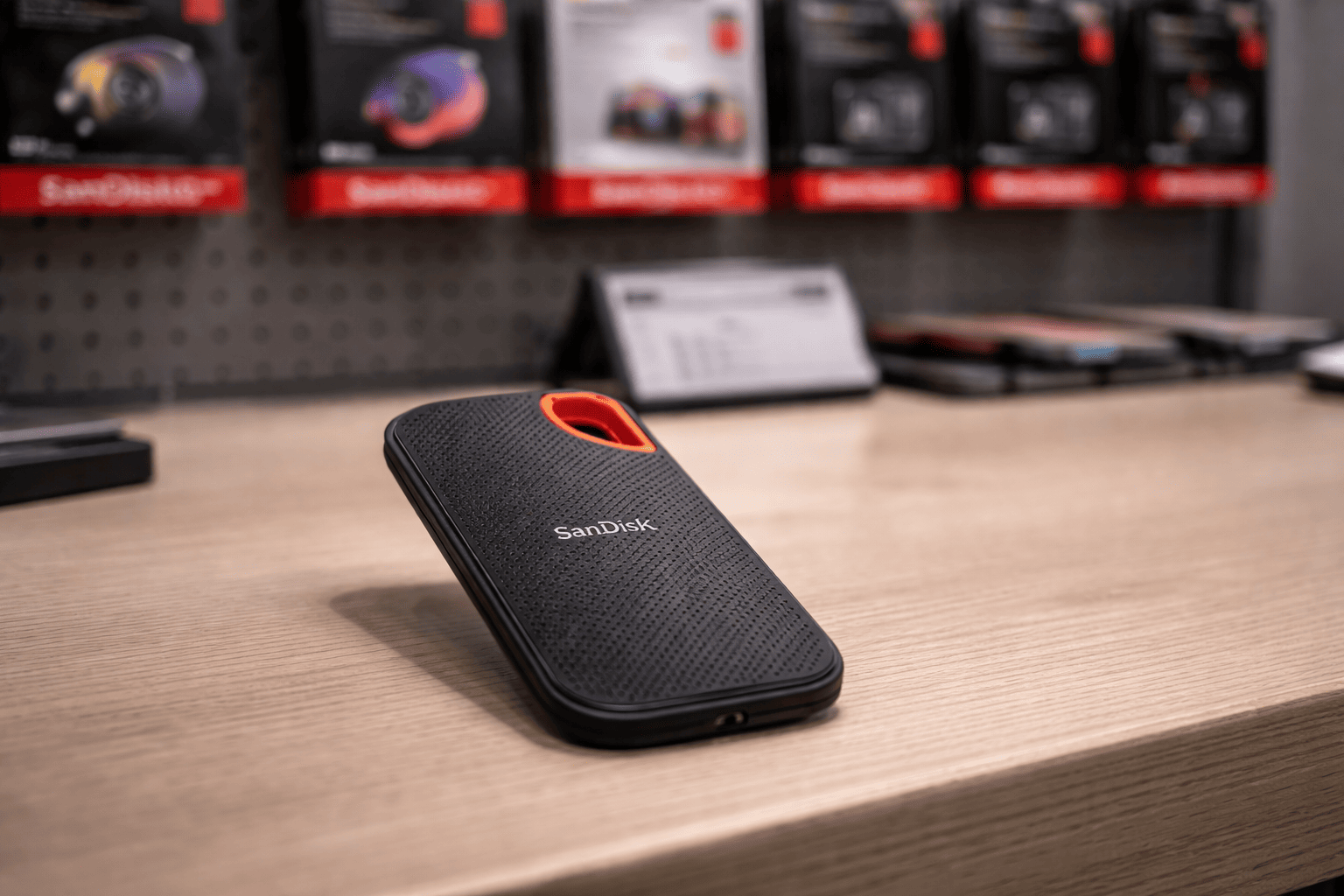
SanDisk (NASDAQ: SNDK) shares climbed nearly 5% in premarket trading on Thursday, extending gains after Nvidia's earnings commentary pointed to persistent memory supply constraints. The move underscores how Nvidia's challenges are being interpreted as a tailwind for memory manufacturers.
Nvidia's finance chief, Colette Kress, said memory shortages are limiting the company's ability to meet demand and pressuring gross margins. The chip giant expects adjusted gross margin to decline from about 75% in fiscal Q2 to 74% in Q3, and to bottom around 71%-72% in Q4. This warning has been read by investors as evidence that memory pricing power remains strong, which could directly benefit NAND producers like SanDisk.

SanDisk closed Wednesday at $1,499.37, up 1.3%, and then rose 3.7% in after-hours trading before Thursday's premarket surge. The stock has been volatile recently, trading above $1,825 earlier this month and below $1,000 in late July, reflecting shifting expectations about the memory cycle.
Nvidia's memory problem could become SanDisk's opportunity
Nvidia expects demand to keep accelerating, but Kress warned that soaring memory prices and higher component costs will squeeze margins. Investing.com analyst Thomas Monteiro told MarketWatch that memory inflation is "mostly cyclical," but added that such cycles have a "habit of lasting longer than expected." With only a few major memory producers controlling supply, manufacturers retain substantial pricing power.
That pricing power is the direct read-through for SanDisk. Stronger NAND pricing can support revenue and margins even as those costs squeeze customers buying memory-intensive AI systems. Thursday's move therefore reflects more than just sympathy with Nvidia—investors are treating Nvidia's warning as evidence that tight industry conditions may persist longer than previously assumed.
Wall Street sees AI changing the old NAND cycle
Bernstein analyst Mark Newman recently called SanDisk's High Bandwidth Flash (HBF) technology a "game changer for AI and the memory industry" and maintained an Outperform rating with a $3,000 price target. Newman argues that HBF could require three to four times more factory space per exabyte than conventional NAND, potentially consuming wafer capacity and causing shortages to last "far longer than even the bulls expect."
JPMorgan analyst Harlan Sur resumed coverage with an Overweight rating and a December 2027 target of $2,250. Sur said SanDisk is "uniquely positioned" to benefit from the structural increase in NAND demand driven by AI inference. He also highlighted eight long-term customer agreements representing about $94 billion in total contract value at floor pricing, which could provide more earnings visibility than investors historically associate with commodity memory producers.
A rally is easier than proving the shortage will last
The risk is that memory remains cyclical because strong pricing encourages more investment. SanDisk and Kioxia said they plan to invest more than $31 billion in Japan through 2032 to expand semiconductor technology and production capacity as AI demand rises. The programme depends partly on Japanese government support.
New capacity gives SanDisk more ability to capture AI growth, but it also creates the longer-term question investors cannot ignore: could supply eventually expand faster than demand? For now, the market is betting that the current tightness will persist, but history suggests that memory cycles can turn quickly.
Related coverage: Samsung and SK Hynix also rallied on Nvidia's memory comments, and Nvidia's own stock slipped despite beating estimates. Investors are also watching Marvell's earnings as the next AI demand test.
This article is for informational purposes only and does not constitute financial advice.