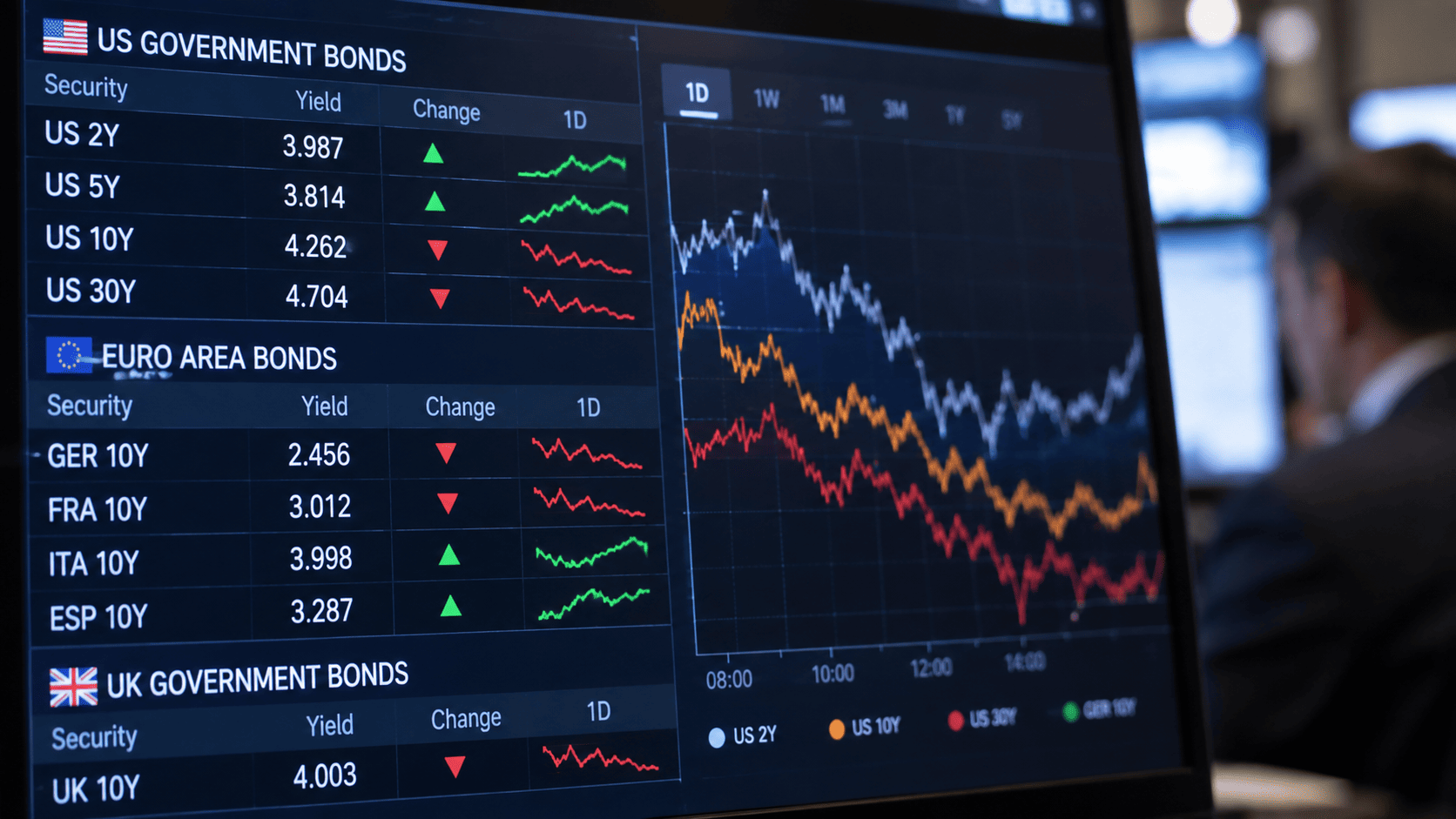
Global bond markets took a breather on Thursday as the Federal Reserve's first interest rate hike since 2023 provided some clarity, pulling the 10-year U.S. Treasury yield off its recent highs and ending an eight-day streak of gains. Investors now turn their attention to the Bank of Japan's policy decision, which could set the tone for the next phase of the global rates repricing.
The 10-year Treasury yield fell about three basis points to 4.99% in early trading, before easing further to 4.988% by 6:54 a.m. EDT. The retreat followed a week of heavy selling that had pushed average global government bond yields to a 19-year high. Yields on comparable Australian bonds also slipped about three basis points, while Japanese 10-year yields declined by less than one basis point.

However, British government bond yields, or gilts, rose across maturities on Thursday morning as investors digested the Bank of England's latest interest rate decision, which added a regional twist to the global picture.
Fed hike brings temporary relief
The Federal Reserve raised its benchmark rate by 25 basis points on Wednesday to a target range of 3.75%-4%, its first increase since July 2023. The move was widely anticipated after a series of elevated inflation readings and mounting pressure in the bond market. Long-term yields, which had touched multi-year highs during the selloff, eased as investors reassessed their inflation expectations.
U.S. inflation remains well above the Fed's 2% target, keeping the possibility of further tightening in focus. "The Fed had no choice but to give the market a hike or risk a much bigger bond market selloff," said Byron Anderson, head of fixed income at Laffer Tengler Investments, in a Bloomberg report. "The market narrative is on a collision course with the Fed from here on out, which means more volatility. A single rate cut is not going to placate this bond market for long and will not solve inflation."
Warsh signals more rate hikes possible
Fed Chairman Kevin Warsh said during Wednesday's press conference that inflation has been "too high ... for too long." "We must be confident that underlying inflation is moving to our objective clearly and at sufficient speed," he said, adding that the Federal Open Market Committee had decided "this standard has not been satisfied."
Fed officials also signaled that another rate hike could come this year. The latest projections showed 16 of 18 officials expected another increase, while four saw the possibility of two additional hikes. Meanwhile, traders see a 51% chance of another Fed increase at the October meeting, up from nearly 44% a day earlier, according to the CME FedWatch tool.
"The history is clear that once the Fed begins raising rates, they do it multiple times; but the pattern is less clear about whether they will raise rates at consecutive meetings or leave rates unchanged at some of the meetings in between," said Chris Zaccarelli, chief investment officer at Northlight Asset Management, in a Reuters report.
The Fed's preferred inflation gauge stood at 3.7% in July, close to its highest level since 2023 and well above the central bank's 2% target. Warsh said summer inflation readings had not provided evidence that underlying price pressures had meaningfully improved. The central bank's stance has added to uncertainty over how far borrowing costs may rise, particularly after the recent surge in longer-term yields. Warsh also cited stronger economic growth, increased capital spending by large technology companies, and geopolitical tensions as contributors to higher long-term borrowing costs.
What happens to bond yields now?
Bob Edwards, chief investment officer at Florida-based Edwards Asset Management, said in an emailed note on Thursday that the bond market's biggest moves "are likely now in the rearview mirror." "There is now a good opportunity for investors after this big move to lock-in these elevated yields," he said in a report by CNBC. "If the Fed raises rates again, it would likely be at the December meeting, as the Fed is unlikely to announce interest rate changes at the October meeting, which is days before the midterm elections, for fear of appearing political."
Hebe Chen, a market analyst at Vantage Global Prime, said the latest developments could have lasting implications for bond markets. "For the bond market, this is likely to cast a long shadow rather than create a short-lived storm," she said in the Bloomberg report. "The front end now has to price the possibility of further Fed tightening, while the long end is already wrestling with inflation, heavy issuance and fiscal concerns — meaning even when the initial volatility settles, the gravitational pull of higher yields may remain."
BOJ decision comes into focus
Investors are now turning to the Bank of Japan, which began its two-day policy meeting Thursday. All BOJ watchers surveyed by Bloomberg expect the central bank to raise its policy rate to 1.25% from 1%. U.S. Treasury Secretary Scott Bessent has expressed strong support for Japan's decisive market and monetary steps to address the substantial undervaluation of the yen, according to a readout.
With markets having largely priced in a rate hike, attention is now turning to any signals BOJ Governor Kazuo Ueda may offer on the timing and pace of future increases. "Markets are divided between those who see hawkish BOJ communication as helping lower bond yields by alleviating concern it is behind the curve on inflation, and others who see it as lifting yields by moving up terminal-rate bets," said Katsutoshi Inadome, a strategist at Suwa Trust Bank.
The BOJ's decision could have ripple effects across global bond markets, especially given the recent divergence in yields between major economies. Meanwhile, the Fed's path remains uncertain, with gold holding above $4,300 as investors weigh the central bank's next move. The TLT ETF has dropped to a seven-month low despite significant inflows, reflecting the ongoing pressure on long-duration bonds.
This article is for informational purposes only and does not constitute financial advice.

