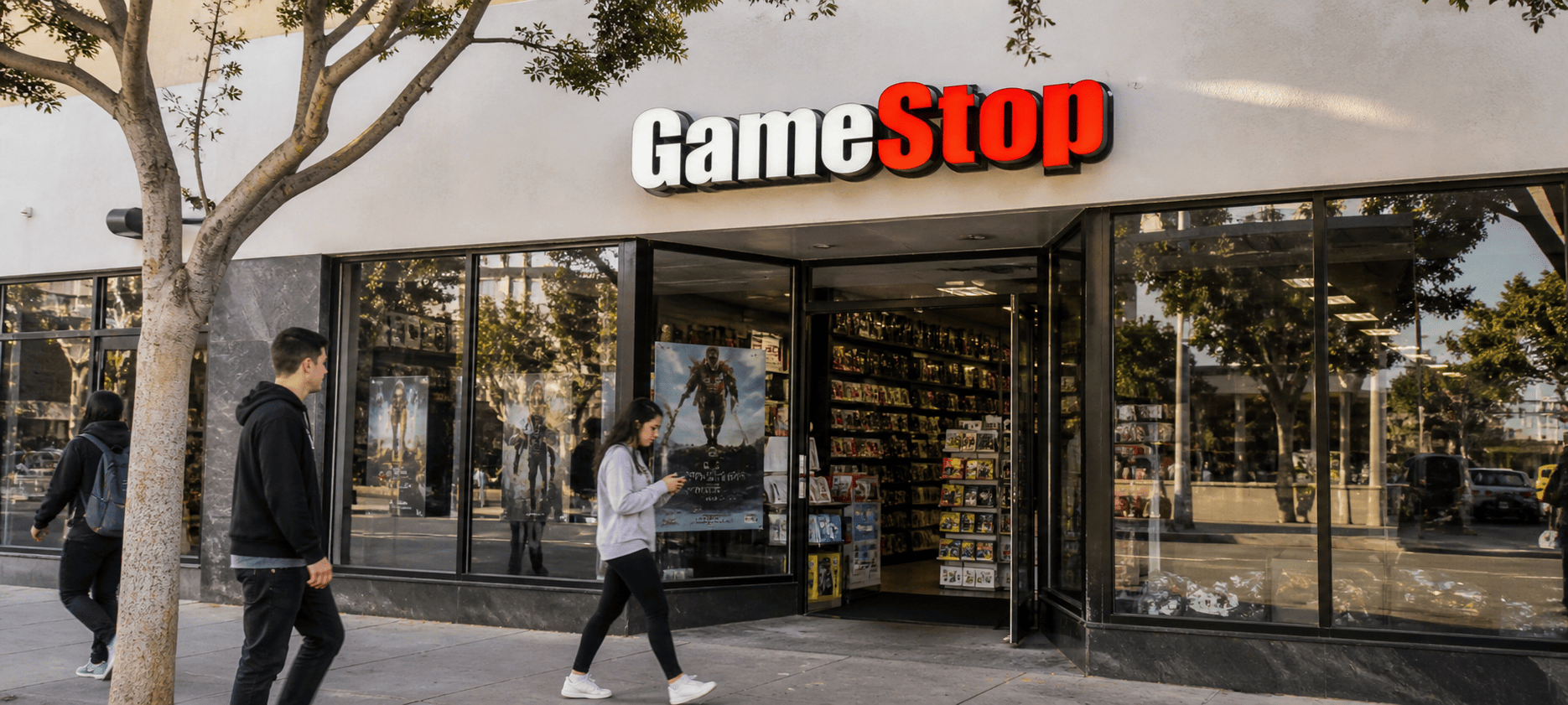
GameStop (NYSE: GME) shares rose Monday after the company released preliminary second-quarter results, but the headline profit growth masks persistent operational challenges. The gaming retailer now expects net income between $290 million and $310 million, roughly double the $168.6 million reported a year earlier. However, net sales are projected to fall to $780 million to $800 million, down sharply from $972 million in the same period last year.
The profit surge is largely the result of financial engineering rather than retail strength. GameStop converted derivative holdings into an equity stake of 43.4 million eBay shares valued at $4.947 billion, generating approximately $238 million in net gains. This move highlights management's ability to leverage its substantial balance sheet to produce earnings, even as physical store revenue continues to shrink.

Despite the positive price action, the stock remains down more than 30% from its year-to-date high. The preliminary report underscores that GameStop is increasingly operating like an investment vehicle rather than a traditional retailer. Cash, cash equivalents, and marketable securities fell to roughly $5.06 billion from $8.694 billion a year ago following the equity conversion.
Value-oriented investors may be attracted to the company's low price-to-earnings ratio and asset backing, but the underlying retail fundamentals remain unsupportive. The company also recorded a $75 million loss on digital asset holdings, partially offsetting the gains from the eBay stake.
For those considering a position, the absence of Wall Street coverage is a red flag. As of now, only one analyst covers GME, and that rating is a Hold with a price target of $13.50, implying significant downside from current levels. This lack of institutional support suggests limited confidence in the company's long-term prospects.
The investment thesis has evolved from a simple turnaround story into a hybrid balance-sheet play. Management's active monetization of strategic equities demonstrates financial agility, giving the company a runway to pivot. However, long-term share performance cannot rely indefinitely on non-operating investment gains.
Until GameStop presents a clear, scalable roadmap to reignite top-line commercial growth, the broader thesis remains neutral. The firm offers some downside protection through its liquid assets, but lacks sustainable operational catalysts. Investors should wait for the full Q2 earnings report on September 8 before making any moves.
In the meantime, broader market dynamics could influence sentiment. For instance, upcoming PCE inflation data may affect risk appetite, while tech earnings and AI-related news continue to shape market direction. These factors could indirectly impact speculative names like GameStop.
This article is for informational purposes only and does not constitute financial advice.