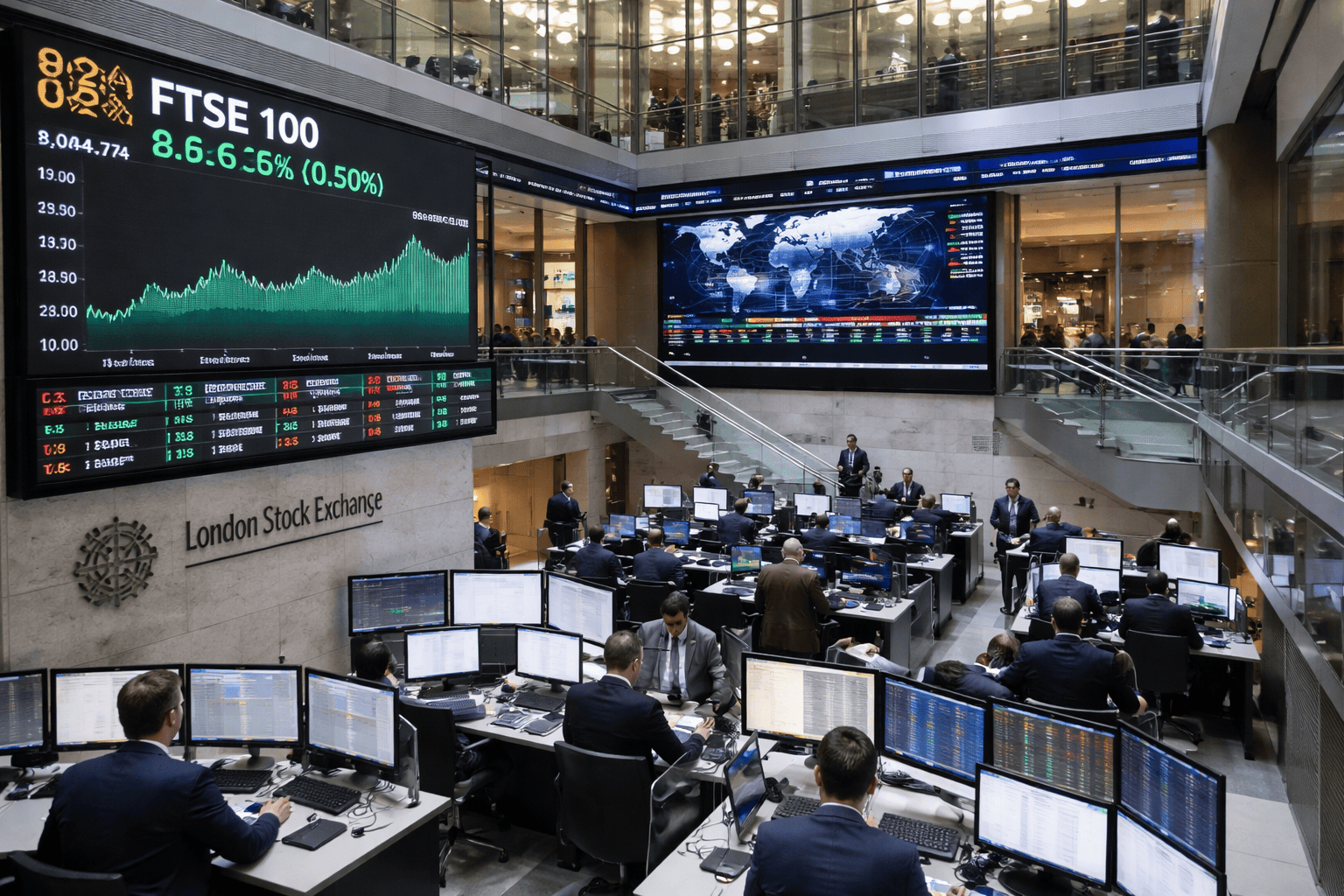
The FTSE 100 slipped in early trading on Wednesday, as rising crude prices and heightened geopolitical tensions kept investors on edge ahead of a pivotal US inflation report. London's benchmark index hovered near 10,830, extending a subdued week after Tuesday's 0.17% decline, and remained below its July record of approximately 10,991.
While the broader European market continued to trade close to all-time highs, the FTSE 100's performance lagged. Germany's DAX edged higher, France's CAC 40 dipped, and the STOXX Europe 600 was little changed near 661.

Oil's dual-edged impact on the FTSE
Brent crude climbed toward $90 a barrel following fresh attacks on commercial shipping and diminished hopes for a swift US-Iran agreement to reopen the Strait of Hormuz. Tehran has insisted the waterway will remain restricted unless Washington meets its conditions.
This creates a complex dynamic for the FTSE 100. The index's heavy weighting in energy and commodity stocks can offer some cushion when oil prices rise, but expensive crude also reignites inflation concerns and pressures margins across transport, retail, and consumer sectors. The tension was evident across Europe: energy shares gained about 0.7%, making them the strongest sector in the STOXX 600, while automobiles and parts fell roughly 0.8%.
Geopolitical risks extended beyond Hormuz. A Houthi attack on a cargo vessel in the Red Sea resulted in crew fatalities, North Korea conducted another ballistic missile test, and Taiwan criticized planned Chinese naval drills near its east coast. These developments reinforced a cautious tone rather than triggering a broad sell-off.
Europe holds records better than London
The FTSE 100's hesitation contrasts with a broader European market that has managed to stay near recent peaks. The STOXX 600 was broadly flat around 661, while the Euro STOXX 50 hovered near 6,550. Germany's DAX gained about 0.1%, though France's CAC 40 declined roughly 0.3%.
Corporate earnings helped prevent a deeper pullback. German warship maker TKMS jumped after raising its outlook for the second time in six months, while K+S advanced following another annual guidance upgrade. TUI moved in the opposite direction after quarterly operating profit disappointed, weighed down by softer bookings and higher fuel costs.
London also saw company-specific support. Balfour Beatty said full-year results should come in slightly ahead of previous expectations, underpinned by strong infrastructure demand and an order book of about £22.9 billion. The contrast leaves the FTSE 250 in focus as well, given its greater exposure to the domestic UK economy, meaning Thursday's growth figures could matter more for mid-caps than for the internationally focused FTSE 100.
US CPI and UK GDP as the next tests
Wednesday's US consumer-price report is the immediate macro catalyst. Economists expect July headline inflation to rise 0.1% from June and slow to around 3.4% year on year from 3.5%. Core inflation is expected to remain firmer, keeping the Federal Reserve's September decision finely balanced. The Bureau of Labor Statistics is due to release the figures at 8:30 am ET.
The latest jump in oil will not be fully reflected in July's data, but a hotter-than-expected reading could push Treasury yields higher and pressure equity valuations globally. London then gets its own macro test on Thursday, with second-quarter UK GDP due from the Office for National Statistics.
For investors tracking the broader market, the STOXX 600's resilience and the upcoming US CPI data will be key to gauging whether the recent record run can continue. Meanwhile, the TSX's record high and Berkshire's cash deployment highlight divergent trends across global markets.
This article is for informational purposes only and does not constitute financial advice.