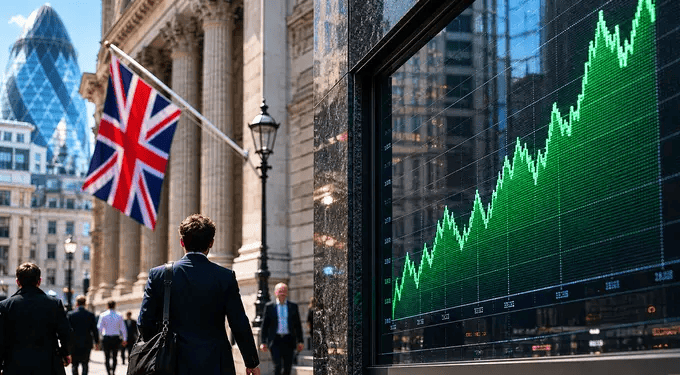
London markets ended the week on a cautious note, with the FTSE 100 barely budging as a fresh wave of geopolitical and political headwinds dampened investor sentiment. The cancellation of US-Iran peace talks in Switzerland rattled markets, reviving concerns about energy supply routes through the Strait of Hormuz and keeping risk appetite in check.
The benchmark FTSE 100 slipped just 5.40 points, or 0.05%, to 10,394.30 by late morning. Meanwhile, the domestically focused FTSE 250 fell 0.5% to 23,210.43, putting it on track for a weekly decline.

Geopolitical Tensions Resurface
Investor caution intensified after Washington and Tehran called off negotiations that had been expected to ease tensions around the Strait of Hormuz, a critical chokepoint for global oil shipments. The breakdown pushed oil prices higher as traders reassessed supply risks, with Brent crude trading near $79.50 per barrel. The move provided a tailwind for energy stocks listed in London, but weighed on broader equity markets globally.
For more on how geopolitical shifts are reshaping energy markets, see our analysis: US Surpasses Saudi Arabia, Russia as Top Oil Exporter Amid Shale Boom and Geopolitical Shifts.
Mining Stocks Drag
Mining shares were among the biggest drags on the FTSE 100. Anglo American fell 2.2%, Glencore declined 1.5%, and Rio Tinto shed 1.1%. The weakness in the sector offset gains elsewhere and contributed to the index's subdued performance.
Commodity markets are also under pressure from tariff uncertainty and geopolitical risks, as highlighted in our report: Copper Dips Below $14,000 as Tariff Uncertainty and Geopolitical Risks Weigh.
Domestic Political Uncertainty Adds to Caution
Markets were also digesting domestic political developments after Labour mayor Andy Burnham cleared a path on Friday to potentially challenge British Prime Minister Keir Starmer. The political maneuvering added another layer of uncertainty for investors already navigating geopolitical tensions and economic concerns.
Bond Yields Rise
British government bond yields climbed to their highest level in a week, slightly outpacing moves in German government debt. The rise followed higher-than-expected government borrowing figures and Burnham's election victory, both of which appeared to influence investor expectations about fiscal policy and political stability.
Energy and Healthcare Provide Support
Despite the cautious tone, energy and healthcare stocks emerged as the strongest sources of support for the FTSE 100. BP gained 1.7%, while Shell advanced 1.0% as crude prices firmed. In the healthcare sector, AstraZeneca rose 1.3% and GSK added 0.9%, helping to counterbalance losses in mining stocks and keep the benchmark index near flat.
Company-Specific Moves
Shares of Admiral Group fell 5% after RBC downgraded the insurer's stock to 'sector perform' ahead of its upcoming results. Homebuilder Barratt Redrow announced the appointment of former British Airways finance chief Rebecca Napier as its new CFO, sending shares 0.5% lower. Meanwhile, Entain edged modestly higher after Reuters reported that the Ladbrokes owner had started exploring options for its joint venture operations in Central and Eastern Europe, including a potential sale.
As trading progressed, investors continued to balance geopolitical risks, domestic political developments, and sector-specific movements, leaving the UK's main stock index little changed while the FTSE 250 remained on track for a weekly decline.
This article is for informational purposes only and does not constitute financial advice.