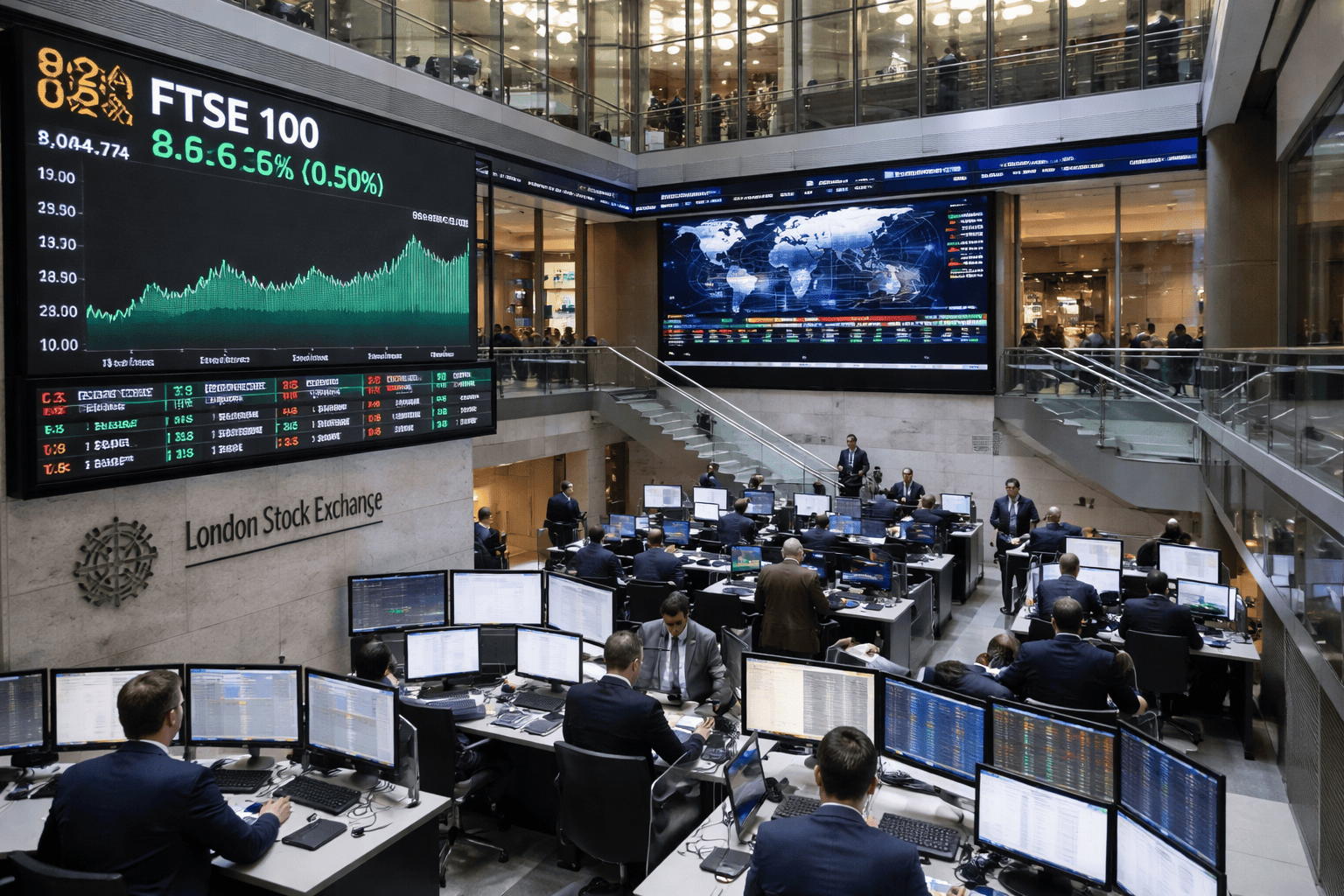
London's FTSE 100 managed a modest advance on Thursday, gaining about 0.2% to trade near 10,910, as a wave of positive corporate updates helped the index shrug off a sharp technology-led decline across Asian markets. The FTSE 250 also moved higher, with mid-cap stocks finding support from a standout rally in advertising group WPP.
The resilience of UK equities stood in contrast to steep losses elsewhere: South Korea's KOSPI tumbled 4.6%, while Japan and Hong Kong also saw significant declines as investors trimmed exposure to crowded artificial-intelligence trades. London's relative stability reflects the FTSE's limited direct exposure to semiconductor companies, which have been at the center of the global pullback.
Earnings strength underpins London's outperformance
Thursday's session was dominated by insurers, housebuilders, and pharmaceuticals, where investors focused on cash returns and earnings visibility rather than speculative growth. Admiral led the blue-chip risers, climbing more than 4% after reporting continued first-half growth and announcing a £45 million share buyback. The insurer said total shareholder distributions for the period reached £258.8 million, reinforcing its appeal as a cash-generative play supported by resilient motor-insurance profitability.
Persimmon also gained more than 3% after lifting its expected 2026 home completions to about 12,500, the top of its previous guidance range. First-half completions rose 13% to 5,189, while revenue increased 15% to £1.73 billion and pre-tax profit climbed by the same percentage to £168 million. Investec analysts described the housing market as challenging but noted that Persimmon is executing relatively well despite affordability pressures and rising construction costs.
WPP's rally: relief, not a full recovery
WPP surged more than 20%, putting the advertising group on course for its biggest one-day gain since 1992. The jump followed evidence that the deterioration in its business had slowed far more than investors had anticipated. First-half revenue less pass-through costs fell 4.7% on a like-for-like basis to £4.75 billion, but the second-quarter decline narrowed to 2.8% from 6.7% in the first three months, comfortably beating forecasts for another drop of more than 6%.
The figures offered an early endorsement of chief executive Cindy Rose's plan to simplify WPP, cut costs, and expand its use of artificial intelligence. Client retention has improved, and recent account wins have strengthened the company's ambition to return to organic growth next year. Citi analysts see scope for current revenue forecasts to prove too cautious, while progress on asset disposals could reveal value not reflected in the share price. Still, one better quarter does not erase years of client losses or lingering concerns that AI could reshape advertising economics.
Construction data offers cautious support
The broader UK backdrop also became slightly less hostile. The S&P Global construction purchasing managers' index rose to 44.7 in July from 34.4 in June. Although the reading remained below the 50 threshold that separates expansion from contraction, the improvement showed the sector moving away from the severe disruption seen earlier in the summer. Builder confidence reached its highest level since before the Iran conflict, helped by expectations for new tenders and infrastructure work.
That supported a broader rise in housebuilding shares, although weak orders and higher material costs remain constraints. Elsewhere, Hikma Pharmaceuticals jumped about 9% after first-half core operating profit rose 9% to $405 million and the company maintained its annual guidance. Tritax Big Box was the FTSE 100's weakest performer, falling more than 4%.
Oil held near $80 a barrel as investors assessed Iran-Oman negotiations over the Strait of Hormuz and threats to Saudi shipping. Friday's US payrolls report is the next major test, but Thursday's session showed that company results can still outweigh a weak international lead. For investors tracking the broader market, the recent Kospi's sharp rebound and the Hang Seng's technical setup highlight the volatility in Asia, while London's earnings-driven resilience offers a contrasting narrative.
This article is for informational purposes only and does not constitute financial advice.