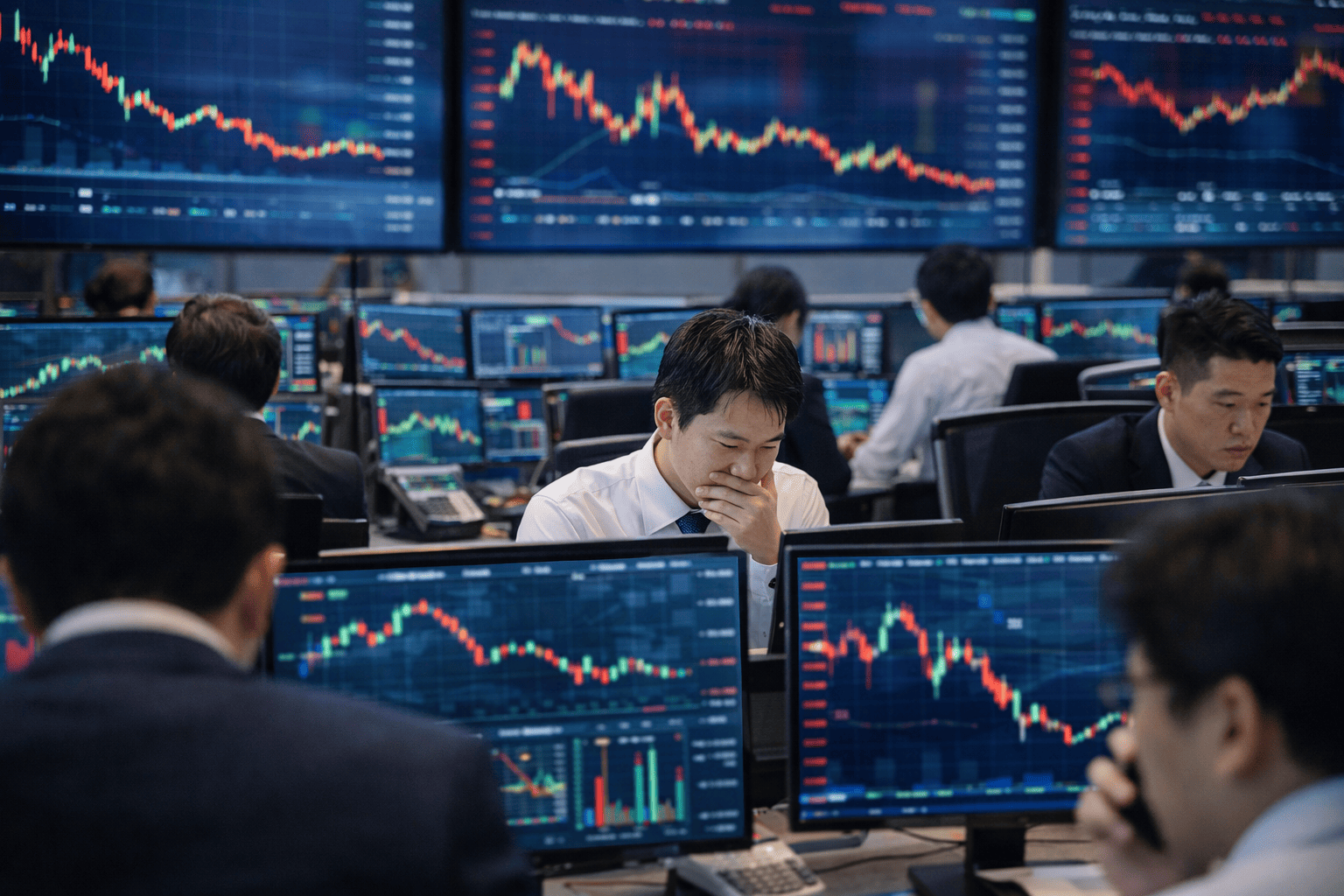
Asian equities staged a powerful rebound on Wednesday, with South Korea's Kospi climbing more than 5% intraday before settling around 4.1% higher, while Japan's Nikkei 225 advanced roughly 3%. The surge was fueled by renewed technology optimism, falling oil prices, and a rush to unwind bearish bets that had built up during July's sharp correction.
Short squeeze amplifies Korea's gains
The Kospi entered August after a 22% decline in July, as leveraged exchange-traded products, margin calls, and concentrated AI-related positions exacerbated the selloff. Bearish positioning reached a three-year high, setting the stage for a violent squeeze when sentiment shifted. According to Citi analyst David Chew, short exposure had become so one-sided that any stabilization in AI sentiment could trigger a rapid short covering. Wednesday's move fit that pattern, with short sellers forced to buy shares to close positions, transforming a modest recovery into a stampede.
SK Hynix and Samsung Electronics led Seoul's advance, with SK Hynix gaining after Wall Street firms initiated bullish coverage on its US-listed securities, highlighting its leadership in high-bandwidth memory. Samsung followed suit as confidence spread across Korea's memory trade. However, analysts caution that the buying is not purely fundamental. Eurasia Group analysts told Business Insider that Korea's daily fluctuations are "mostly divorced from market fundamentals," even though corporate profits remain at record levels.
Japan's rally has broader support
Japan's advance was less dependent on forced buying. Electronics stocks tracked Wall Street's technology rally, while earnings encouraged investors to add exposure to exporters and manufacturers. The Nikkei also benefited from hopes that Washington and Tehran could reach an agreement to reopen the Strait of Hormuz, which would ease oil supply concerns. Lower crude prices are particularly supportive for Japan, which imports most of its energy, as it reduces costs and inflation pressure.
The yen remained near 157.7 per dollar early, a level that supports stocks. A sharp appreciation would weaken exporters' overseas earnings, while another rapid decline could revive intervention concerns. This balance has helped maintain a favorable environment for Japanese equities.
Fundamentals vs. momentum
Despite the strong rebound, some analysts urge caution. Daiwa Capital Markets analyst SK Kim told Bloomberg TV that there has been no fundamental change in the AI-driven supercycle, noting that SK Hynix's recent earnings disappointment reflected product mix rather than weakening demand. Saxo strategist Charu Chanana offered a more cautious view, telling Business Insider that while AI remains one of the decade's most important opportunities, powerful themes become vulnerable when positions are crowded, expensive, and leveraged.
This distinction explains Wednesday's rally: AI demand may remain intact, but stocks can still experience violent swings unrelated to earnings. The speed of the rebound, particularly in Korea, suggests that positioning, not just fundamentals, is driving the move. Investors should be aware that such rapid gains can be as fragile as the declines that preceded them.
For context, the recent AI-driven rally on Wall Street has provided a template for Asian markets, but the leverage dynamics in Korea are unique. Meanwhile, Samsung and SK Hynix have lagged the US chip rally due to lingering leverage concerns, though Wednesday's surge suggests some of that overhang is being unwound.
As the week progresses, investors will watch whether the rally can sustain its momentum or if profit-taking and renewed caution will set in. The Hang Seng Index's technical setup and CoreWeave's expansion news are among the factors that could influence regional sentiment.
This article is for informational purposes only and does not constitute financial advice.