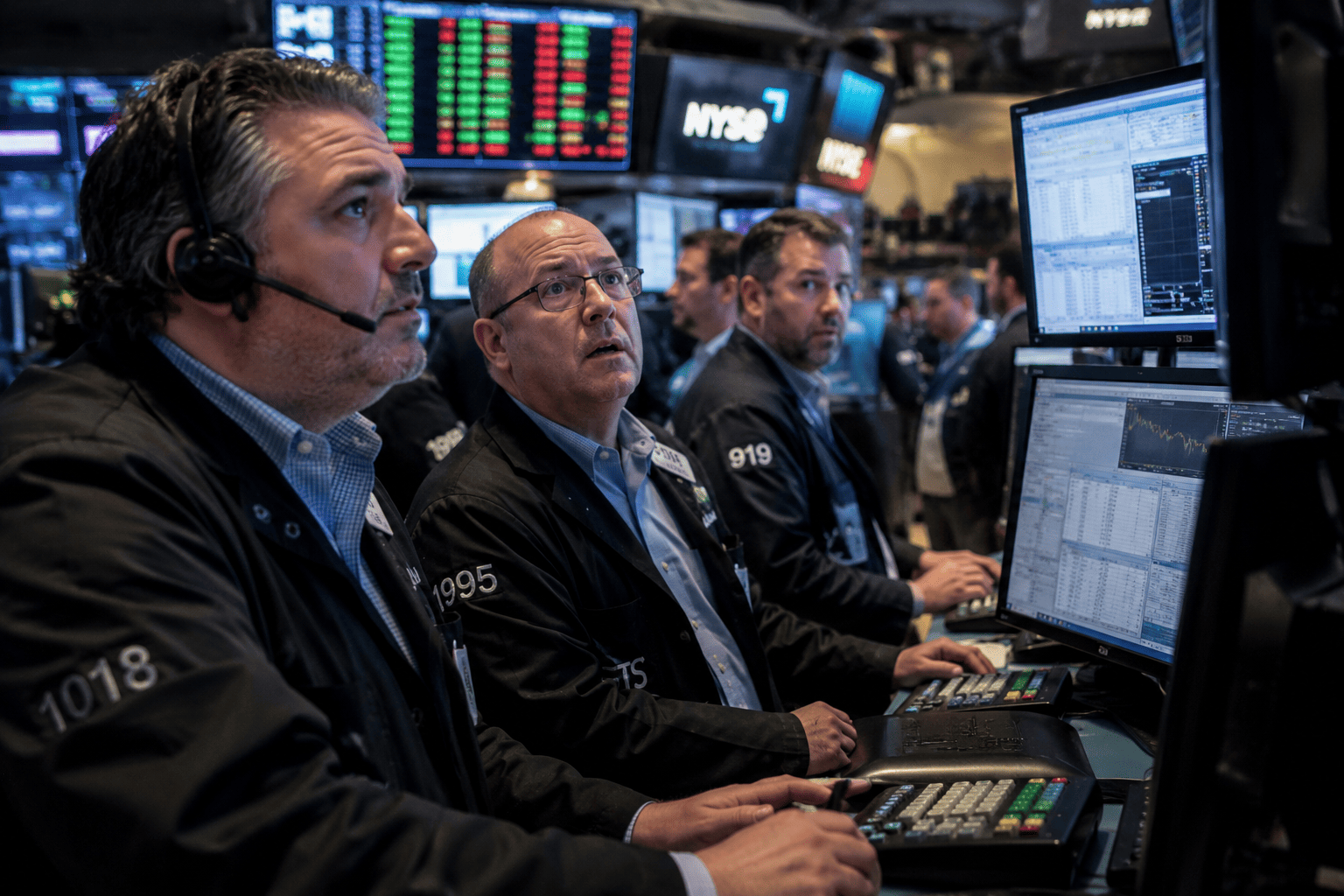
Wall Street's main indexes opened sharply lower on Friday, extending a broad reassessment of the artificial intelligence rally that had propelled markets to record highs earlier this year. The Dow Jones Industrial Average fell approximately 486 points, or 0.9%, while the S&P 500 declined 1.1%. The Nasdaq Composite dropped 1.7%, reflecting renewed weakness across technology stocks.
The selloff was led by semiconductor shares, which continued their recent pullback. Nvidia shares fell about 3.4%, while Applied Materials and Lam Research each dropped more than 5%. Intel, KLA Corporation, Arm, and Micron Technology also traded lower. The iShares Semiconductor ETF (SOXX) and the VanEck Semiconductor ETF (SMH) both declined more than 3%.
The Philadelphia Semiconductor Index remained under pressure after hitting a nearly two-month low on Thursday. The benchmark has fallen more than 19% from its late-June record high and was on track for its worst weekly performance since March 2025. The weakness persisted despite strong quarterly results from Taiwan Semiconductor Manufacturing Co. (TSMC) and upbeat guidance from ASML, suggesting investors remain focused on broader concerns surrounding AI infrastructure spending rather than company-specific earnings.
The selloff was not limited to US markets. Semiconductor shares also weakened across Asia-Pacific and European markets on Friday. Chinese startup Moonshot AI added to competitive concerns after unveiling a new artificial intelligence model that it said narrows the gap with leading US offerings. For more on the global chip rout, see our coverage: Nikkei 225 Plunges 2.8% as Chip Rout Deepens; TSMC Profit Surge Fails to Halt Selloff.
Netflix and Other Tech Stocks Weigh on Sentiment
Technology stocks faced additional pressure after Netflix forecast third-quarter revenue and earnings below Wall Street expectations. Netflix shares plunged more than 11% in trading despite reporting second-quarter results that were broadly in line with analyst estimates. Elsewhere, Intuitive Surgical fell 11% after maintaining its da Vinci procedure growth forecast and warning that insurance-plan changes may be delaying patient care.
Investors also awaited the University of Michigan's consumer sentiment survey and industrial production data later in the day, which were expected to provide further insight into the health of the US economy following a busy week of inflation reports and second-quarter earnings. Although major US banks delivered solid earnings earlier in the week and recent inflation data came in softer than expected, those positives failed to offset mounting concerns surrounding technology valuations. For a broader perspective on market rotation, see: Dow Futures Drop 360 Points as AI Rally Unravels, Netflix Guidance Disappoints.
Geopolitical Tensions Add to Market Uncertainty
Investors also monitored escalating tensions in the Middle East. The US military said it completed its sixth consecutive evening of strikes against Iran, targeting military infrastructure, logistics assets, and maritime capabilities. Iran, meanwhile, said it had targeted US military forces in Syria and Bahrain, while Kuwait reported that an Iranian attack struck a power and water desalination plant. The renewed conflict has further weakened the fragile truce reached last month and continued to disrupt energy flows through the Strait of Hormuz, a critical shipping route that normally carries around one-fifth of global oil supplies.
Oil prices moved higher amid the geopolitical developments. US West Texas Intermediate crude traded above $81 a barrel, while Brent crude rose above $86 a barrel. The CBOE Volatility Index, often viewed as Wall Street's fear gauge, also climbed to its highest level in more than a week as investors adopted a more cautious stance heading into Friday's session. For investors looking to diversify beyond the AI trade, consider: Diversify Beyond AI: 3 Stocks with Strong Fundamentals for 2026.
This article is for informational purposes only and does not constitute financial advice.