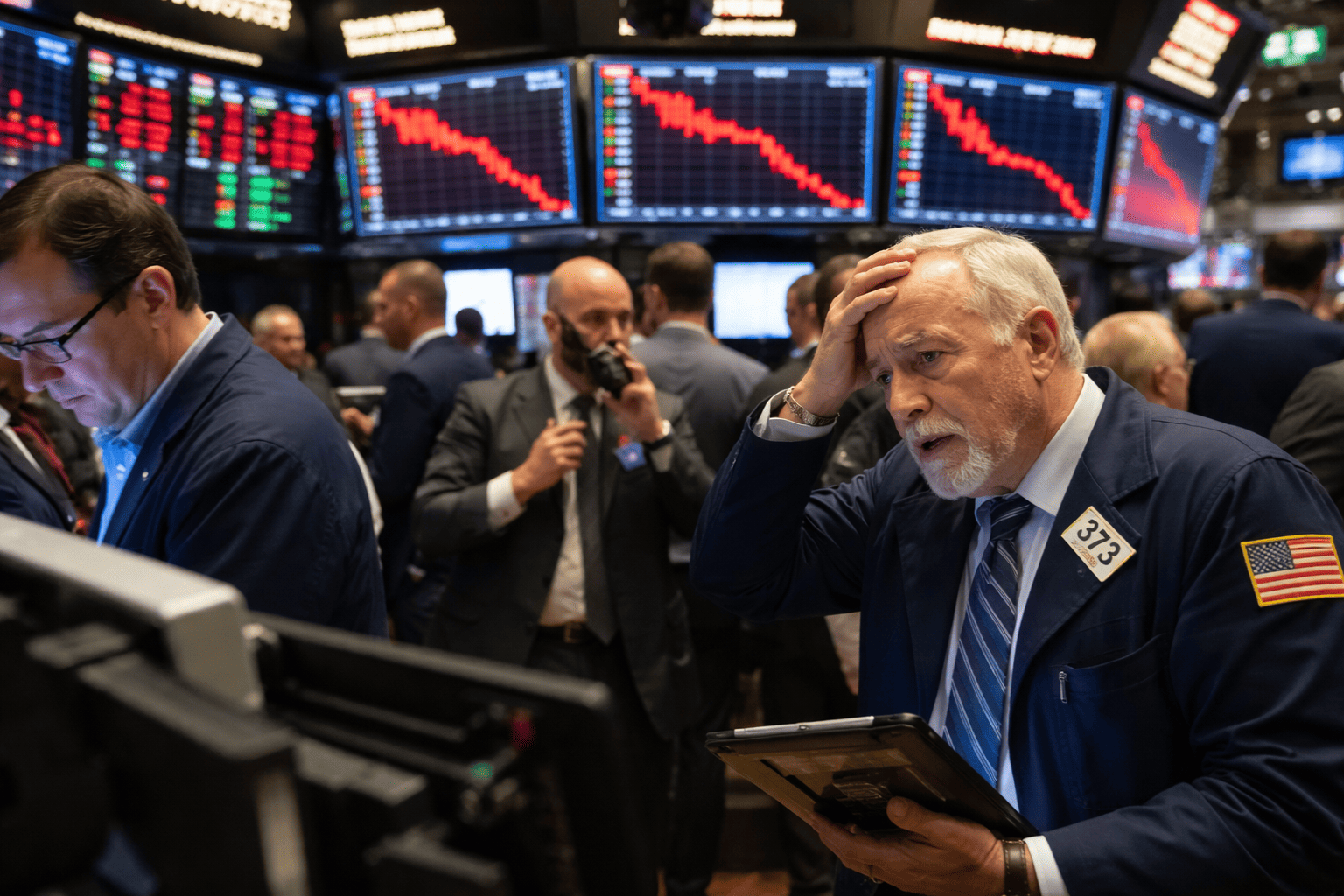
U.S. stock futures tumbled Friday, with the Dow Jones Industrial Average futures shedding 360 points, as a retreat from artificial-intelligence winners accelerated and Netflix's cautious outlook added to investor anxiety. The selloff signals a shift in market sentiment, where growth alone is no longer sufficient to sustain valuations after a record-setting rally.
Memory-Chip Rout Deepens
Shares of memory-chip makers extended their decline in premarket trading, with SanDisk, Western Digital, Seagate, and Micron falling between 4.6% and 6.5%. The Philadelphia Semiconductor Index had already dropped 4.3% on Thursday, hitting a near two-month low, and is on track for its worst week since March 2025. The selloff follows a strong first half, raising questions about whether AI infrastructure spending can continue to accelerate fast enough to justify current valuations. This weakness mirrors a broader trend seen in Asian markets, as highlighted in our coverage of the Nikkei 225 plunging 2.8% amid a chip rout.
Netflix Guidance Misses Expectations
Netflix shares slid 9.4% after the streaming giant forecast third-quarter revenue of $12.86 billion and diluted earnings of 82 cents per share, both below Wall Street estimates of about $13 billion and 84 cents. While second-quarter revenue rose 13% year-over-year to $12.56 billion and operating income reached $4.19 billion, the market focused on slowing growth and a narrower full-year sales outlook. This disappointment adds to a pattern where companies beating quarterly estimates are still being penalized for weak forward guidance, as seen with Intuitive Surgical, which sank about 11% despite beating estimates.
Broad Risk-Off Sentiment
Futures across major indices signaled a risk-off open: Dow futures fell 0.67%, S&P 500 contracts lost 1.03%, and Nasdaq 100 futures dropped 2.05% by 4:55 a.m. in New York. The CBOE Volatility Index (VIX) rose to 18.53, its highest in over a week, reflecting heightened investor anxiety. The selloff is broad-based, with investors demanding stronger guidance rather than rewarding backward-looking results.
Geopolitical Tensions Add Pressure
Geopolitical risks are compounding market jitters. Iran launched fresh attacks on U.S. facilities in the Gulf after a sixth consecutive night of American strikes, keeping oil prices elevated. Brent and U.S. crude are heading for weekly gains of more than 11% as reduced traffic through the Strait of Hormuz sustains supply concerns. Higher energy costs could complicate the recent improvement in U.S. inflation, adding another layer of uncertainty for investors.
Meanwhile, President Donald Trump accused China of interfering in U.S. elections, allegations Beijing rejected as groundless. While no new trade measures were announced, the rhetoric threatens to unsettle a diplomatic thaw ahead of President Xi Jinping's expected Washington visit in September. The combination of U.S.-Iran fighting and U.S.-China tensions is keeping global markets on edge.
Market Implications
The current selloff underscores a market recalibration, where investors are reassessing the sustainability of the AI-driven rally and the broader economic outlook. With the VIX rising and futures pointing to a weak open, traders are bracing for increased volatility. The memory-chip rout, in particular, highlights the fragility of the semiconductor sector, which has been a key driver of market gains. For context, similar dynamics have played out in other high-growth stocks, such as the Rocket Lab stock plunging 55% on technical signals.
As earnings season progresses, the focus will remain on forward guidance and the ability of companies to justify their valuations in a higher interest rate environment. The coming sessions will be critical in determining whether this is a temporary pullback or the start of a deeper correction.
This article is for informational purposes only and does not constitute financial advice.