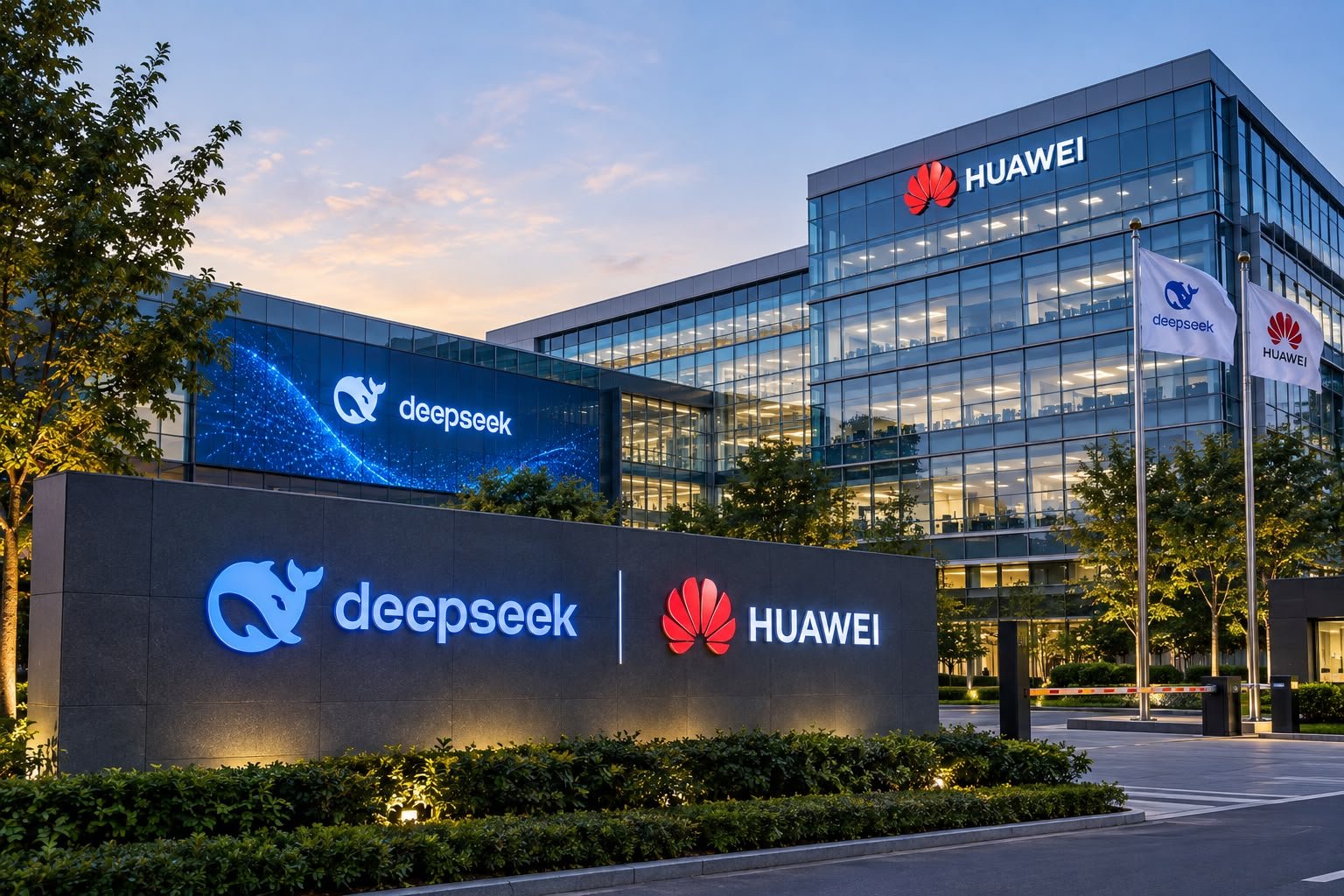
Chinese AI startup DeepSeek has announced a collaboration with Huawei Technologies to develop and open-source programming tools tailored for Huawei's Ascend chips. The move, disclosed via DeepSeek's official WeChat account, marks a significant step in China's efforts to build a domestic AI ecosystem less reliant on Nvidia's hardware and software.
The centerpiece of the release is TileLang, a programming language designed to simplify development for AI chips. DeepSeek positions TileLang as a more accessible alternative to Nvidia's CUDA, the proprietary software platform that has underpinned AI development for over a decade. Alongside TileLang, the company has open-sourced DeepGEMM Ascend, a matrix multiplication kernel library, and DeepEP Ascend, which facilitates efficient large-scale communication across Ascend chips.

This partnership comes two weeks after Huawei unveiled its next-generation AI processors and supernode computing systems, with expectations that its AI systems will be widely adopted for model training next year. DeepSeek stated that Huawei provided full support in developing the programming infrastructure, and the two companies jointly advanced a supernode solution based on 128 Ascend 950 chips, optimizing both computation and communication.
In its announcement, DeepSeek emphasized the need for a new generation of independent, self-controlled GPU software ecosystems. The company said, "To build a new generation of independent, self-controlled GPU software ecosystems, the first priority is establishing a high-level language that is universal, easy to program, and still capable of reaching the hardware's full performance potential." TileLang was created to meet this need, offering a simpler programming model than CUDA.
DeepSeek's pivot toward domestic hardware has been building for months. While the company previously relied heavily on Nvidia's H800 GPUs for training, it has increasingly adapted its models and software to Huawei's Ascend platform in 2026. Its V4-Flash AI model was optimized specifically for Huawei chips, and DeepSeek plans to install more than 160,000 Huawei Ascend chips at a new data center in Inner Mongolia.
The announcement adds to a complicated week for Nvidia's China exposure. According to The Information, Beijing is considering allowing domestic firms, including Alibaba and ByteDance, to purchase Nvidia's RTX Pro 5500. Nvidia sales staff have reportedly told customers to place orders by September 30 to secure supply. Nvidia CEO Jensen Huang has stated that US export restrictions reduced the company's share of China's advanced AI chip market from roughly 95% to effectively zero, with H200 sales to Chinese customers accounting for less than 1% of Nvidia's data center revenue in the quarter ended July 26.
Chinese chipmakers have capitalized on this vacuum to advance domestically. Homegrown players including CXMT and Moore Threads have completed stock market debuts over the past year as Beijing pushes to reduce dependence on foreign chip technology. Nvidia closed Tuesday at $227.21, down 0.72%, and was trading higher in premarket action Wednesday at $228.22, up 0.44%, as of about 6:07 a.m. ET.
This collaboration between DeepSeek and Huawei underscores a broader trend of Chinese tech firms uniting to counter US export controls and foster self-sufficiency in critical technologies. By open-sourcing these tools, DeepSeek aims to accelerate the adoption of Huawei's Ascend platform and potentially diminish the global dominance of Nvidia's CUDA software.
This article is for informational purposes only and does not constitute financial advice.

