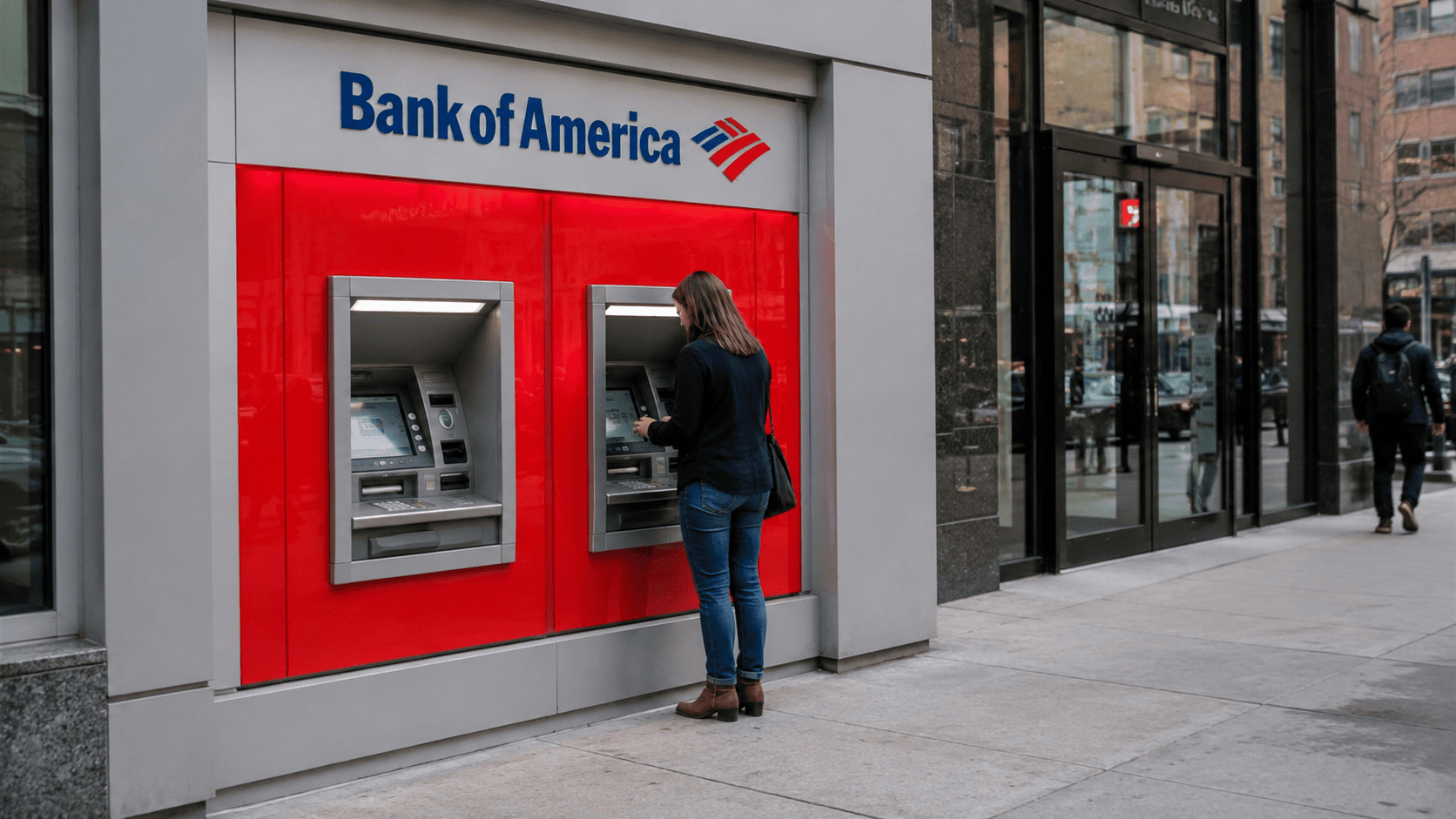
Bank of America (NYSE: BAC) shares continued to climb Tuesday after the firm reported fiscal second-quarter results that topped Wall Street expectations. The bank posted earnings per share of $1.21 on revenue of $31.6 billion, a 15% year-over-year increase. However, beneath the headline beat, several areas of concern suggest investors should approach the stock with caution, especially given its elevated valuation.
Net Interest Income Miss Signals Deposit Cost Pressure
Net interest income (NII) rose sequentially to $16 billion but fell short of the $16.2 billion consensus estimate. The shortfall reflects ongoing pressure from funding and deposit costs. During the quarter, interest-bearing deposits stood at $1.5 trillion, while non-interest-bearing deposits declined to $514.5 billion as customers shifted cash from free checking accounts into higher-yielding products such as certificates of deposit and money market funds.

This migration forces Bank of America to pay more to retain deposits, keeping funding costs elevated and limiting net interest margin expansion. The NII miss underscores a structural challenge in the bank's traditional lending business, even as its capital markets operations shine.
Trading and Investment Banking Fuel the Beat
The Q2 earnings beat was largely driven by a 70% surge in equities trading revenue and a 50% jump in investment banking fees. These gains are inherently cyclical and may not be sustainable if market conditions cool. The reliance on volatile revenue streams raises questions about the durability of the earnings momentum, particularly if capital markets activity slows in the second half of 2026.
For context, Goldman Sachs also reported strong trading results, but similar concerns about revenue mix persist across the sector.
Valuation and Technical Signals Warrant Caution
Bank of America shares have rallied more than 30% from their year-to-date low, and the stock now trades at a forward price-to-earnings multiple of 13x, a premium relative to historical averages. From a technical perspective, the relative strength index (RSI) sits just below 70, approaching overbought territory that often triggers profit-taking.
The market appears to have priced in a high degree of perfection, leaving little room for error. If the trading and investment banking tailwinds fade, the underlying weakness in retail banking could become more visible, potentially weighing on the stock.
Outlook and Investor Considerations
While Bank of America's capital markets engine is firing on all cylinders, the cracks in its lending business cannot be ignored. The NII miss and deposit cost pressures suggest that the traditional banking engine is growing more slowly, which could become a drag if market conditions normalize.
For investors, the combination of a premium valuation, overbought technicals, and cyclical revenue concentration suggests that waiting for a pullback before adding exposure may be prudent. As BlackRock's Q2 earnings also highlighted, the broader financial sector is navigating a complex environment where fee-based income is strong but core lending faces headwinds.
This article is for informational purposes only and does not constitute financial advice.