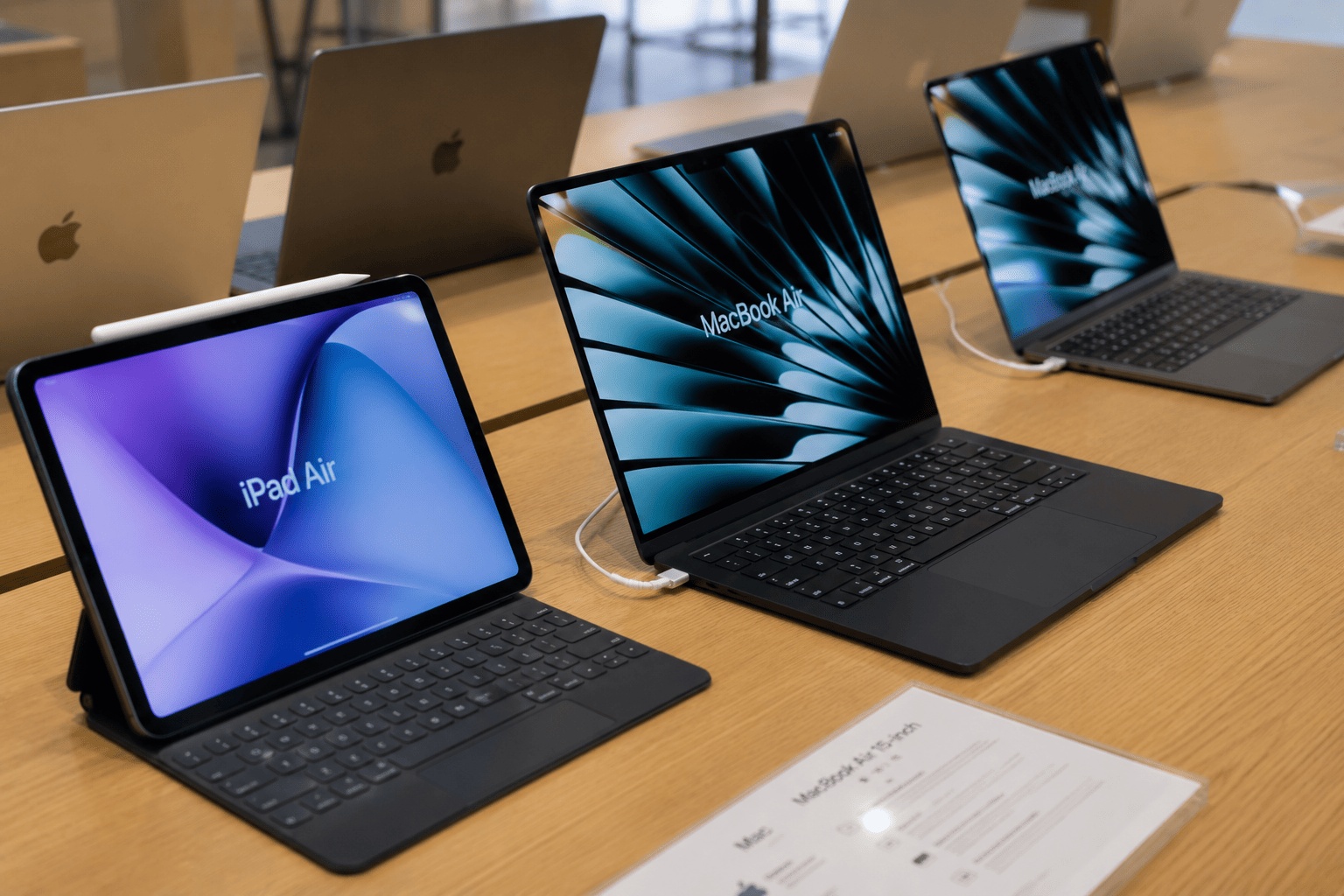
Apple Inc. (AAPL) shares fell nearly 5% on Wednesday after the company announced price increases across its Mac and iPad lineups, citing an unprecedented surge in memory and storage costs driven by artificial intelligence infrastructure demand. The stock was down approximately 4.89% in midday trading.
The price adjustments mark Apple's first direct pass-through of higher component costs to consumers. Chief Executive Tim Cook had previously described the situation as a “hundred-year flood,” telling The Wall Street Journal last week that the company could no longer fully absorb the cost increases.
New Pricing Structure
Under the revised pricing, the base MacBook Air now starts at $1,299, a $200 increase. The MacBook Pro rose by $300 to $1,999, while the entry-level MacBook Neo increased by $100 to $699. In the iPad lineup, the iPad Air now costs $749, up $150, and the iPad Pro starts at $1,199, a $200 increase. iPhone prices remain unchanged for now.
“The consumer electronics industry is facing an unprecedented challenge,” Apple said in a statement. “The rapid expansion of AI data centers has created an extraordinary surge in demand for memory and storage. We have never seen a component price increase this much, this quickly.” The company left open the possibility of further price increases.
AI Demand Reshapes Memory Market
The global memory market has been transformed by the explosive growth of artificial intelligence. According to Counterpoint Research, memory and storage prices have quadrupled over the past three quarters as suppliers prioritize high-bandwidth memory for AI servers and accelerators. Manufacturers such as Micron have focused on orders from AI chipmakers like Nvidia, driving record profits but leaving limited supply for consumer electronics.
Apple joins a growing list of companies raising prices due to memory shortages. Dell, HP, Lenovo, and Asus have all flagged price increases this year, while Samsung raised prices on two versions of its S26 smartphone by $100 in the United States.
For more on the broader memory market dynamics, see our analysis: Nvidia Lags AI Peers as Rotation to Memory, Infrastructure Plays Accelerates.
Investor Concerns Over Margins
The rapid rise in memory costs has raised questions about Apple's ability to manage component expenses without hurting demand. Investors had hoped Apple's scale and bargaining power would help it negotiate better terms or offset costs through vertical integration. However, the global DRAM market is dominated by Micron, SK Hynix, and Samsung, all of which have surpassed $1 trillion in market value this year as they benefit from AI infrastructure demand from Google, Meta, and Amazon.
Apple has explored sourcing memory from Chinese suppliers YMTC and CXMT, but those efforts have faced resistance from U.S. policymakers over security concerns. A recent Morgan Stanley report described the situation as “chipflation,” estimating that memory prices have increased sixfold over the past year and warning that building additional manufacturing capacity could take years.
JPMorgan analysts estimate that DRAM and NAND memory, which currently account for roughly 10% to 15% of the bill of materials for an iPhone, could represent more than 45% by 2027. Despite the cost pressures, JPMorgan maintained a positive outlook on Apple, as noted in their report: JPMorgan: Apple Price Hikes Unlikely to Dampen Demand, PT Raised to $345.
Apple had warned in April that existing inventories allowed it to maintain margins above Wall Street expectations, but said rising memory costs would eventually begin weighing on profitability by the end of June.
For investors considering memory-focused plays, the SK Hynix ADR listing offers an alternative: SK Hynix ADR Listing: A Stronger AI Memory Play Than Micron or SanDisk.
This article is for informational purposes only and does not constitute financial advice.