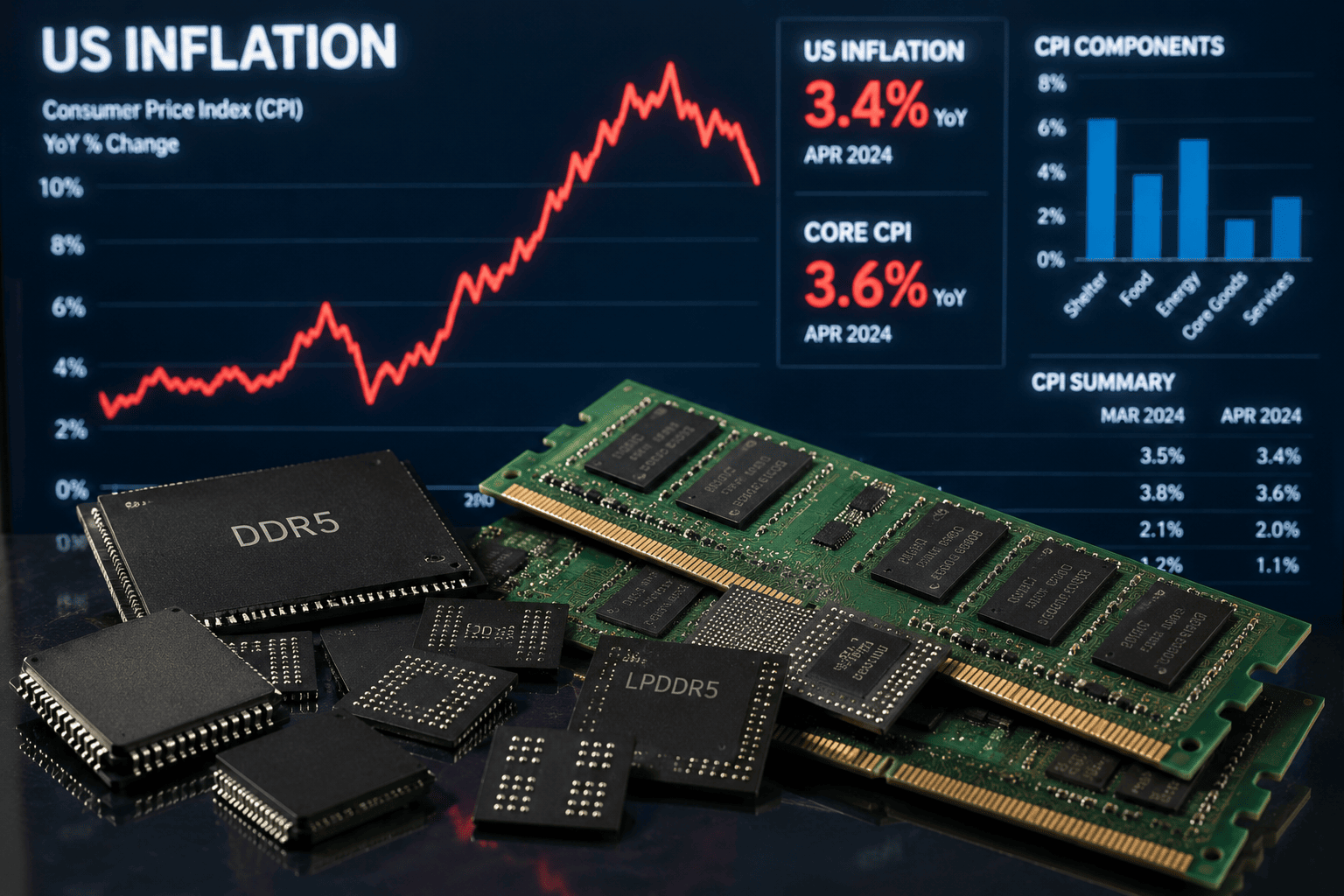
Apple and Microsoft both announced price increases on Thursday, attributing the moves to soaring costs for memory and storage components—a direct consequence of the massive capital spending wave tied to artificial intelligence. The developments have intensified debate over whether the AI boom, long touted as a deflationary force, is instead becoming an engine of inflation.
Apple raised prices on several MacBook and iPad models by $100 to $300, while leaving iPhone pricing unchanged. The company said in a statement that the rapid expansion of AI data centers had created an extraordinary surge in demand for memory and storage, adding: "We have never seen a component price increase this much, this quickly." Apple shares fell 6% on the day, their worst single-day decline in over a year.

Microsoft followed suit, announcing global price increases for Xbox consoles—$100 for 512-gigabyte models and $150 for one-terabyte versions, effective August 1. The company also said it would discontinue its two-terabyte Xbox model. These moves add to a growing list of technology manufacturers raising prices, including Dell, HP, Lenovo, Asus, and Samsung.
The price hikes stem from an unprecedented shortage of memory chips, as hyperscalers race to build increasingly powerful data centers. Suppliers have shifted production toward high-bandwidth memory chips used in AI servers, leaving consumer electronics manufacturers scrambling for supply. According to James Bull at RSM UK, the four largest US technology companies are forecast to spend $725 billion on data centers and AI equipment in 2026 alone. "That level of demand for memory chips has created a shortage the supply chain cannot keep pace with," he said.
Morgan Stanley analysts warned earlier this month that soaring memory prices could trigger "chipflation" across industries, noting that memory chip prices have risen six-fold over the past year. "What began as an AI infrastructure bottleneck is now spreading into hardware margins, device affordability, cloud costs, inflation and policy," the bank wrote.
The inflationary impact of AI may extend beyond semiconductors. In an April note, JPMorgan Asset Management's Chief Global Strategist David Kelly argued that the enormous spending wave tied to AI development is likely to be inflationary in the near term because demand hits the economy well before productivity gains materialize. He pointed to electricity demand as a clear example: US electricity production rose 2.5% in 2024 and 2.4% in 2025, with much of the increase driven by data center consumption. Consumer electricity prices rose 4.6% year-over-year in March, though higher power costs accounted for just 0.1 percentage point of March's 3.3% annual headline inflation due to electricity's small weight in the CPI basket.
Construction wages also rose 4.3% year-over-year in March, outpacing the broader private sector's 3.5% increase, partly due to labor shortages in a sector that has historically relied on immigrant labor. However, Kelly noted that most corporations have not yet realized significant cost savings from deploying the latest AI models, and even fewer have passed any savings on to consumers.
For investors, the price hikes at Apple and Microsoft underscore a growing tension: the AI revolution may deliver long-term productivity gains, but the near-term costs are being passed on to consumers. As Chris Beauchamp, chief market analyst at IG, put it: "The AI boom might be inflationary, particularly for the hard-pressed consumer, hurting rather than aiding economic growth."
Related coverage: JPMorgan: Apple Price Hikes Unlikely to Dampen Demand, PT Raised to $345 and SK Hynix ADR Listing: A Stronger AI Memory Play Than Micron or SanDisk.
This article is for informational purposes only and does not constitute financial advice.