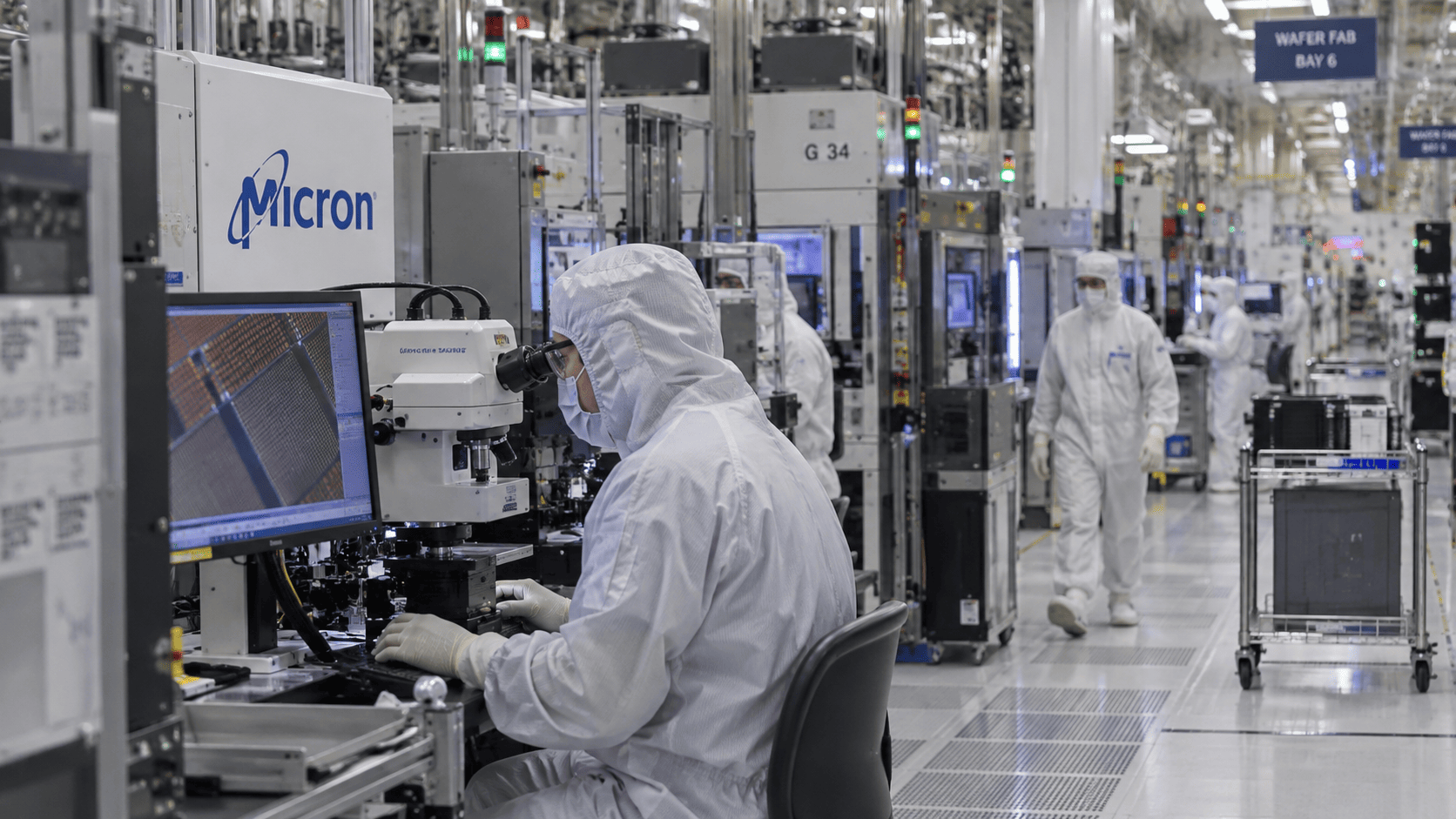
The artificial intelligence boom is reshaping the economics of the semiconductor industry, delivering windfall profits for memory-chip makers while giving workers greater leverage to demand a larger share of those gains. Micron Technology announced on Friday that direct labour employees in Taiwan would receive bonuses equivalent to 35 to 68 months of pay for fiscal 2026, with minimum cash compensation of NT$1.7 million (approximately $53,029). The company described the payouts as its strongest ever, with more than 60,000 employees globally set to receive fiscal 2026 rewards.
The announcement came as unions representing about two-thirds of Micron's workforce in Taiwan have signalled widespread support for a strike. Two unions representing roughly 10,000 employees at Micron's Taoyuan and Taichung facilities have been pushing for changes to the company's bonus structure. The latest rewards include a NT$1 million (approximately $31,193) cash bonus for Taiwan employees who joined before August 29, 2025. For entry-level engineers, total rewards will average NT$3.4 million (approximately $106,058), including about NT$2.9 million (approximately $90,461) in cash compensation, with the remainder comprising equity at grant value. Every employee will also receive an annual equity grant, according to Micron.

The company employs about 15,000 people in Taiwan, one of its most important manufacturing hubs, and has invested more than NT$1.6 trillion (approximately $49.9 billion) on the island. The size of the payouts reflects the extraordinary turnaround in the memory-chip industry as demand for components used in AI infrastructure has surged. Memory makers have benefited from higher prices for DRAM, NAND, and high-bandwidth memory (HBM) as technology companies race to build increasingly powerful AI data centres. For workers, the boom has created an opportunity to demand a larger share of the profits generated by the industry's rapid expansion.
The battle over AI chip bonuses
Micron is not alone in facing pressure from employees over compensation. Samsung Electronics, one of the world's three major producers of DRAM and HBM chips required for AI systems, spent months in a dispute with workers over bonus payments earlier this year. The dispute reflected growing frustration among Samsung employees over what they saw as a widening gap with rival SK Hynix, which moved faster in supplying HBM products to Nvidia and other customers after the launch of ChatGPT in late 2022 accelerated demand for AI infrastructure. The stakes escalated when more than 45,000 Samsung workers threatened to stage what would have been the largest strike in the conglomerate's history from May 21. A strike could have disrupted production of memory chips that have become critical components in AI data centres, smartphones, and laptops.
A government-mediated agreement eventually brought the dispute to an end. Under the agreement, chip workers would receive 50% of their annual salary as a regular cash bonus, according to the union. Samsung would also set aside 10.5% of operating profit for special bonuses in the form of stock. Of that pool, 40% would be distributed across the entire chip business, while the remainder would be used to reward employees in the memory-chip unit. A memory-chip worker earning a base salary of ₩80 million (approximately $52,259) could reportedly receive total bonuses of about ₩626 million (approximately $408,927) this year. That payout would still be below the more than ₩700 million (approximately $457,267) that SK Hynix employees could earn if the company reaches an annual profit of ₩250 trillion (approximately $163.3 billion).
SK Hynix shifts toward stock rewards
SK Hynix has also been changing how it compensates workers as the value of its shares and profits have surged with the AI boom. Last month, the South Korean chipmaker said it had reached a tentative wage agreement with employees under which at least 60% of this year's bonuses would be paid in company stock, rather than entirely in cash as they were last year. SK Hynix had agreed last year to share 10% of annual operating profit with workers in cash under an arrangement that was set to remain in place for 10 years. This year, however, management's proposal to shift more than half of the bonuses into shares faced resistance from some workers concerned about the volatility of the company's stock.
Under the latest agreement, employees will receive 40% of their bonuses in cash and another 40% in stock that can be cashed out immediately. The remaining 20% will be paid as deferred stock compensation, with half distributed after one year and the rest after two years. The agreement also includes a 6.3% increase in base wages and allows the company to defer up to 3% of wages if SK Hynix records losses. The debate over compensation illustrates a broader tension in the memory industry. Chipmakers are investing heavily to expand capacity, but workers are also demanding compensation that reflects the exceptional profitability generated by AI demand.
Bonuses become an inflation concern
The scale of these payouts is becoming significant enough to attract the attention of South Korea's central bank. In a June 17 report, the Bank of Korea said inflation this year had been driven largely by higher energy prices linked to the Iran war. But it warned that even if the conflict subsides, inflationary pressures could gradually increase as household incomes improve and wage growth spreads. The central bank specifically highlighted unusually large performance bonuses at major information-technology companies. The BOK said bonuses would normally have a limited effect on demand because they do not represent permanent income, but the sheer size of these payouts could fuel spending and price pressures.
As the AI memory boom continues, the competition for talent and the pressure on companies to share profits are likely to intensify. For investors, the rising labour costs and potential inflation implications are factors to watch, even as memory makers enjoy record revenues. The memory price surge shows no signs of abating, and SK Hynix's recent rally underscores the market's optimism. However, the momentum in Micron's stock could be tempered by these labour dynamics. The competitive pressures on Samsung also add another layer of complexity to the industry's outlook.
This article is for informational purposes only and does not constitute financial advice.

