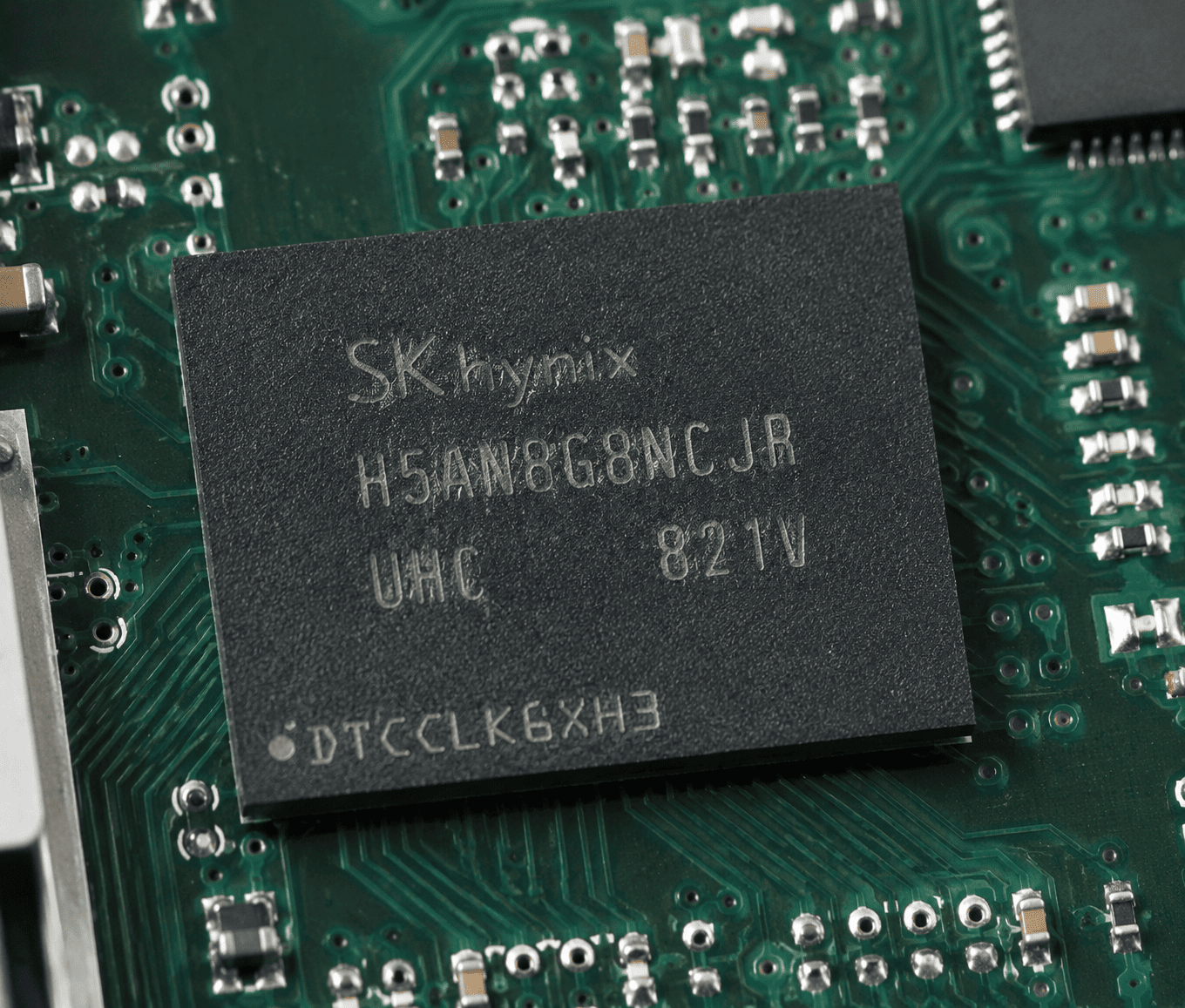
SK Hynix shares extended their sharp rally on Wednesday, climbing nearly 5% to 1.87 million won in morning trading, bringing the stock's weekly gain to roughly 17%. The surge underscores growing investor conviction that the next phase of the AI boom will demand significantly more memory, not less.
The primary catalyst was OpenAI's launch of GPT-6 Astra, which has revived the AI memory trade. Astra's agentic systems, designed to run longer and handle more complex tasks, are expected to increase total computing workloads, lifting demand for accelerators, server DRAM, and high-bandwidth memory (HBM). This is particularly favorable for SK Hynix, already a leading HBM supplier.
Kiwoom Securities analyst Han Ji-young told Seoul Economic Daily that earnings momentum across the AI industry has remained intact since the GPT-6 release. Han noted that the KOSPI's resistance around 7,000 appears more like consolidation than a trend breakdown, despite headwinds from higher oil prices, Middle East tensions, and weaker U.S. equities.
The more powerful driver, however, may be physical scarcity. KB Securities estimates that memory inventories at Samsung Electronics and SK Hynix have fallen below 10 days of supply. Kim Dong-won, head of research at KB Securities, told Korea JoongAng Daily that 2027 could bring the “tightest supply conditions in history” as hyperscaler AI infrastructure investment approaches $1.3 trillion.
HBM4, the next-generation memory, makes this constraint harder to solve. KB estimates that HBM4 requires roughly three times the wafer capacity of conventional DRAM. As manufacturers allocate more production to higher-margin HBM, less capacity remains for standard DRAM, potentially tightening the broader memory market simultaneously.
This shifts the investment case: investors are not merely betting on stronger AI demand but on demand rising into a supply base with minimal short-term cushion, allowing memory makers to sustain unusually strong pricing. The trend is reminiscent of Nvidia's warnings of a memory crunch through 2028, which had already boosted the sector.
SK Hynix's HBM opportunity is also broadening beyond Nvidia-linked GPUs. Meta, Microsoft, and other hyperscalers are developing proprietary AI accelerators that require large amounts of advanced memory. Mirae Asset analyst Kim Young-gun said that broader HBM adoption among ASIC developers is favorable for SK Hynix because it expands its customer base. Mirae raised its price target to 3.1 million won from 2.8 million won this week.
DB Securities separately lifted its target to 2.3 million won from 2 million won. Analyst Seo Seung-yeon expects HBM4 shipments to accelerate from the third quarter, while resilient server demand helps offset pressure from the stronger won. The stock's recent volatility, including a 20% slide on Apple-CXMT talks, highlights the sector's sensitivity to competitive dynamics.
Despite these swings, the current rally reflects a broader re-rating of memory makers as AI infrastructure spending accelerates. Investors are watching whether supply constraints will persist, as CXMT's DRAM share gains add a competitive wrinkle. For now, the market is betting that SK Hynix's leadership in HBM and the tight supply picture will continue to drive outperformance.
This article is for informational purposes only and does not constitute financial advice.