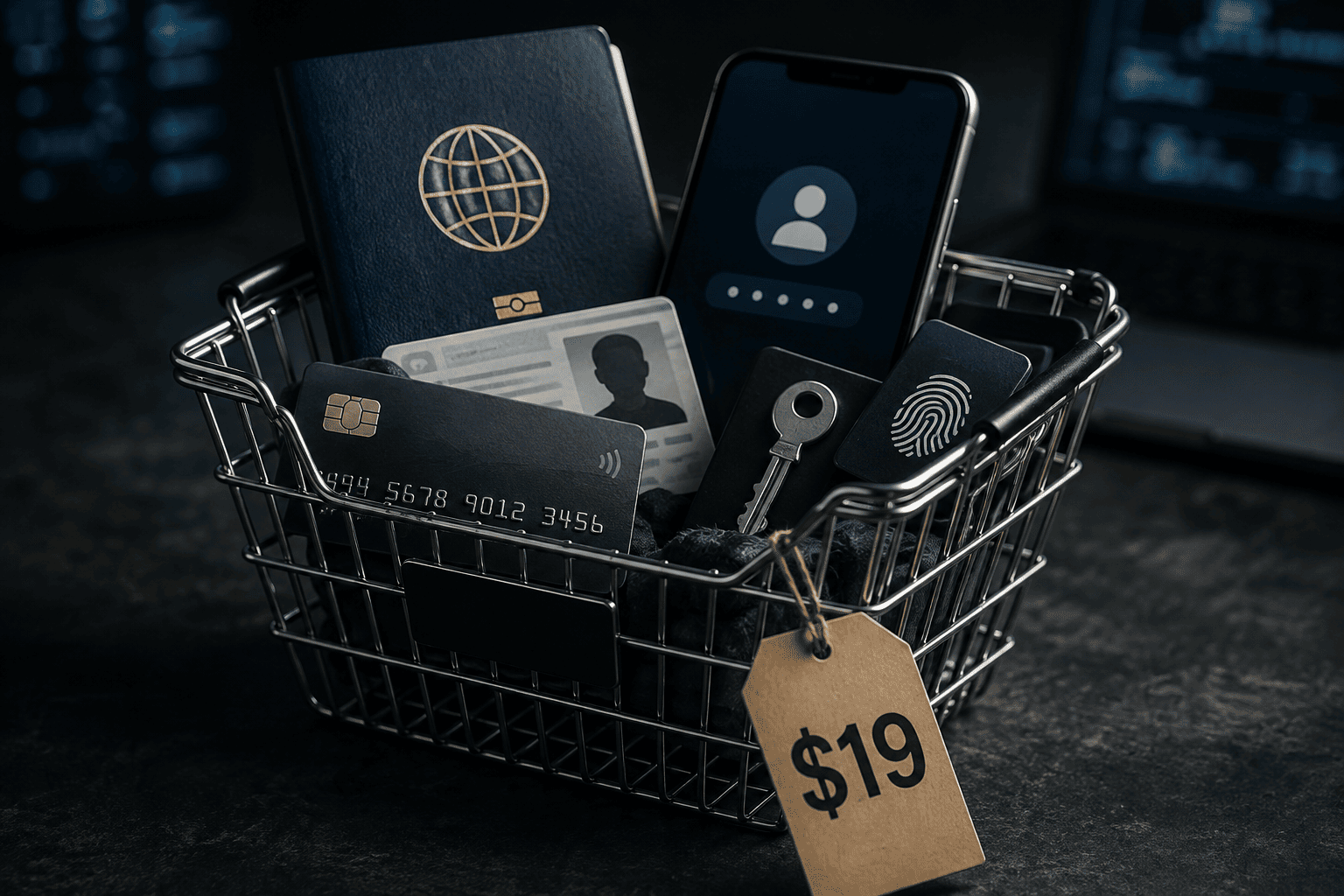
The cost of committing fraud has plummeted to almost nothing, according to Marijus Briedis, chief technology officer at NordVPN. Speaking on the On The Margin podcast, Briedis revealed that a complete set of stolen credentials—including a business email, a live credit card, and an ID—now sells for roughly $19. This dramatic price drop is a direct result of AI's ability to scale fraudulent activities at near-zero marginal cost.
Briedis explained that data breaches occur almost daily, providing a constant stream of raw material for fraudsters. "You are operating at a data level, and basically, you don't care, honestly. You just combine that data from different sources and put it into a basket... a new database, and you just try to sell it as much as possible," he said. This industrial-scale approach has led to record losses: the FBI's IC3 report counted $16.6 billion in cybercrime losses in 2024, a 33% year-over-year increase, while Deloitte projects generative-AI fraud could reach $40 billion in the US by 2027.

AI's Role in Fraud Industrialization
The barriers to entry for cybercrime have collapsed. Briedis noted that setting up a fake storefront to harvest credit card details is now "just like a ten-minute job these days, including buying the domain, putting the website, pushing it to the prod as we call it." This ease of deployment is why phishing and scam campaigns are scaling exponentially, particularly around major shopping events like Black Friday. He expects AI tools to accelerate this trend further.
The next frontier is voice fraud. Briedis described advanced attacks where scammers first call a relative to capture a person's voice, then use AI-generated audio to impersonate them in calls to other family members. He predicts fraud will increasingly combine text, voice, and video to create convincing deepfakes. A notable example is the 2024 case at Arup, where a Hong Kong finance worker transferred $25.6 million after a video call featuring AI-generated deepfakes of company executives.
The Rise of Machine Identity Fraud
Varun Kabra, chief growth officer at blockchain firm Concordium and former Proton executive, highlighted the emerging threat of AI agents conducting transactions autonomously. "The counterparty on the other side... has no way to verify where a real accountable human is behind the transaction," he said. This could open the door to bots acting as humans and agents operating without accountability. Kabra estimates that within six to twelve months, machine-to-machine transactions may outnumber human-to-human ones, making human-to-agent accountability a critical issue.
VPNs Evolve into Fraud Defense
NordVPN has expanded beyond its core VPN offering into a comprehensive fraud-defense suite. Briedis pointed to session cookies as a overlooked vulnerability: users who stay logged in can have their cookies stolen via info-stealers, allowing attackers to hijack accounts. He emphasized that product features must be simple enough for his mother to use, reflecting a focus on accessibility.
This pivot is also a margin story. Standalone VPN services have become commoditized, while identity and fraud protection offer higher value and customer stickiness. The market for identity-theft protection is estimated at $14-17 billion in 2025, with low-double-digit annual growth. Gen Digital's $1 billion acquisition of MoneyLion in April 2025 underscores this trend, as does NordVPN's own strategy.
Trust and Regulatory Risks
Briedis stressed that trust is the key differentiator for paid VPN providers. He questioned how free VPNs sustain their infrastructure, hinting they might monetize user data. NordVPN conducts annual no-logs audits and has withdrawn from markets where data retention is mandated, such as India's 2022 CERT-In rules. These decisions carry regulatory and political risks that investors should monitor.
As AI continues to lower the cost of fraud, the cybersecurity industry is shifting from simple privacy tools to robust identity protection. For investors, this represents a significant opportunity, but also underscores the growing threat landscape that could impact businesses and consumers alike.
This article is for informational purposes only and does not constitute financial advice.