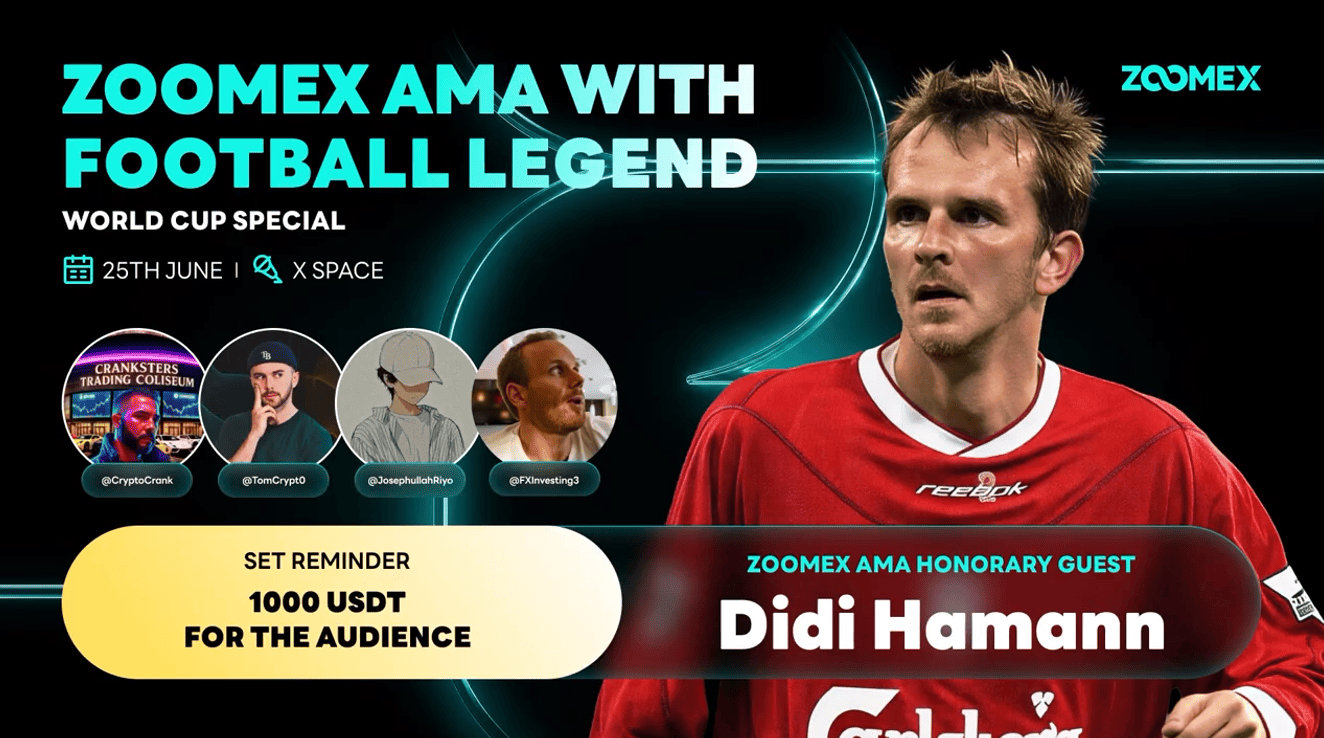
Zoomex hosted the second episode of its World Cup Edition X Space, bringing together Champions League winner Didi Hamann and three traders—Mario from Forex Trading & Investing, Crank, and Joseph—for a discussion that bridged football strategy and trading discipline. Hosted by Fernando Aranda, the session explored risk management, defensive structure, and the psychology of high-stakes decision-making.
Charity Initiative and Predictions
The event is part of Zoomex's five-part World Cup Impact Pledge, committing 1,000 USDT per episode to a charity chosen by each football guest, with an additional 5,000 USDT if the guest's World Cup prediction proves correct. Hamann backed Japan to beat Sweden and nominated a homeless support charity in Munich, a cause he regularly supports.
Risk and Reward: The 'Nothing to Lose' Dynamic
Aranda opened by asking which is harder: a match you must win, or one you cannot afford to lose. Hamann noted that the most dangerous opponents are those with nothing to lose. 'When a team has nothing to lose, they're the most dangerous because they just go for it,' he said. This dynamic, he argued, makes the must-win scenario easier to manage because the team still operates within a calculation, while a team with nothing to lose discards that calculation entirely. The panel cited Morocco against Italy and South Africa against South Korea as recent examples.
Crank observed the same pattern in trading: traders entering without a prebuilt plan are emotionally exposed, like a team with nothing to lose. The difference, he noted, is that in trading, the cost of that freedom comes directly out of your account.
Discipline Under Pressure
Hamann described his role as a holding midfielder, where he gave himself one instruction regardless of the score: win the ball, protect the structure, and give it to players with the license to take risks. 'I always felt in my position I couldn't afford to give the ball away,' he said, referencing teammates like Steven Gerrard and Luis Garcia. The 2005 Istanbul final against AC Milan served as a case study: Hamann came on at half-time with Liverpool trailing 3-0, and his disciplined approach helped spark a comeback. 'I was sure if we scored one, we'd score a second,' he recalled, emphasizing that the process did not change.
Joseph drew a direct parallel to trading: 'I always start with a plan, like a coach picks his starting eleven. But if the market moves against me, I exit my position early instead of hoping for a comeback. The best traders are not the ones who are always right; they are the ones who know how to manage risks when they are wrong.'
Defense Wins Championships
Aranda raised the classic sports adage that attack wins games but defense wins championships. Hamann agreed, sharpening the point: 'It's almost impossible to outscore teams on a regular basis. You need a good defense, a balance in your team, and a good holding midfielder.' He cited Barcelona's era of Messi, Suárez, and Neymar, which was built around defensive midfielder Sergio Busquets and defenders like Puyol and Piqué. France, he noted, ticks the same boxes in the current tournament.
The session underscored that discipline, structure, and risk management are as critical in trading as in football. For investors, the lesson is clear: a solid plan and the ability to adapt under pressure often outweigh aggressive, unstructured moves.
This article is for informational purposes only and does not constitute financial advice.