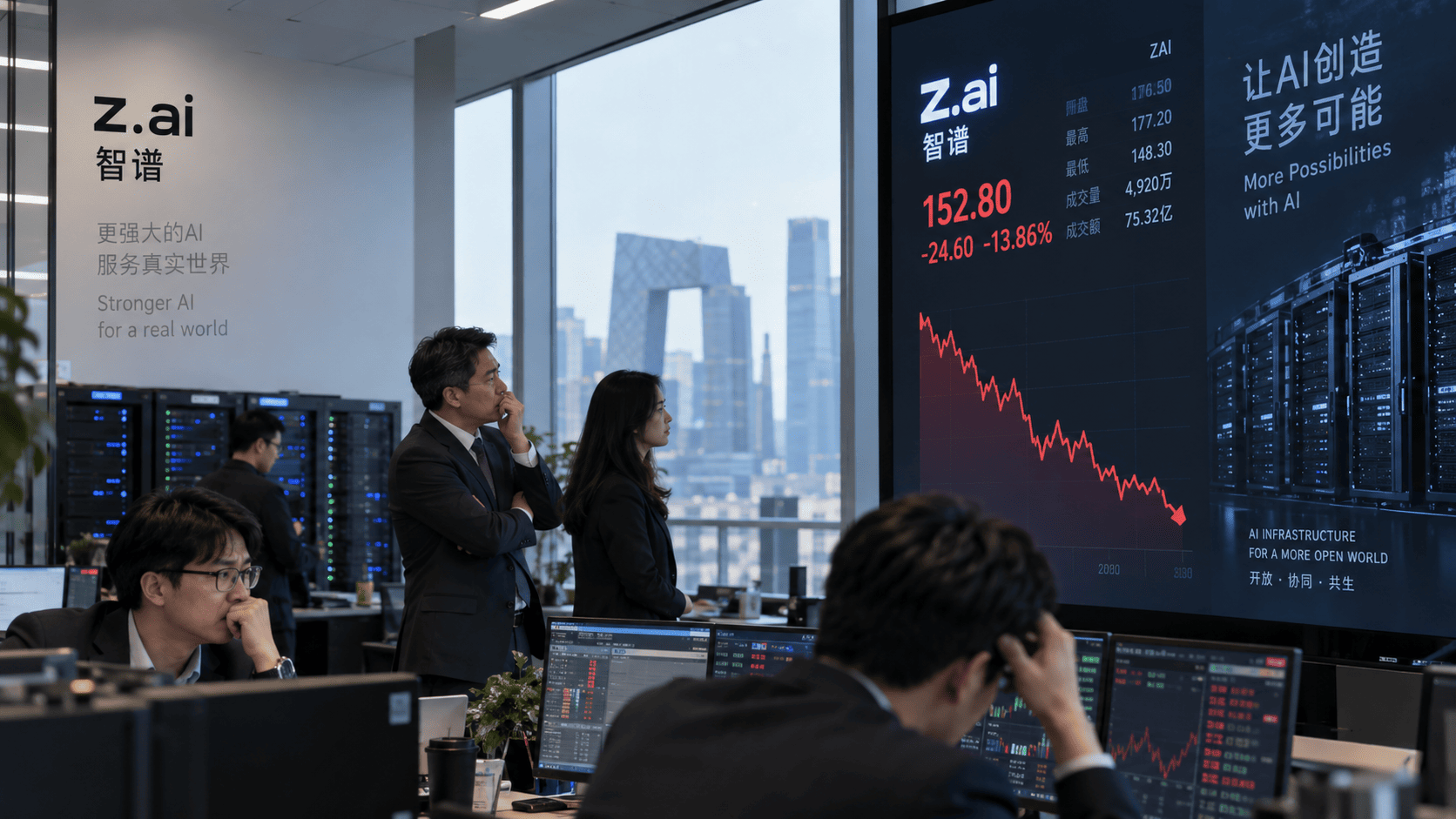
Z.ai, the Beijing-based artificial intelligence developer formerly known as Zhipu AI, saw its shares plunge as much as 10.5% on Monday following the completion of a $5 billion fundraising round. The move, which combines a Hong Kong share placement and convertible bonds, has put shareholder dilution squarely in focus even as the company posts explosive revenue growth.
The company raised approximately $2 billion through the issuance of 21.97 million new Hong Kong shares at HK$714 each—a 10% discount to Friday's close of HK$793—and another $3 billion via zero-coupon convertible bonds due in September 2027. Proceeds are earmarked for research and development, computing infrastructure, expansion, and potential investments or acquisitions.

This latest raise follows a $4 billion round in July, underscoring the capital-intensive nature of competing at the frontier of AI. The company's GLM models have edged closer to state-of-the-art performance, particularly in coding, and adoption among Chinese enterprises and overseas developers has grown. However, the financing also highlights the steep cost of staying in the race against global rivals like OpenAI and Anthropic.
Macquarie analyst Ellie Jiang told the South China Morning Post that the bank still models losses for Z.ai and MiniMax into 2030. Jiang noted that China's shortage of advanced computing power is two to three times more acute than the global crunch, partly due to US restrictions on Nvidia's most advanced processors.
Despite the dilution concerns, Z.ai's financial metrics are striking. First-half revenue surged 400% year-over-year to 953.9 million yuan, and Macquarie estimates annual recurring revenue (ARR) reached about $1.6 billion by August. The bank projects ARR could approach $3 billion by year-end, exceeding management's target of roughly $2.4 billion.
Yet investors are becoming more discerning about AI valuations. Jefferies acknowledged that Z.ai's ARR guidance beat expectations but flagged sustainability risks, including customer concentration, uneven compute supply, low switching costs, and intense competition. The brokerage maintained a Hold rating and cut its price target to HK$1,183.79 from HK$1,299.80, while also reducing the multiple applied to Z.ai's cloud business despite raising revenue forecasts.
The sell-off was not isolated to Z.ai. Asian AI stocks broadly declined on Monday after industry leaders called for a slower pace of model development over safety concerns. This broader pressure, combined with the dilution overhang, amplified the negative reaction.
Goldman Sachs, which initiated coverage this month with a HK$1,880 target, offers a more bullish perspective. The bank argues that Z.ai's strong coding usage could drive frequent model upgrades and reinforce its position in enterprise AI. From this angle, the latest raise is ammunition rather than distress—a rational investment to secure the compute necessary to remain competitive in a market still taking shape.
Monday's decline suggests investors are weighing the trade-off between growth and dilution more carefully. Z.ai may indeed need another $5 billion to stay in the game, but shareholders are demanding evidence that these billions will translate into durable margins rather than simply higher ARR and another funding round down the line.
This article is for informational purposes only and does not constitute financial advice.

