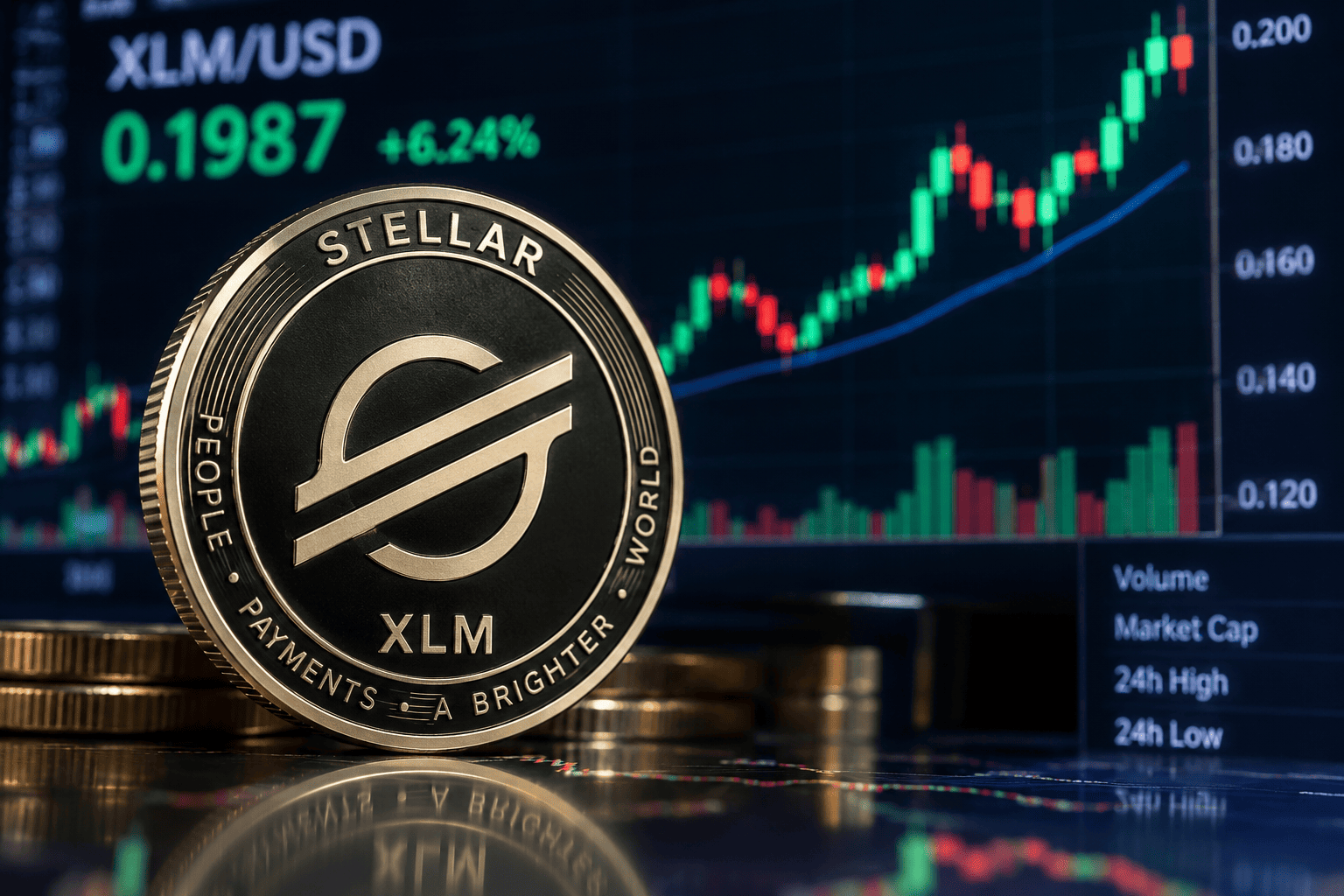
Stellar's native token XLM has advanced nearly 6% in the past 24 hours, trading around $0.193 on Sept. 15, as market participants position ahead of the network's Protocol 28 mainnet upgrade vote scheduled for Sept. 16. The move comes amid renewed interest in Stellar's payments infrastructure, highlighted by recent developments with MoneyGram and US Bank.
Protocol 28 upgrade vote
The Stellar Development Foundation has set the mainnet vote for Sept. 16 at 17:00 UTC, following a successful testnet upgrade on Aug. 27. Known as Adapter, the upgrade introduces several changes to Stellar Core and Soroban smart contracts. Key proposals include CAP-83, which allows validators to begin voting before receiving a complete transaction set and provides a mechanism to discard late or invalid sets, and CAP-85 and CAP-86, which focus on smart contract upgrades and data structure modifications.

The vote is the most immediate Stellar-specific catalyst for XLM's price action, with traders anticipating potential network improvements that could enhance scalability and functionality.
Payments ecosystem developments
Beyond the protocol vote, Stellar's ecosystem has seen notable activity. MoneyGram launched a stablecoin-backed Visa card in Colombia on Sept. 10, developed with stablecoin payments firm Rain and using Crossmint wallet technology on the Stellar network. The card supports USDC at launch, with plans to add MoneyGram's MGUSD stablecoin later. This extends MoneyGram's existing collaboration with the Stellar Development Foundation, which began in 2021 for cash-to-USDC and USDC-to-cash services.
Earlier in September, US Bank completed its first pilot transaction using USBDC, its proprietary dollar-backed stablecoin, over the Stellar network. The transaction moved funds between the bank's entities in North America and Europe while maintaining integration with US Bank's finance, risk, compliance, and operations systems. The pilot covered the stablecoin's full lifecycle, including minting, payment, redemption, freezing, and clawback. The bank and the foundation are exploring additional use cases such as liquidity management, collateral mobility, and cross-border treasury operations.
Price action and technical analysis
XLM's daily chart shows the token recovering from the $0.15-$0.16 area reached in August and pressing back toward $0.20. The latest move has pushed price above the early-September range of $0.175-$0.185, but $0.20 remains the first major resistance level. The daily Vortex Indicator has turned bullish, with VI+ at 1.1331 and VI- at 0.8630, indicating buyers are in control. The Money Flow Index has risen to 60, above the neutral 50 level but below the overbought threshold of 80, suggesting increased buying pressure without extreme conditions.
A daily close above $0.20 would bring the July swing area of $0.205-$0.21 into focus, with potential upside toward $0.22. Conversely, failure to break $0.20 could lead to a pullback, with first support at $0.185, followed by $0.175-$0.18 and the August base near $0.16.
On the 4-hour chart, XLM has formed a series of higher lows since dipping to $0.175 on Sept. 11, reaching $0.195 in the latest push. Trading volume expanded during the breakout above $0.185. The Percentage Price Oscillator (PPO) is positive, with the PPO line at 1.68% above its signal line at 0.81%, and the histogram expanding to 0.87%, indicating accelerating short-term momentum. Bull Bear Power stands at 0.0108, remaining positive during the move, confirming buyer control.
Immediate resistance is between $0.195 and $0.20. A 4-hour close above $0.20, supported by a positive PPO histogram and Bull Bear Power staying above zero, would target $0.205 and $0.21. If rejected, the breakout area around $0.185-$0.188 becomes the first support, with a drop below $0.185 exposing $0.178-$0.18 and a move under $0.175 negating the higher-low sequence.
As the Protocol 28 vote approaches, market participants will watch for the outcome and its potential impact on Stellar's network capabilities and adoption. The recent partnerships with MoneyGram and US Bank underscore the blockchain's growing role in payments, which could support long-term demand for XLM.
This article is for informational purposes only and does not constitute financial advice.

