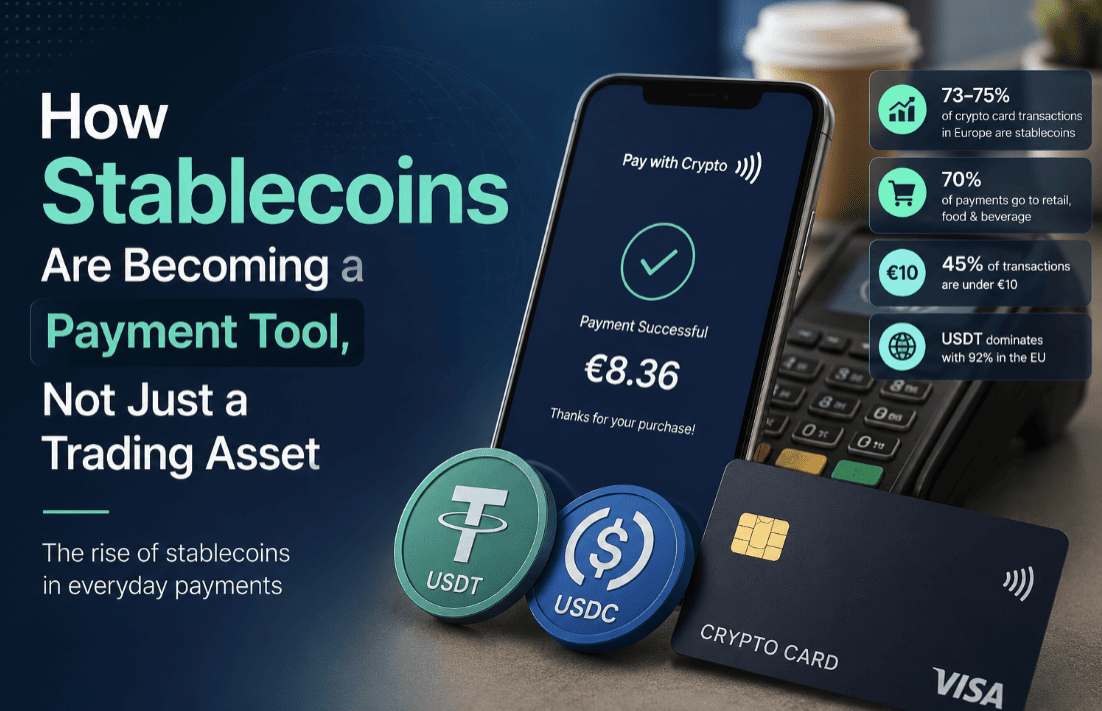
Stablecoins are rapidly evolving from a niche trading instrument into a practical payment tool, with new data showing they now account for roughly three-quarters of all crypto card transactions across Europe. This shift marks a significant departure from their original role as a bridge between volatile crypto assets and fiat currency.
Stablecoins Gain Traction in Everyday Spending
According to recent figures, stablecoins represent approximately 73–75% of crypto card transactions in the European Economic Area (EEA). Tether (USDT) alone accounts for about 92% of that stablecoin volume. The average transaction size is just $8.36, with around 70% of payments going toward retail, food, and beverage purchases. This data underscores a growing trend: users are increasingly turning to stablecoins for routine expenses like coffee, snacks, and small online orders, rather than solely for speculative trading or large transfers.

Why Stablecoins Are Winning Over Volatile Crypto
The primary driver behind this adoption is stability. Unlike Bitcoin or Ethereum, whose values can swing sharply within hours, stablecoins are pegged to traditional currencies like the U.S. dollar, offering predictable value. This predictability makes them far more suitable for everyday transactions, eliminating the risk that a coffee bought in the morning could cost significantly more by the afternoon. As a result, stablecoins are moving beyond trading desks and into wallets used for daily purchases.
ConfidoPay: A Case Study in Frictionless Spending
Platforms like ConfidoPay are at the forefront of this transformation. The service links crypto holdings directly to virtual and physical payment cards, bypassing the typical multi-step process of converting crypto to fiat on an exchange and then withdrawing to a bank account. Users can connect their stablecoin balance, load a card, and spend via Apple Pay or Google Pay with automatic conversion at the point of sale. This seamless experience is particularly valuable for freelancers paid in USDT or travelers who want to use crypto abroad without pre-converting funds. ConfidoPay's payments-first architecture distinguishes it from many competitors that treat spending as an add-on to trading apps.
Real-World Use Cases: From Freelancers to Travelers
A typical user journey illustrates the practical benefits: a freelancer receiving payment in USDT can spend directly from their balance the same day, avoiding exchange delays and transfer fees. Similarly, a traveler holding stablecoins can use a ConfidoPay card for a taxi or dinner in a foreign country, with conversion happening automatically at checkout. These scenarios highlight how stablecoins are becoming functional money, not just assets sitting in a wallet.
Adoption Still Lags Behind Ownership
Despite these advances, crypto ownership in Europe has grown from 4% in 2022 to 9% in 2024, yet only 16% of holders actually use crypto for payments. Merchant acceptance remains a concern for nearly half of users, and volatility fears persist. Stablecoins address the volatility issue, but changing ingrained habits takes time. The infrastructure, however, is improving rapidly.
The Future of Crypto Payments
As payment tools like crypto cards and digital wallets become more sophisticated, stablecoins are likely to play an increasingly central role in everyday finance. The conversation has shifted from 'which coin to buy' to 'what can I actually do with this?' Platforms such as ConfidoPay, along with innovations in tokenized assets and trading infrastructure, are turning that question into actionable answers. For a deeper look at how tokenized assets are reshaping markets, see our analysis on Tokenized Real-World Assets Need Market Infrastructure, Not Just Digital Wrappers. Additionally, the integration of crypto wallets with broader financial ecosystems, as seen with KuCoin Web3 Wallet Integrates Robinhood Chain, further expands the utility of stablecoins.
Stablecoins won't replace traditional payments overnight, but they are making crypto feel far less distant from everyday life. As more users discover the convenience of spending stablecoins directly, the line between crypto and conventional money continues to blur.
This article is for informational purposes only and does not constitute financial advice.