Shares of SpaceX (SPCX) declined 4% on Tuesday after the Federal Aviation Administration (FAA) said it would conduct an environmental impact statement and hold public hearings on the company's proposal to significantly expand launch and landing operations at its Starbase facility in South Texas.
The proposed expansion, which would eventually allow up to 456 launches and 912 landings annually, represents a substantial increase from the current authorization of 25 launches and 50 landings per year. The plan is part of SpaceX's broader strategy to scale up its Starship program, which the company expects to support its broadband and artificial intelligence ventures.

Two-Phase Expansion Plan
Under the proposal, SpaceX would initially be permitted to conduct up to 100 Starship launches and 200 landings annually, with no restrictions on timing. A second phase, contingent on improved vehicle reliability, would raise the annual limit to 456 launches and 912 landings, though launches would be restricted to weekdays.
The landing limits apply to returns to Starbase regardless of where the vehicles originally launched. SpaceX plans to recover both the Starship spacecraft and its Super Heavy booster upright and intact, enabling faster reuse. The company would also retain the option to splash down rocket components in the Gulf of Mexico or the open ocean.
FAA Review Focuses on Environmental and Aviation Risks
The FAA's environmental review will assess potential impacts on coastal resources, local wildlife, and regional air quality. Regulators will also examine effects on commercial aviation, as airlines sometimes adjust flight routes to avoid launch danger zones and potential debris from rocket explosions.
The FAA said a draft environmental study would be published later, providing the public an opportunity to review and comment. This regulatory step means the proposed increase in Starship activity remains subject to federal assessment.
SpaceX Chief Executive Officer Elon Musk has long pursued a vision of high-frequency Starship flights, with future ambitions of multiple launches per hour. The company is also planning a separate $100 billion launch complex in southern Louisiana to support its intended launch cadence.
Falcon 9 Operations Continue
Despite the focus on Starship, SpaceX continues to operate its established Falcon 9 launch system. A Falcon 9 rocket carrying a Dragon capsule departed Cape Canaveral, Florida, early Tuesday on a mission to deliver about three tons of equipment to the International Space Station. The capsule is scheduled to dock with the station on Thursday.
SpaceX has launched Falcon 9 more than 110 times this year and is on pace for about 150 launches by the end of December, compared with 165 last year. The rocket accounted for approximately 47% of all launches this year, down from 50% in 2025, reflecting increased competition in the launch market.
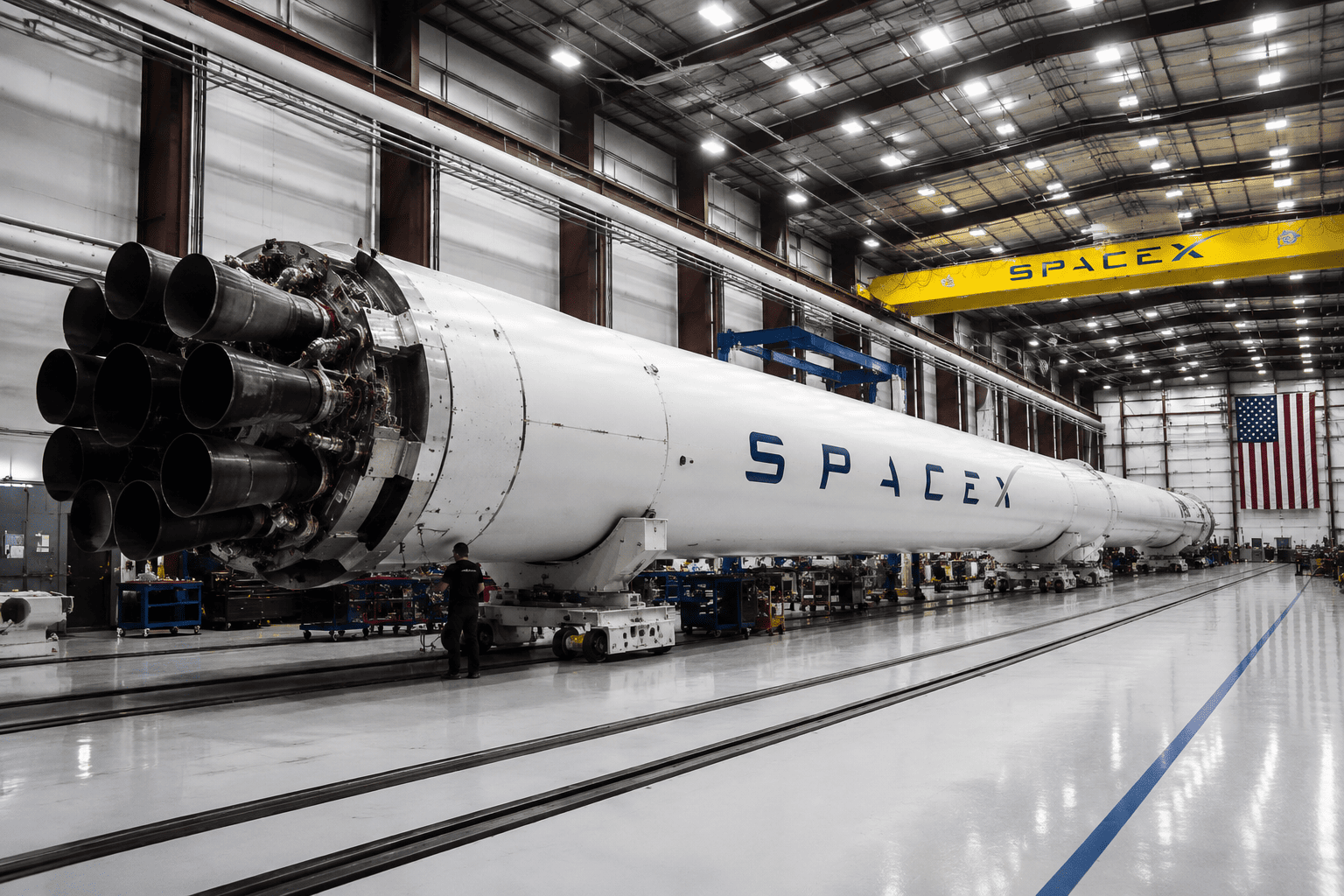
Starship is being developed as a larger, fully reusable launch system, almost twice as tall as Falcon 9 and with roughly six times its payload capacity. The company expects Starship to support the expansion of its broadband and AI businesses while providing additional services to NASA and other commercial partners.
SpaceX has yet to achieve full reusability for Starship. Company executives hope to land both the spacecraft and its Super Heavy booster back at Starbase before the end of the year.
This article is for informational purposes only and does not constitute financial advice.