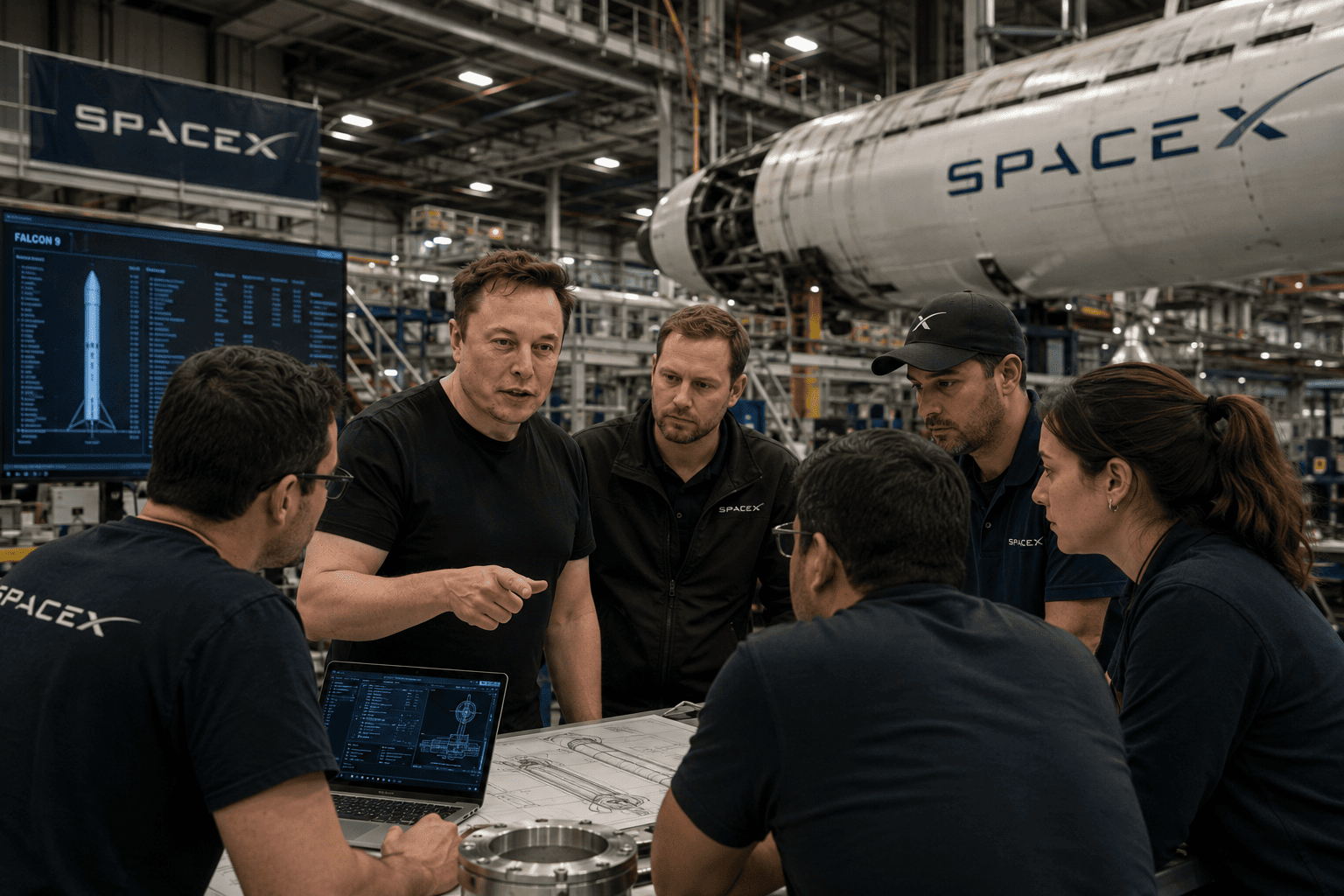
SpaceX (NASDAQ:SPCX) is set to release its first quarterly earnings as a publicly traded company on Tuesday, a moment that will test whether Starlink's profitability can underwrite the company's ambitious spending on artificial intelligence and space infrastructure. The stock has faced pressure since its June listing, with much of the criticism centered on Elon Musk's outsized voting control and his combined roles as CEO, CTO, and chairman.
Jefferies strategist Aniket Shah, however, argues that attributing the recent share weakness to governance is a stretch. Speaking with Bloomberg, Shah suggested that the market's concerns may be misplaced, and that the more immediate risk lies in SpaceX's ability to fund its heavy capital expenditures without over-relying on debt or diluting shareholders.
Governance vs. financial reality
Shah, who serves as Jefferies' global head of sustainability and transition strategy, questioned the automatic rejection of companies with concentrated ownership or dual-class structures. His comments are not an earnings forecast or a formal recommendation, but they shift the narrative toward the financial challenges SpaceX faces.
That said, governance risks remain. Musk's control of over 80% of voting rights gives outside shareholders limited influence, and critics have raised concerns about board independence and potential conflicts with his other ventures. But these issues were known before the June 12 listing, so the recent stock slide may reflect something else—possibly a reassessment of AI-related growth assumptions.
Starlink's role in funding the moonshots
Tuesday's report will be a key test. Consensus estimates from Visible Alpha put second-quarter revenue at $6.9 billion, led by the Connectivity division, which includes Starlink. That unit is expected to post a 35.9% operating margin, helping to offset losses in the Space and AI segments, according to S&P Global Market Intelligence.
Earnings per share estimates vary widely, from a loss of $1.26 to a profit of $0.33, reflecting uncertainty about the timing and classification of development expenses. As a result, investors will likely focus more on Starlink subscriber growth, Connectivity margins, and spending guidance than on a single EPS figure.
Updates on Starship development, AI data centers, and the timeline for turning these investments into revenue will also be closely watched. S&P Global's Melissa Otto highlighted capital investment as a key concern, with consensus projections showing annual capital expenditure rising from $48.7 billion in 2026 to $118.4 billion in 2028. Debt could climb from $41.7 billion to over $218 billion in the same period.
Valuation and share supply loom
Analyst targets reveal a wide valuation gap. Morgan Stanley's Adam Jonas remains bullish with a $300 price target, suggesting that shares below $120 offer reasonable value for the Space and Connectivity businesses, while assigning limited value to the AI opportunity. Morningstar, by contrast, values SpaceX at $63 per share, arguing that the market price relies heavily on optimistic outcomes for Starship, satellite connectivity, and orbital computing that remain unproven.
Adding to the uncertainty, the first earnings-linked lock-up expiration arrives on August 6, when up to 911.5 million shares could become eligible for sale. Morningstar notes that staggered releases could eventually place more than 6.4 billion additional shares on the market, although eligibility does not guarantee selling.
SpaceX will publish results after Tuesday's market close, followed by a webcast at 4:30 PM ET. The outcome will likely influence not only SpaceX's stock but also sentiment across the broader space and AI investment landscape. For context, recent market movements have been shaped by similar earnings-driven reassessments, as seen in Palantir's pre-earnings steadiness and Wix's AI-related valuation concerns.
This article is for informational purposes only and does not constitute financial advice.

