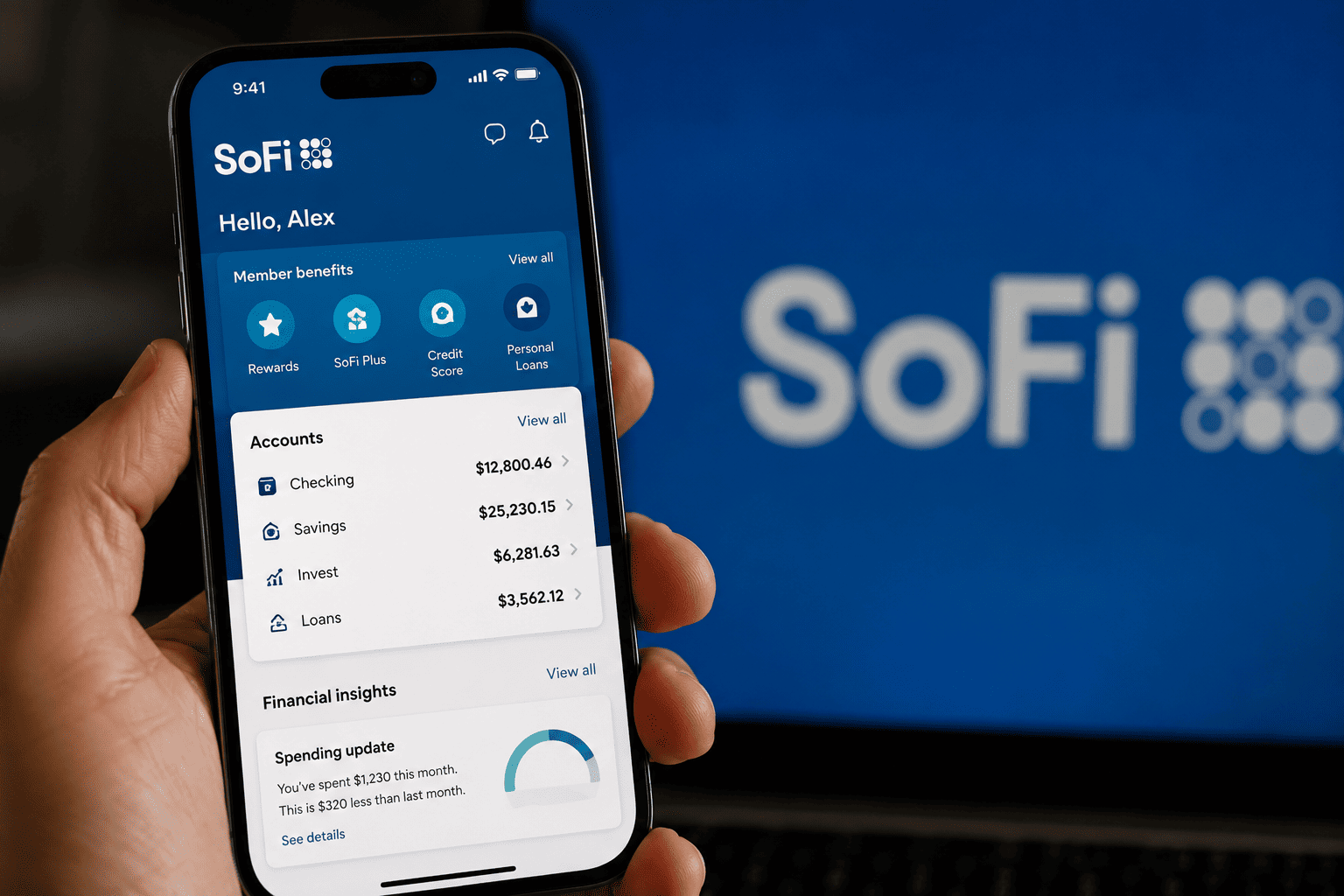
SoFi Technologies (NASDAQ: SOFI) saw its shares decline more than 9% on Wednesday, even after the fintech lender delivered second-quarter results that topped analyst estimates and lifted its full-year 2026 revenue guidance. The market reaction underscores a disconnect between headline numbers and investor concerns over interest rate uncertainty and the company's ability to sustain margin expansion in the second half of the year.
Earnings and Revenue Beat Estimates
SoFi reported earnings per share of $0.12, surpassing the consensus estimate of $0.11. Revenue rose 43% year over year to $1.2 billion, exceeding the $1.1 billion analysts had expected. The company also raised its 2026 revenue outlook to a range of $4.8 billion to $4.9 billion, above the roughly $4.7 billion Wall Street had penciled in.

Despite these positive figures, the stock sold off sharply, a move analysts described as a classic "sell the news" event. Investors had bid up SoFi shares ahead of the report, and the strong results may have already been priced in. Attention quickly shifted to the second-half outlook, where the company will need to boost its adjusted EBITDA margin from about 30% in the first half to roughly 38% in the second half to meet its full-year target. That significant ramp remains a key area of skepticism.
Record Growth in Lending and Membership
CEO Anthony Noto characterized the quarter as an inflection point, highlighting record customer acquisition and deeper engagement. SoFi added a record 2.2 million new products during the quarter, a 42% increase year over year, and for the first time added twice as many products as new members. Total loan originations reached a record $14.8 billion, while the member base expanded 35% year over year to 15.8 million.
"Despite continued market uncertainty, our business model continues to prove its durability," Noto said in the earnings release. The results suggest consumer borrowing activity remains resilient even with elevated borrowing costs and persistent inflation.
Fed Uncertainty Weighs on Sentiment
Investor sentiment toward SoFi remains sensitive to expectations around U.S. monetary policy. While the Federal Reserve is widely expected to hold rates steady at its upcoming meeting, markets have recently priced in a higher probability of a rate hike following hawkish comments from policymakers and rising energy prices. According to the CME FedWatch Tool, traders on Tuesday assigned a 35.8% chance of a quarter-point increase, up from just 16% a week earlier. Interest-rate swaps implied roughly a 40% probability of a hike.
Higher interest rates create a mixed environment for consumer lenders. While banks can earn higher yields on loans, elevated borrowing costs typically reduce credit demand, increase default risk, and constrain deposit growth. These dynamics can disproportionately affect companies like SoFi, whose lending business is its largest revenue driver and whose customer base skews toward younger borrowers.
Analysts Point to Elevated Expectations
Analysts said the weak price action reflected more than just macro headwinds. Truist maintained a Hold rating on SoFi with an $18 price target ahead of the results, warning that the remainder of 2026 "may prove difficult" for the company. The broader market also offered little support, with the S&P 500 slipping 0.12% and the Nasdaq Composite falling 0.16% on Wednesday.
Investors are also monitoring fintech peers such as LendingClub and Upstart for signs of changing credit conditions across the consumer lending sector. The selloff in SoFi shares suggests that, despite another quarter of rapid growth and raised guidance, the market is demanding evidence that the company can sustain margin expansion while navigating an uncertain interest-rate environment.
For context, broader market dynamics have also been influenced by recent moves in other sectors. For example, a DRAM ETF slid 43% as semiconductor stocks tumbled, while Wall Street futures were mixed ahead of the Fed decision and big tech earnings. Meanwhile, Visa shares slid 4% after its Q3 earnings miss on margin pressure, highlighting the broader challenges facing financial firms.
This article is for informational purposes only and does not constitute financial advice.