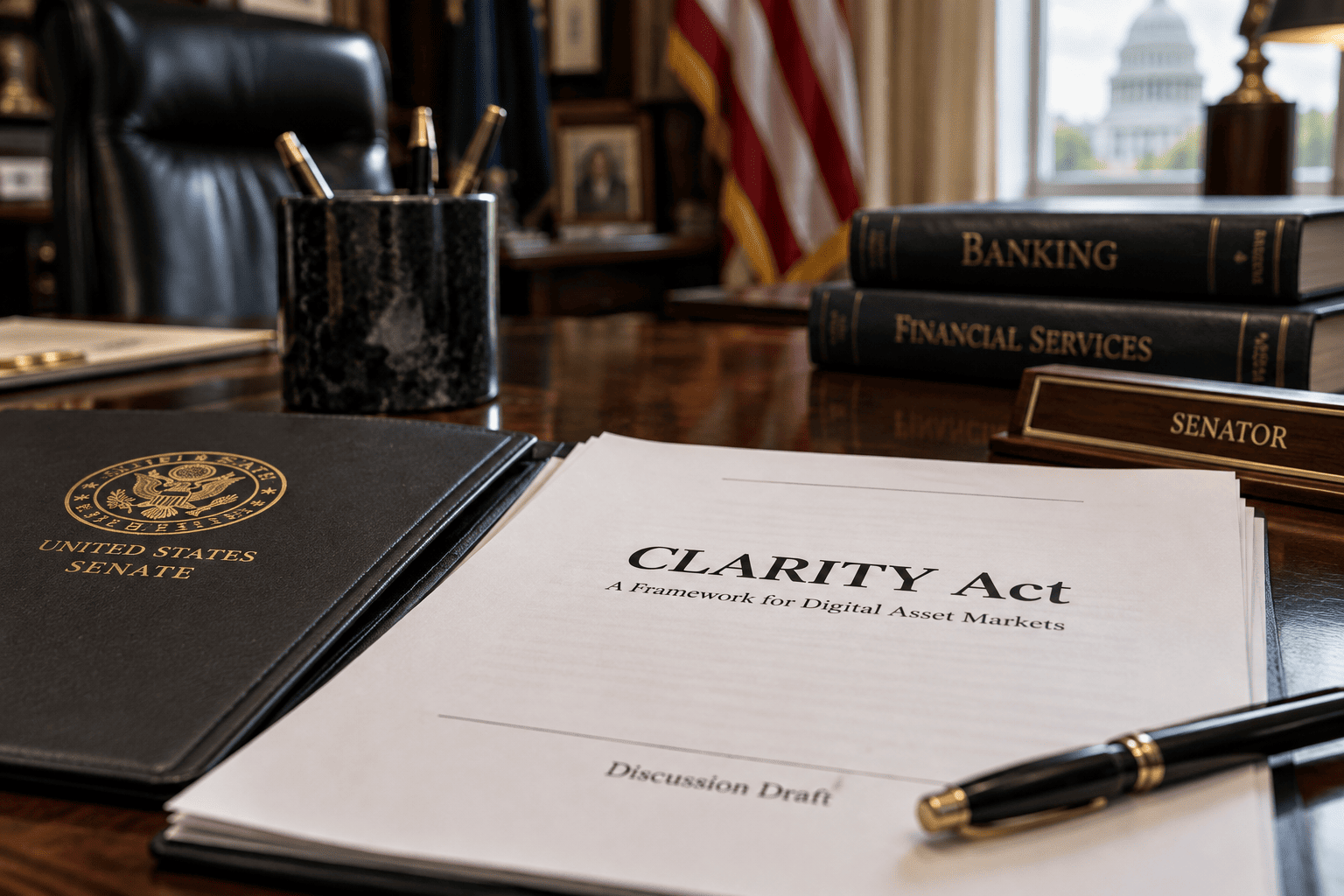
Senate Republicans have unveiled a revised 635-page version of the Digital Asset Market Clarity Act (CLARITY Act), calling it their final offer to Democrats ahead of a critical procedural vote scheduled for Tuesday at 2:15 pm ET. The updated text incorporates 126 changes requested by Democrats, adds new ethics restrictions, narrows protections for blockchain developers, and introduces a potential circuit breaker for stablecoin rewards.
Key Revisions Aim to Address Democratic Concerns
The revised bill, released by Digital Assets Subcommittee Chair Cynthia Lummis, Banking Chairman Tim Scott, and Agriculture Chairman John Boozman, reflects over a year of bipartisan negotiations. The ethics section largely adopts a proposal from Senators Thom Tillis and Ruben Gallego, imposing restrictions on federally elected officials, judges, and their spouses. President Donald Trump has also agreed to divest substantial crypto-related interests or place them in a blind trust. Additionally, state attorneys general would be empowered to enforce ethics requirements involving federal officials.

Senator Lummis described the bill as a bipartisan compromise and urged Democrats to support it, arguing that rejection would leave Americans without stronger protections in digital asset markets and weaken U.S. leadership in the sector. However, Senator Chris Van Hollen remains opposed, stating the bill still has significant problems and is being presented as consumer protection legislation despite unresolved concerns.
Developer Protections and Stablecoin Rules Tightened
The revised text narrows the Blockchain Regulatory Certainty Act's protections to cover only the Bank Secrecy Act and civil enforcement, removing language that would have shielded developers from criminal charges under 18 U.S.C. 1960—a statute previously used against developers of Tornado Cash and Samourai Wallet.
On stablecoins, the bill introduces a mechanism allowing Treasury Secretary Scott Bessent to direct federal regulators to intervene if substantial deposits move from community banks into stablecoins. This change addresses banking industry concerns that interest-like rewards could trigger deposit flight and reduce local lending capacity. The agriculture section also adds limits on vertical integration and affiliate trading at digital commodity exchanges, brokers, and dealers, while clarifying that developer protections do not exempt anyone from derivatives laws.
Vote Outcome Uncertain as Banking Opposition Persists
The Senate Banking Committee approved the CLARITY Act in May, but securing the 60 votes needed for cloture remains challenging. With full attendance, at least seven Democrats would need to support the measure. Senate Majority Leader John Thune has framed Tuesday's vote as a procedural step, not a final passage, leaving room for amendments if the motion succeeds.
A Democratic aide indicated some Democrats may back the motion to keep negotiations alive, especially since further changes could be considered before final passage. The White House has also signaled willingness to offer additional concessions if the Senate clears the preliminary vote. Crypto industry executives remain confident; Coinbase CEO Brian Armstrong said regulation would emerge regardless of the vote, noting that the SEC and CFTC are prepared to issue rules if the bill fails.
However, banking groups, including the American Bankers Association and nearly 80 other organizations, continue to oppose the current version. They have urged Senate leaders to strengthen restrictions on stablecoin interest, yield, and rewards, warning that weak protections could threaten community-bank deposits and local lending to small businesses, farmers, and families. The updated bill has not fully resolved these concerns.
If the legislation passes, companies like Circle and Coinbase could benefit; both saw premarket gains on Monday. Yet the outcome of Tuesday's vote remains uncertain, and failure could leave lawmakers with limited time to revise and pass the bill before the end of the congressional session. For more context on recent market reactions, see Coinbase's stock surge and XRP's slide on regulatory uncertainty.
This article is for informational purposes only and does not constitute financial advice.

