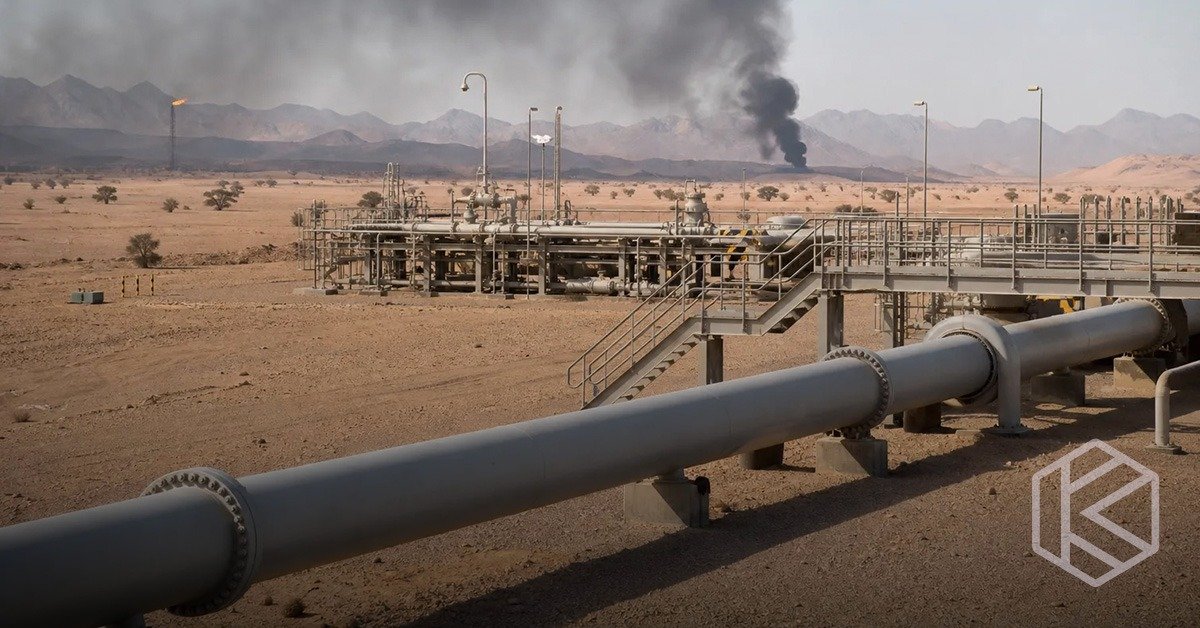
Saudi Arabia's East West pipeline stayed offline this week following drone attacks on pumping stations, cutting off roughly four million barrels a day of crude that normally reaches the Red Sea port of Yanbu. The kingdom's energy ministry described the closure as precautionary but gave no assessment of damage or a timeline for restarting flows.
Brent crude climbed $3.90 on Monday to settle at $108.50 a barrel, a gain of 3.7% for the session. Industry sources indicate Yanbu's storage capacity can support exports for five to seven days before the outage begins to remove as much as 4% of global supply from the market.

Repair timelines diverge
Saudi officials have attributed the drones to Maysan province in south-eastern Iraq, near the Iranian border, an area that has long hosted Iran-aligned armed groups. Estimates for restoring the line vary widely: one source told Reuters repairs could take five to six weeks, another suggested a partial restart might come sooner, and Goldman Sachs cited assessments ranging from very soon to eight weeks.
The East West route was built to bypass the Strait of Hormuz, which has been largely closed during the US-Israeli conflict with Iran. In recent months it has carried between 4% and 5% of worldwide supply. Saudi output had already dropped to 6.2 million barrels a day last month, down from 10.9 million six months earlier — a more than three-decade low reflecting constrained flows through both Hormuz and the Red Sea.
The International Energy Agency expects global oil supply to contract by 5.7 million barrels a day year on year, a decline of roughly 6%.
Bond markets under pressure
The supply shock is landing on fixed income markets still processing last Thursday's sell-off, which pushed the 10-year US Treasury yield up 11 basis points to 4.95%. The 30-year yield reached 5.36% that day, a level last seen nearly two decades ago. A Treasury buyback of up to $5.7 billion, which took in just under $5 billion, did little to slow the advance.
Wholesale price data point to accelerating inflation last month, and CME FedWatch put the probability of a Federal Reserve rate increase at the next meeting at 70% on Thursday, up from 49% a week earlier. The 10-year yield, already at its highest in almost three years, touched the 5% mark on Monday.
European bonds show similar strain. Germany's 10-year Bund yield stands at 3.395%, and the 10-year UK gilt yield is at 5.294% following Thursday's sell-off. The European Central Bank's main rate sits at 2.5% after a 25 basis point increase that day, following an earlier rise, and the bank expects inflation to remain well above target for an extended period.
Portfolio exposure measured by calendar
David Nilson, Director of Private Clients at Kinzey Capital Management, assesses both shocks against the dates on which capital must be available, describing that schedule as "a truer measure of exposure to this shock than any abstract tolerance for risk."
Income portfolios face a more difficult calculation, because government bonds hedge growth shocks more reliably than inflation shocks. When supply disruption coincides with elevated inflation, yields rise and bond returns weaken, squeezing fixed-income books between slower growth and higher prices. Two-year and 10-year rates are now rising in parallel, a signal that markets are repricing the level of rates rather than the shape of the curve. Nilson sees in that shift "a different arithmetic for any obligation that promises fixed payments on fixed dates."
Liquidity carries its own test, and the energy shock four years ago demonstrated how rapidly it can arrive. Collateral postings on commodity portfolios roughly doubled in the first half of that year, and European utilities faced margin calls of up to $1.2 billion while gas prices rose from $92 per MWh early in the year to nearly $391 by late summer. Portfolios funding withdrawals within one to three years face a different question from accounts compounding across decades, because cash must be present on the afternoon it is required.
Whether markets treat the closure as a regional event or reassess its global economic weight depends on how long the supply loss persists. Kinzey Capital Management's reading is that the impact falls unevenly across portfolios, because energy volatility transmits through inflation expectations, consumer spending, corporate earnings and central bank policy, each carrying a different weight. Nilson argues that "the duty capital carries, and when it may be called on, decides what this disruption means for each book."
This article is for informational purposes only and does not constitute financial advice.

