Nvidia (NASDAQ: NVDA) delivered another blockbuster quarter, but the market's reaction was muted, with shares slipping more than 1% in after-hours trading. The chipmaker reported record second-quarter fiscal 2027 revenue of $96.2 billion, up 18% sequentially and 106% year over year, driven by relentless demand for AI infrastructure.
Net income more than doubled to $53.95 billion, while diluted earnings per share came in at $2.22 on a non-GAAP basis, surpassing analyst expectations. GAAP EPS was $2.46. Gross margins held steady at 75% on both GAAP and non-GAAP bases, reflecting strong pricing power despite rising competition.
Data Center remains the growth engine
Data Center revenue surged 117% year over year to $89 billion, accounting for the vast majority of total sales. The company said its Vera Rubin platform is now in full production, with systems deployed at major cloud providers including CoreWeave, Google Cloud, Microsoft Azure, Oracle Cloud Infrastructure, and Nebius. Nvidia also highlighted the rollout of its Spectrum-6 networking platform and the Vera CPU, its first processor designed specifically for AI agents. The Groq 3 LPX inference accelerator has also entered full production.
These results underscore Nvidia's evolution from a GPU supplier to a provider of complete AI factory infrastructure, a strategy that has helped it maintain dominance in the AI chip market.
Guidance points to continued growth
For the third quarter of fiscal 2027, Nvidia expects revenue of $108 billion, plus or minus 2%, which would represent another sequential increase. Notably, the guidance excludes any Data Center compute revenue from China, reflecting ongoing export restrictions. Gross margins are projected at 74%, plus or minus 50 basis points, slightly below the second quarter's 75% as the company ramps new products.
Operating expenses are expected to rise to approximately $9.2 billion on a GAAP basis and $9 billion on a non-GAAP basis, as Nvidia continues to invest heavily in R&D and market expansion.
Why the stock is slipping
The tepid market reaction highlights growing investor skepticism about the sustainability of the AI boom. After years of rapid appreciation, some market participants worry that valuations across the AI sector have entered bubble territory. Nvidia's numerous investment agreements with AI companies have also raised concerns about circular transactions, which could amplify downside risks if spending momentum slows.
As the world's most valuable company and the leading supplier of AI accelerators, Nvidia's results are closely watched as a barometer for the entire AI industry. The stock's decline despite strong fundamentals suggests that investors are increasingly focused on the long-term durability of AI capital expenditures.
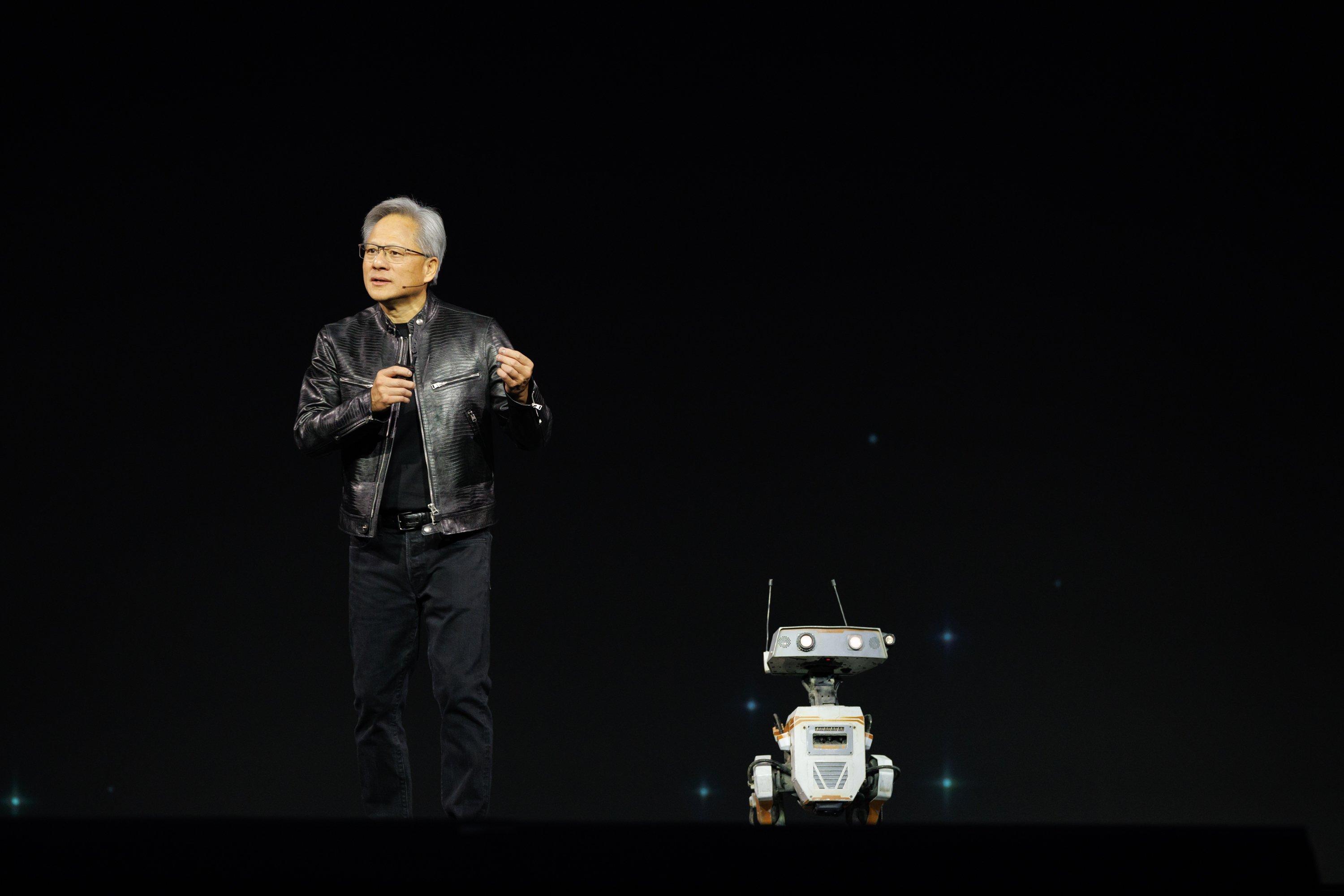
CEO Jensen Huang struck an optimistic tone, stating, "We believe AI has reached its inflection point. It's doing useful work. Its tokens are productive and profitable. Now, compute is revenue."
The company's conference call with investors is scheduled for 5 p.m. ET, where executives are expected to provide additional color on demand trends and the competitive landscape.
For context, Nvidia's performance comes amid a broader market environment where inflation data and earnings are shaping investor sentiment. The company's results also follow a period of volatility in its share price ahead of the report.
While Nvidia's fundamentals remain robust, the market's reaction suggests that even stellar numbers may not be enough to quell concerns about the sustainability of AI-driven growth. Investors will be watching for signs of whether the massive spending cycle can continue in the quarters ahead.
This article is for informational purposes only and does not constitute financial advice.