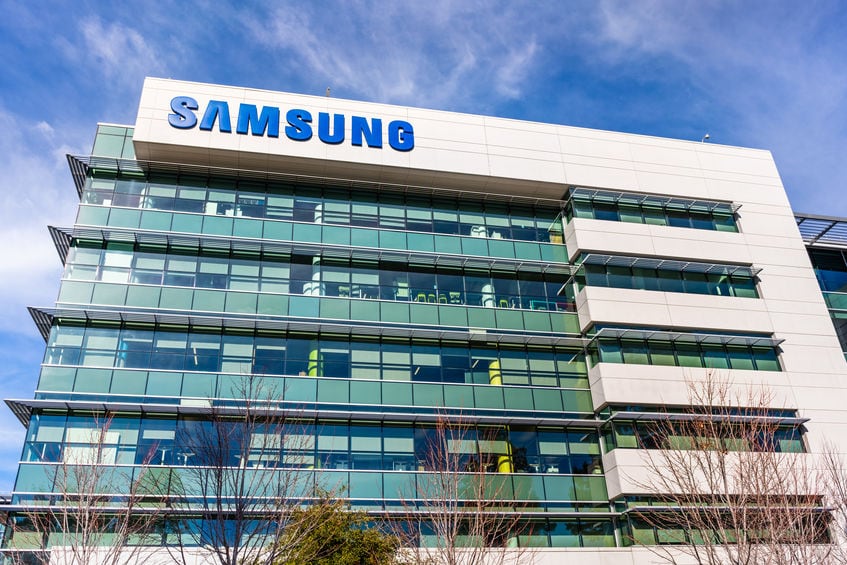
Samsung Electronics shares climbed sharply on Thursday after the company posted record quarterly earnings, reigniting investor optimism around its artificial intelligence memory business. The stock opened more than 2% higher and surged as much as 8% before settling around a 5% gain.
Record earnings driven by AI chip demand
For the second quarter, Samsung reported revenue of 171.5 trillion won, up 28% from the prior quarter, while operating profit hit a record 89.5 trillion won. Earnings per share rose 52% sequentially to 10,849 won. The semiconductor division alone contributed 89.2 trillion won in operating profit, accounting for virtually all of the group's earnings.

The memory business achieved record revenue and profit as rising prices combined with robust demand from AI servers. Samsung expanded sales of its HBM4 memory and shipped what it described as the industry's first HBM4E samples to major customers. These milestones are part of Samsung's effort to close the gap with SK Hynix in the high-bandwidth memory market used alongside AI accelerators.
Management expects continued AI infrastructure investment and broader adoption of agentic AI to accelerate demand for HBM, server DRAM, and enterprise solid-state drives in the second half of the year. The company also noted that the memory market should remain undersupplied despite a moderation in smartphones and PCs.
Concentration risk from non-chip businesses
However, Samsung's reliance on its chip division exposes it to concentration risk. The mobile and networks businesses recorded a 700 billion won operating loss, squeezed by expensive components. Its TV and appliance operations also posted a slight loss. This leaves the group heavily dependent on memory pricing and hyperscaler demand to offset pressure elsewhere.
Analyst targets point to substantial upside
KB Securities research head Kim Dong-won maintained a Buy rating and a 600,000 won target on July 23. He argued that expanding HBM4 and HBM4E production would create unavoidable structural limits on conventional DRAM capacity, supporting the memory cycle. He forecast third-quarter operating profit of 110 trillion won and noted that major US tech companies see underinvestment in AI as riskier than overinvestment.
Mirae Asset Securities offers a more restrained view. Analyst Kim Young-gun retained a Buy rating but cut his target to 370,000 won from 550,000 won, citing lower sector valuations and concerns about Chinese competition and memory-cycle volatility. Citi is more bullish with a 530,000 won target, stating that memory fundamentals remain intact and server DRAM pricing is outperforming on strong processor-driven demand.
What could stop Samsung stock from climbing higher?
To approach the most ambitious targets, Samsung must convert HBM4 progress into sustained customer orders, Big Tech must keep increasing AI capital expenditure, and memory supply must remain disciplined as global and Chinese producers expand capacity. Kiwoom Securities analyst Park Yoo-ak cut his target to 390,000 won in July, expecting slower earnings-per-share growth and greater volatility, even while identifying HBM4 and enterprise storage as longer-term growth drivers.
China remains another threat. Faster development by CXMT and domestic equipment makers could eventually add to conventional memory supply, pressure prices, and reduce the valuation multiples awarded to Samsung and SK Hynix. For context, the DRAM ETF has slid 43% this year despite record inflows, reflecting sector volatility. Meanwhile, Microsoft's Q4 earnings beat driven by 43% Azure growth underscores the AI demand that benefits Samsung, but Amazon's upcoming Q2 earnings will test whether AI spending continues to outpace cloud growth.
This article is for informational purposes only and does not constitute financial advice.