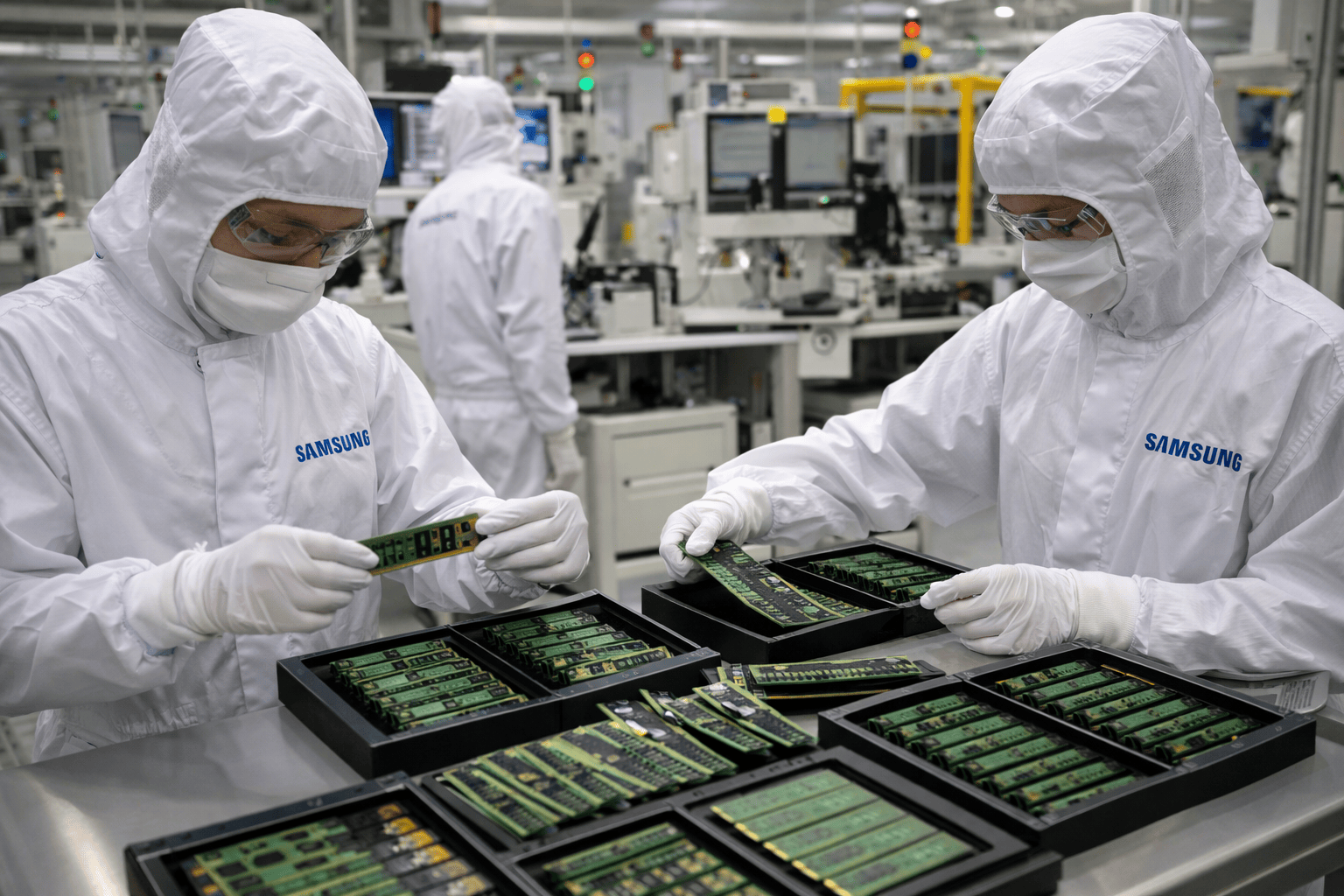
Samsung Electronics shares climbed more than 9% on Thursday, rebounding sharply from the prior session's selloff, after reports that the company had lifted prices on selected advanced foundry orders by as much as 15%. The stock traded near 269,500 won after touching an intraday high of 273,000 won.
The price adjustments apply to certain new orders on its 4nm, 5nm, and 8nm process nodes. For years, Samsung has struggled to turn a profit in its contract chipmaking business, which has remained in the red since 2022 and trails far behind Taiwan Semiconductor Manufacturing Company (TSMC). According to Counterpoint Research, Samsung held roughly 7% of foundry revenue in the first quarter, versus TSMC's more than 70% share.
The latest increases suggest that AI-driven capacity constraints are finally giving Samsung some pricing power. The company raised prices for 4nm customers in China and the U.S. by 10% to 15%, while 5nm wafer prices rose by a similar margin and 8nm products increased by nearly 10%. Its 4nm line at Pyeongtaek has been running at full capacity since late last year.
KB Securities analyst Jeff Kim argues that Samsung is approaching a period where memory, foundry, and robotics can contribute together. He expects all three growth engines to be running from the second half of 2026. The pricing hikes introduce a stronger earnings lever beyond just improving utilisation and manufacturing yields, which had been the main turnaround drivers until now.
AI shortages are giving Samsung more negotiating leverage, even though it has not suddenly overtaken TSMC technologically. The sheer scale of AI investment is creating shortages across advanced chips, memory, and packaging, giving alternative suppliers more room to raise prices. TSMC itself is expected to hike prices for advanced processes by up to 10% in 2027, while JPMorgan forecasts AI capital expenditure will exceed $1 trillion next year.
Samsung's expanding relationship with Broadcom illustrates the opportunity. JPMorgan analyst Harlan Sur wrote that Samsung is expected to remain Broadcom's main HBM supplier, with part of the partnership also covering foundry wafers. The shortage extends beyond logic chips: Morgan Stanley analyst Stephen Byrd told Barron's that “there isn't enough memory vs. AI requirements,” and data-centre contacts see no sign of shortages easing.
Despite the rally, Samsung's competitive gap with TSMC remains substantial. JPMorgan analyst Gokul Hariharan expects TSMC to retain more than 95% of the first waves of demand for its N2 and A16 technologies, and he believes progress on A14 should keep TSMC ahead of Samsung and Intel at the leading edge through 2029.
Samsung does not need to displace TSMC for its economics to improve. If leading-edge capacity remains tight, customers seeking a second source can still lift Samsung's utilisation, pricing, and margins. The recent price hikes are a step in that direction, but the stock's 9% jump does not mean Samsung has caught up with TSMC.
This article is for informational purposes only and does not constitute financial advice.

