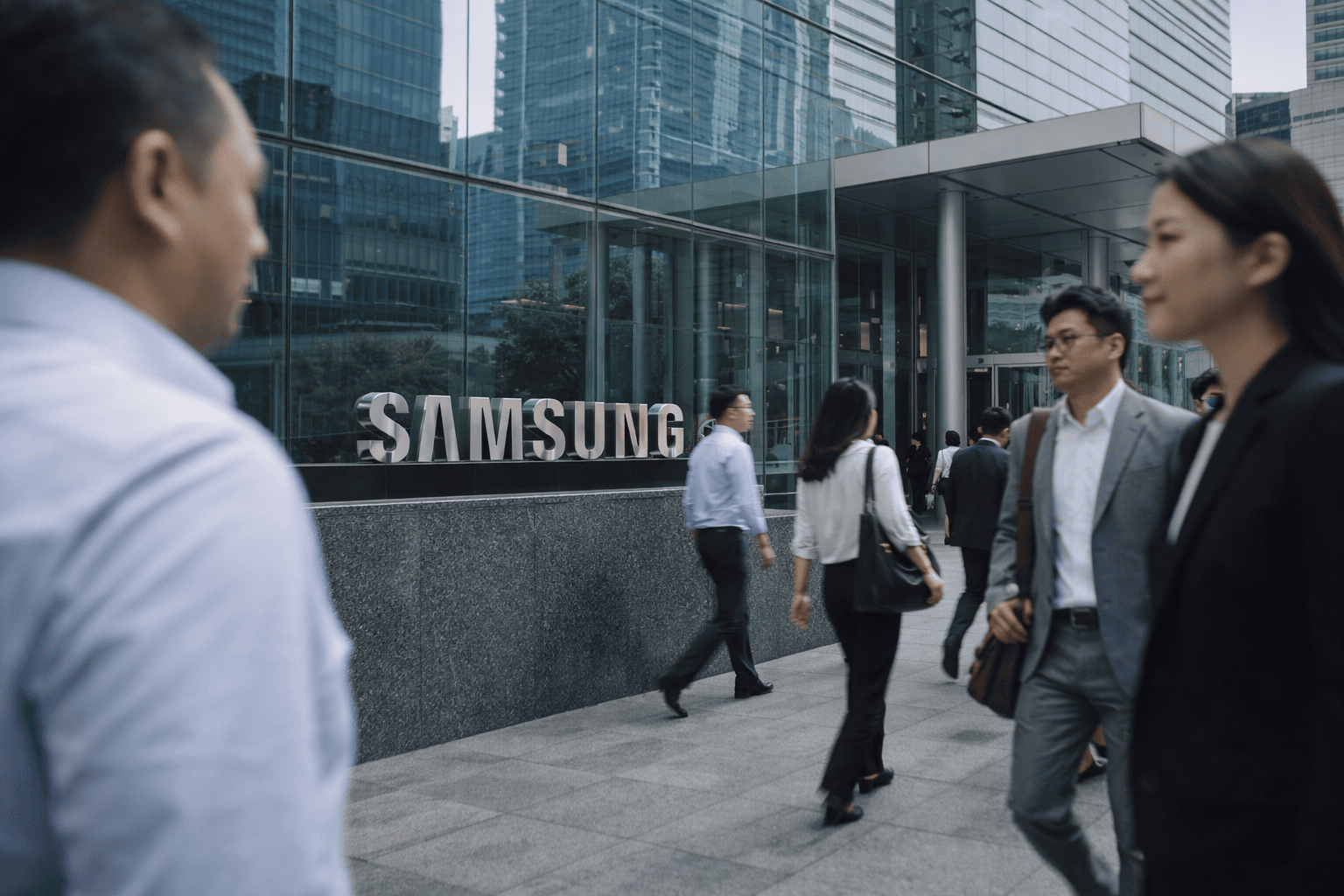
Samsung Electronics shares recovered on Tuesday following a sharp 5.4% decline, as investors reassessed the company's AI strategy after a $1 billion commitment to an infrastructure platform backed by Nvidia.
The company, along with five affiliates, will invest in Helix Digital Infrastructure, a KKR-led venture focused on data centers, power systems, and connectivity for artificial intelligence. Samsung Electronics is contributing $500 million, while Samsung C&T, Samsung SDS, Samsung SDI, Samsung Life, and Samsung Fire & Marine will provide the remaining $500 million.

This move signals a broader push beyond memory chips, positioning Samsung to capture more of the AI value chain. Helix aims to combine Nvidia's technology with Samsung's expertise in semiconductors, cloud services, energy storage, and construction, offering a turnkey solution for AI infrastructure.
Memory remains the core driver
Despite the diversification, memory chips continue to underpin Samsung's earnings. Executive Vice President Kim Taewoo noted that high-bandwidth memory (HBM) could account for nearly 30% of global DRAM wafer capacity next year, up from about 20% currently. Since HBM and conventional DRAM share the same wafer capacity, increased HBM production tightens supply of standard memory, supporting prices.
Analysts see this shortage persisting. Yuanta Securities' Baek Gil-hyun raised his target price for Samsung to 630,000 won, arguing that supply constraints will ease later than expected. He highlighted that HBM is consuming capacity that would otherwise produce conventional DRAM, while AI inference drives demand for higher-capacity memory, with tight conditions expected through 2028.
Investors weigh the broader strategy
The Helix investment broadens Samsung's strategic narrative, but memory remains the cash-generating engine that finances expansion elsewhere. The key question is whether Samsung's sprawling portfolio can create more value together than separately.
Monday's selloff, which saw Samsung close at 270,000 won, was driven by foreign and institutional selling amid rising global bond yields. J.P. Morgan analysts, led by Mislav Matejka, suggested the AI trade could recover after the pullback, citing cleaner positioning and more attractive valuations.
For Samsung, the debate has shifted. Investors no longer need convincing that AI spending exists; they need evidence that Samsung can capture that spending across multiple businesses without merely adding capital commitments.
This article is for informational purposes only and does not constitute financial advice.

